

Wadax Reference Server/Akasa Optical cable, Reference PSU and Akasa DC cable
Wadax Reference DAC with Dual Akasa Optical input module and Akasa DC cables
CH Precision L10 Line-stage (+2dB input gain, Local feed-back setting)
CH Precision M10 Power Amp x2 (bi-amp mode, -1dB input gain, 0dB channel off-set, 0% GFB)
All electronics supported on Göbel stainless-steel/ceramic couplers, mated to FalkenOhr racks or amp-stands (apart from the Wadax Transport and its PSU, which were placed on finite elements amp-stands, awaiting the arrival of another FalkenOhr rack).
All power, signal and speaker cables – Göbel Lacorde Statement
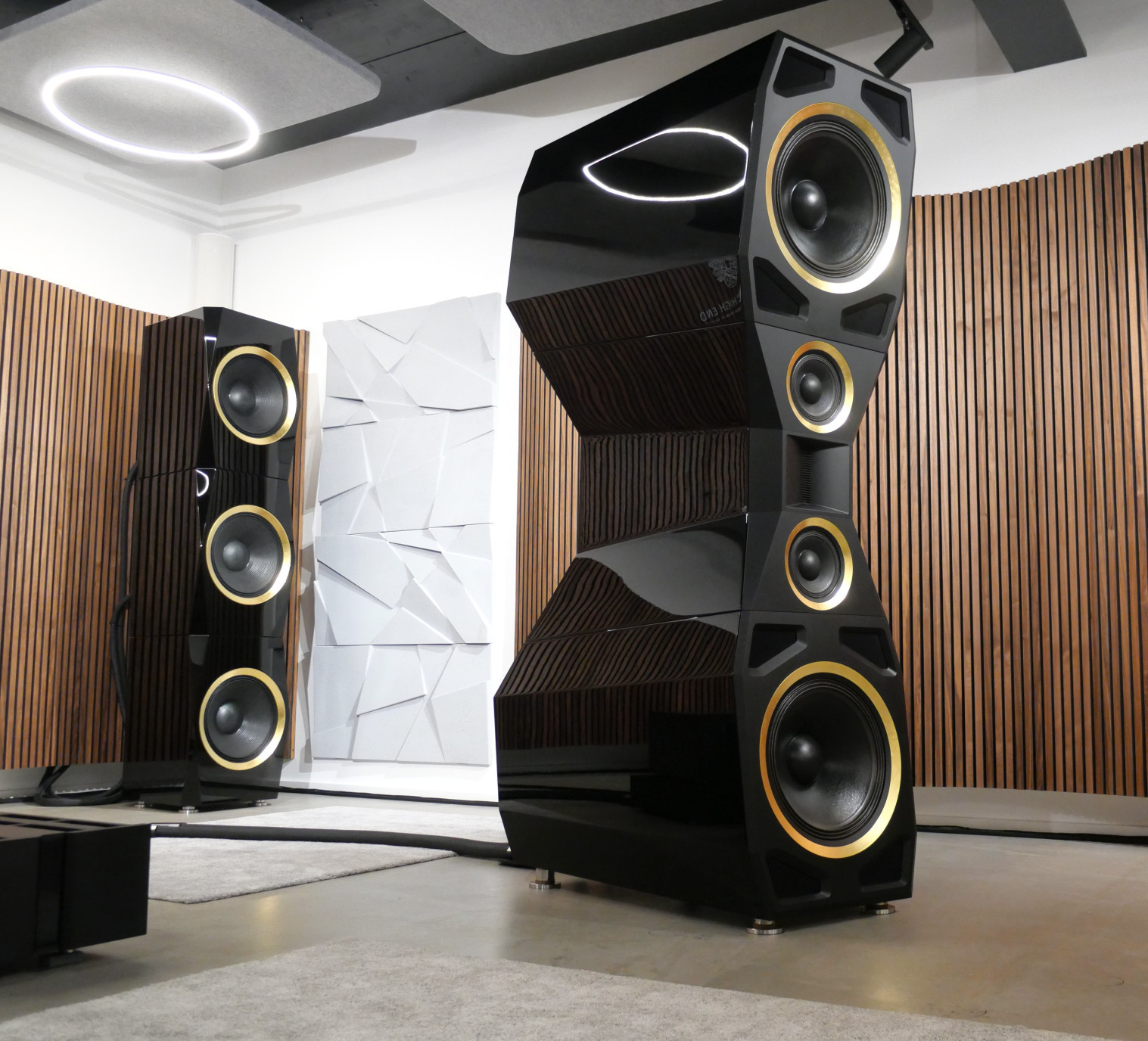
Göbel Divin Majestic Loudspeakers
Göbel Divin Sovereign Sub-woofers x6
Vitus Masterpiece MP-L 201 Mk.II Line-stage and 2x MP-M 201 Mk.II Mono-blocs
The Listening Room
8.5m(W) x 12.5m(L) x 3.7m(H)
Bare, polished concrete, with thick, central wool rugs.
Walls constructed from layered hard-wood and damping layers, 15” thick.
Ceiling, 8” laminated hardwood.
Custom built dispersion, targeted absorption and ‘clouds’ to create a lively, even acoustic.
Dedicated AC supply, totally independent of workshop and domestic feeds.
Taking advantage of the size of the room, speaker placement and listening seat follow a modified Rule of Thirds, with the stacked sub-woofers in the front corners: it’s undoubtedly somewhat daunting to have a speaker this large, that close, but it’s a placement that proved spectacularly effective in maximising the (musical) use of space and minimising (intrusive) system or room artefacts. Initially, it’s also slightly disconcerting to have speakers this large standing mute, as the performance goes on, completely independent of their solid, slightly brooding presence but, believe me, you soon get used to it.
What should you expect from a system like this? There’s an almost irresistible temptation to reach for the biggest, loudest recording you have, just to see if the ‘promise’ is real. In this case, that might be (seriously) gratifying, but it would also be to miss the point. Past experiences with the Majestics have left me with an abiding impression, despite their imposing presence, of just how astonishingly well they do ‘small’. Add a six-pack of sub-woofers and that capability becomes even more impressive.
With that in mind, the first disc I reached for was Víkingur Ólafsson’s Debussy-Rameau (DGG 4837701) – a big instrument but playing full of restraint, delicacy and temporal sensitivity. The system conjured a solid, credible, life-sized piano, planted in space. It didn’t move or waver. It didn’t shimmer. It offered a solid, substantially dimensional space, defined by the notes and harmonics of the playing. Note weight and attack were beautifully clear and natural, graduation and pace through the phrases fluid and articulate. But the ‘gotcha’ moment came at the first pause in ‘La Demoiselle élue’, as the harmonics of the last chord played extend – and extend – and extend… before being silenced by the damper. The complex harmonics are impressive enough: I’ve never heard their interlocking layers so clearly defined or seem so vibrant: they’ve never seemed to hang for so long, yet despite that, their sustained length seems not just natural, but just right. Yet the kicker comes after the pedal. As Ólafsson damps the chord it reveals absolute quiet. This isn’t the clichéd ‘black back drop’ we hear so much about. It’s not transparency. It’s not a lower noise floor – at least not in the conventional sense. There’s none of the grain, texture or almost sub-audible presence you hear from every other system I’ve ever listened to. This is complete, utter, silence…
Optical disc bites back…
What I’m describing here is, of course, system performance. Most systems aren’t this sorted, most rooms aren’t this quiet. But a big, big part of this is the contribution of the Reference Transport. Listen to Wadax’ latest mechanical, optical and electrical magnum opus and it’s obviously different to more familiar disc players. It has a solidity, dimensionality, presence, a natural sense of proportion and absolute stability that surpass any other source component I’ve used – but that doesn’t quite isolate what makes the Reference Transport so special. It wasn’t until I was discussing the Transport with Stirling Trayle and he mentioned the utter silence against which the Wadax presents the recording that the pieces fell into place. As soon as he articulated the quality, I recognized exactly what he was talking about – and its significance. But the significance here is not what the Transport can do, but just how clearly and utterly unambiguously the speakers reveal it. The Transport might have a silent background, but so too do the Divin Majestics – and that’s rarer than you might think.