

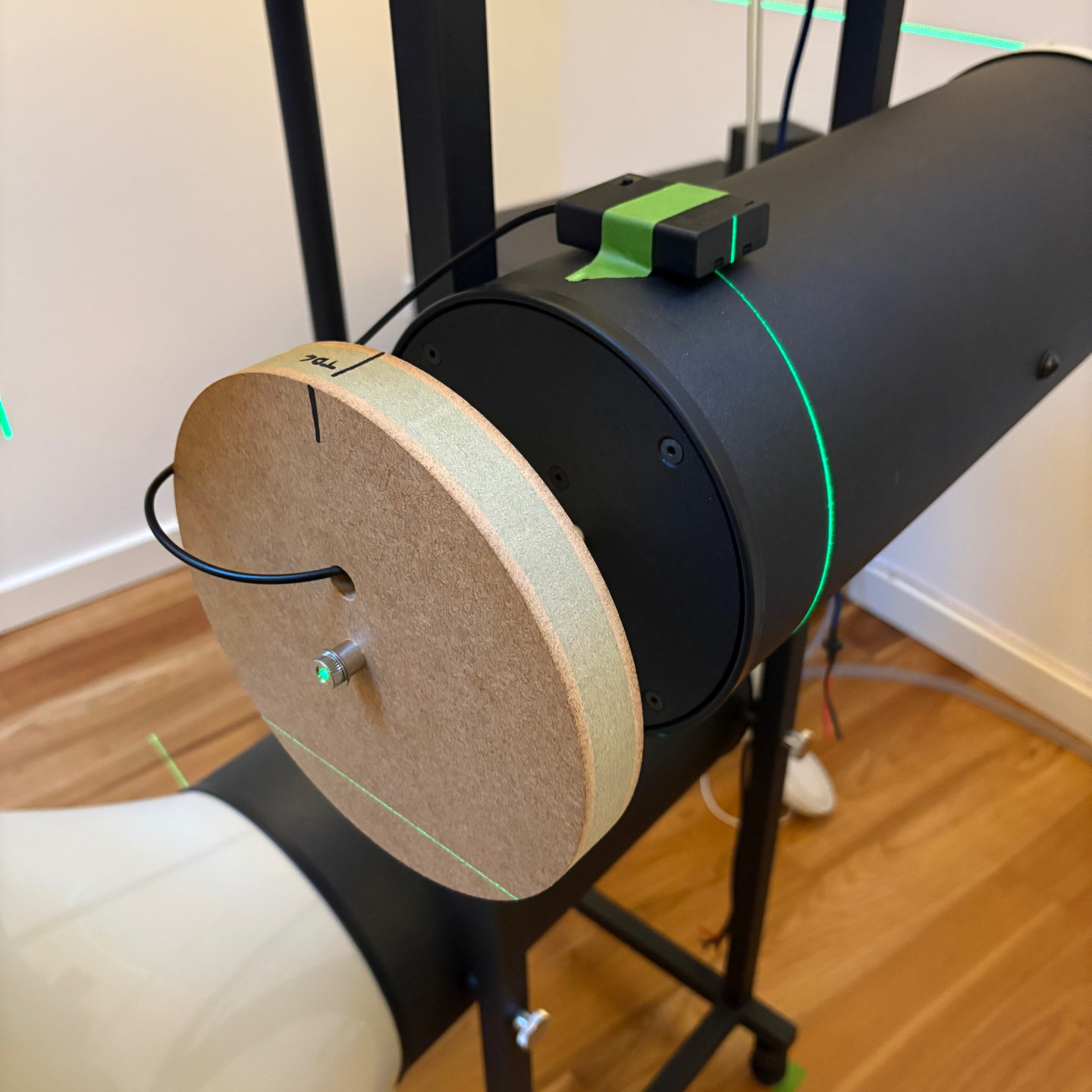
 A laser and/or improvised mount which will allow you to adjust tweeter axis with precision. Given that most speaker manufacturers make no effort to provide a facility to mount a laser on-axis with the tweeter, you will need to provide a solution yourself. In most cases it’s not that difficult and merely demands a degree of ingenuity and a bore-sight laser – generally a small cylinder, around 9mm in diameter, that can be inserted into a suitable hole, once a mounting has been provided.
The ‘disc’ shown here was originally proposed by Todd Binnix of Vibrant Hi-Fi in the USA.
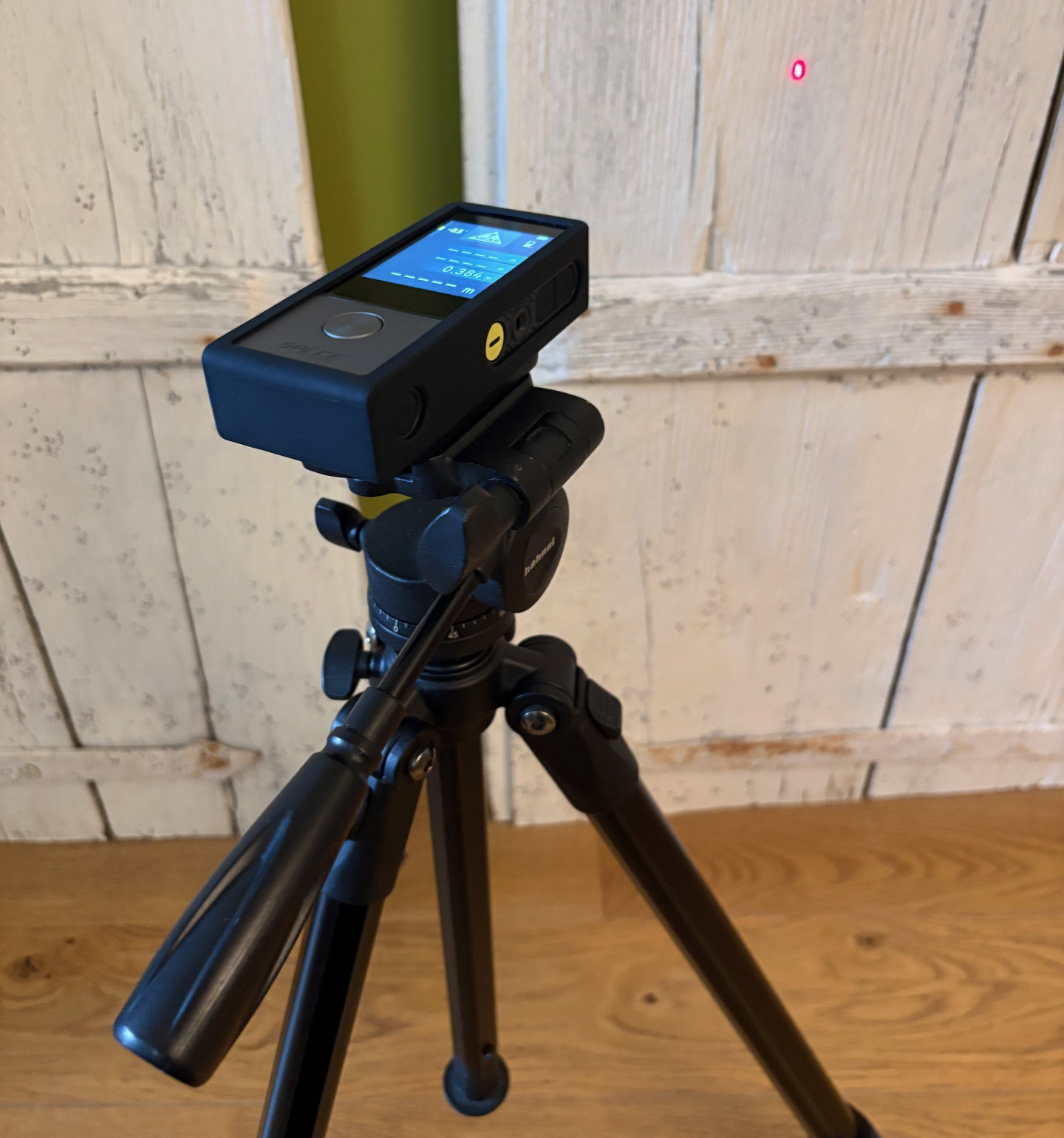 A photographic tripod with a ¼” mounting on a swivel and pivot head.
Why do you need a tripod? Because trying to handhold a laser larger negates any benefits it might bring in terms of accuracy or consistency/repeatability – which is what this process is all about. Of course, the tripod itself needs to be mechanically and positionally stable, so don’t cut corners on a cheap, lightweight model with the structural integrity of an over-cooked rice noodle. Solid, with good rubber feet (to prevent it moving on wooden or tiled floors) is the way to go. It’s worth checking the pan and tilt action as well: you need that to be precise and repeatable too.
The process itself…
In most cases, you are working around two fixed points: a listening seat and one, optimised speaker: it’s always best (and easiest) to start working with a single speaker when it comes to placement. Once you have initially fixed one speaker, placing the other relative to the listening seat becomes quite straightforward.
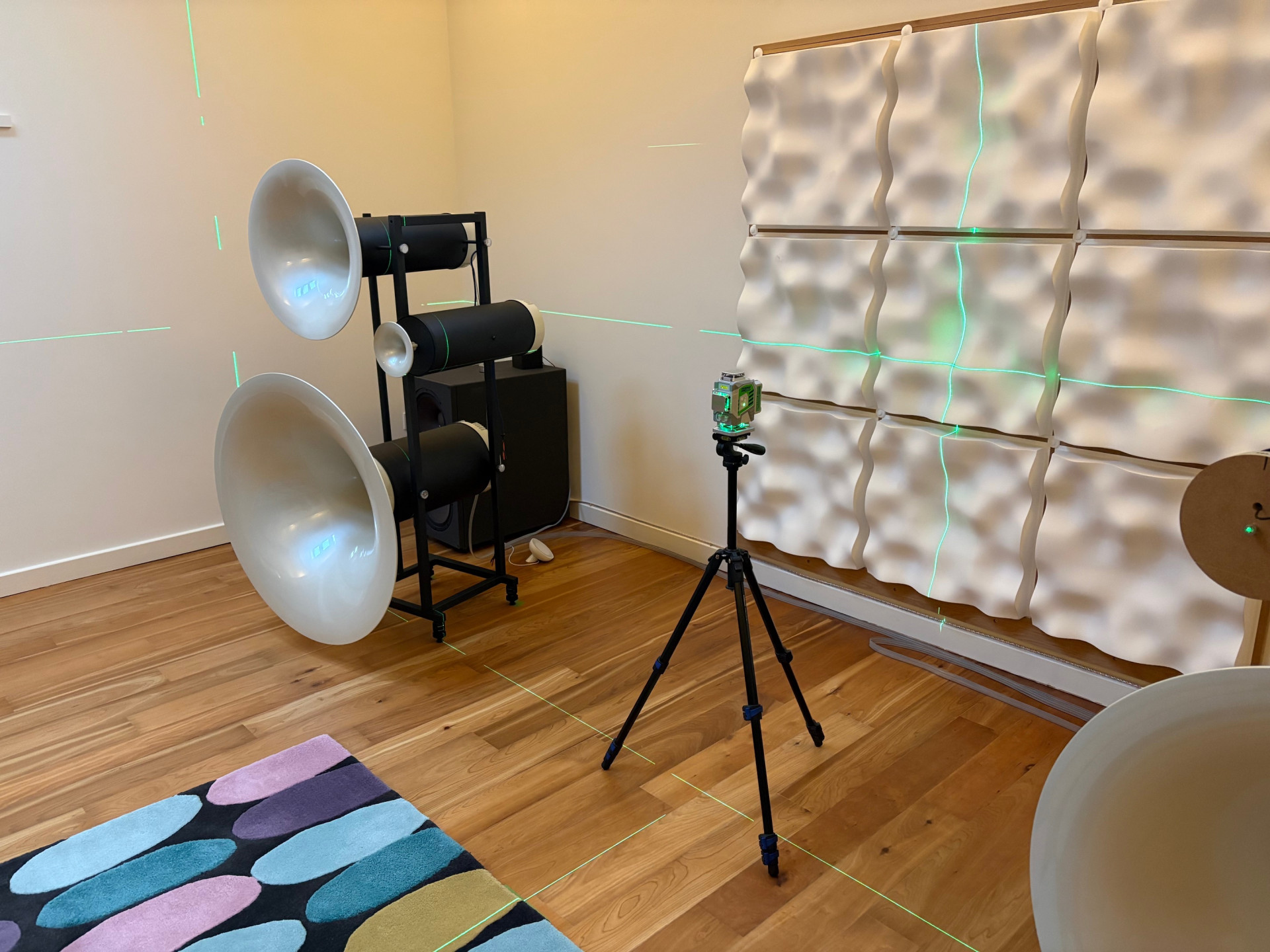
By using the 4×360 laser, you can throw a line that sets a perpendicular to the plane of the speakers. Centre that perpendicular on the listening position and that will give you the centre point between the speakers. Measure from the placed speaker to the centre and then place the other speaker the same distance the opposite it along the speaker plane. Always choose a specific point on the speakers: the inside front spike is a good option, or you can provide a laser target by placing a precisely measured mark on a piece of tape at an appropriate point on the edge of the speaker. One advantage of using the spike is that it will also likely be the point about which you rotate the speaker to adjust toe-in. Alternatively (and with wide-bandwidth speakers) you can fix the centre line of the speaker by attaching a cocktail stick at that point. In this particular case, the inner spike approach worked fine as the Trio ‘satellites’ only extend down to 100Hz, so listening axis of the horn drivers is more important than their placement relative to room nodes/bass performance – which is handled by the subs and is a whole different story.