
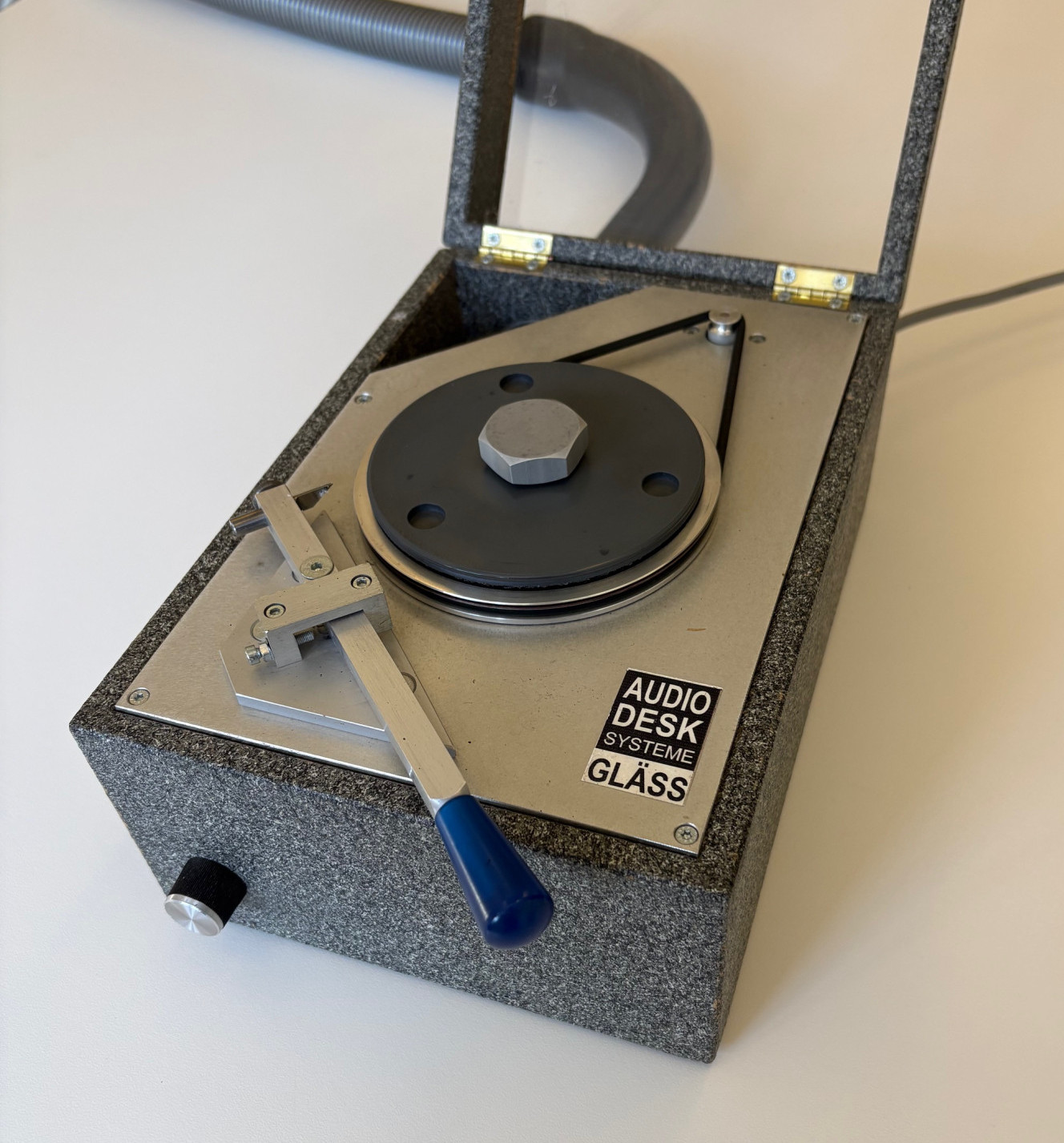
So, what is the CD Sound Improver? As already described, it’s a small manual lathe designed solely to cut a precise bevel on the edge of a 12cm optical disc. To that end, it consists of a simple, belt driven sandwich platter, that clamps the disc between its inner rubber or felt faces. Place the disc label side down on the lower face of the platter, clamp the top layer firmly in place, close the lid and set the disc spinning. The clever bit comes in the shape of the robust swinging arm that extends to the front of the unit. Move the handle gently to the left and it brings the edge of the blade into contact with the edge of the disc, shaving away material to create the bevel. Travel of the blade is precisely limited, so move it in until it stops and you’re done. Open the lid, apply the supplied, black, permanent marker to the cut edge, release the disc and you are good to go. The whole exercise should take around half a minute. Any process that is too complex, involved or time consuming quickly gets abandoned, so the Sound Improver’s speed and ease of use is certainly welcome.
One other thing that’s welcome is the circular port and gasket mounted in the rear of the unit’s casework. Anybody who stops to think for even a moment or two will quickly realise that the CD Sound Improver will, like any lathe, produce dust or spall in operation. There’s a triangular port in the rear corner of the chassis top-plate, just behind the blade/disc interface, creating a well in the rear left corner. The external, circular port is mounted in the rear face of this well. The elastic gasket allows you to insert the hose of a vacuum cleaner, those sucking away the vast majority of detritus as it’s produced. I don’t want to over-egg this particular pudding: the amount of material removed from each disc is minimal. But after shaving thirty or forty discs, it starts to build up, while breathing or spreading polycarbonate dust isn’t a great idea.
In essence, the CD Sound Improver does a simple task, easily and effectively. It has looked at the issues of consistency and cleanliness and dealt with them. Its mechanism is robust and delivers a long working life and, if the MDF box it’s mounted in isn’t quite as impervious to the passage of time, that’s not really a concern. This isn’t the sort of unit you put on show or run in the listening room. The odd dent or chip to the paintwork isn’t really significant and certainly won’t impact its operation.
Taking the plunge…
Testing the benefits of the CD Sound Improver is almost as simple as using it. Get two identical discs, put one through the lathe process and then compare them. I chose Lisa Batiashvilli’s Tchaikovsky/Sibelius Concertos recording (with Daniel Barenboim and the Staatskapelle Berlin, UCCG-41048) an MQA UHQ-CD issue of the DGG original. I had two copies on hand, not just sealed, but bought at the same time. You don’t get much more identical than that but, even so, I did compare them before offering one up to the Gods of circumcision. Clamping the disc into the CD Sound Improver’s platter and setting it in motion, I’ll admit to a moment of trepidation before swinging the blade against the spinning edge. It just seems wrong. We spend (often uncalculated) sums of money on discs, cherish and care for them and yet, here I was, about to savage and physically scar one with a sharp object! Even so, I gently swung the blade into contact and was rewarded with a low grinding sound and a noticeable slowing of the platter. That aside, within a couple of seconds, the swinging arm had reached the limit of its travel and, applying marker pen to the cut edge aside, it was job done. With ‘cut’ and ‘un-cut’ discs in hand, we repaired to the Music room to assess results.