
Perhaps at this point it’s also worth noting that the SX base increases the overall weight of the speaker from 100kg/220lbs, to 139kg/306lbs each. Even if you buy the SX as a complete speaker (rather than adding the base to an existing A5) the bases arrive separately and need to be attached. Thankfully, Stenheim have thought about this and simply redeploying the packaging allows easy attachment of the base to the cabinet, despite the 39kg dead weight. Once upright, the speakers are actually easy to move, either on their footers or on the supplied Delrin domes that screw to the bottom of the spikes. These are thin enough to actually be useful in preliminary positioning, unlike a lot of the ‘sliders’ supplied with some other speakers that add too much to the height.
I used the A5-SX with a number of different amplifiers, including the Trilogy 995R and VTL S-400 II, but the best results were achieved using a pair of CH Precision M1.1s, a result of the of the bi-amping options offered by both amp and speakers rather than any assumed ‘match’ between the two. Indeed, Stenheims bi-amped with VTL have offered stellar performance both here and at Axpona, while the A5-SXs were launched in a system that bi-amped them with Nagra Classic amps. I have extremely fond memories of driving the A5-SE with a pair of VTL S-400s. These speakers just love to be bi-amped. Horizontal or vertical? Always vertical (one stereo amp per speaker, split between bass and mid/treble). If you are using monos, like the VTL MB-185s used on the Stenheim U2s at Axpona last week, then the question is moot. Whatever you do, avoid horizontal bi-amping and especially avoid mixing different amps top and bottom.
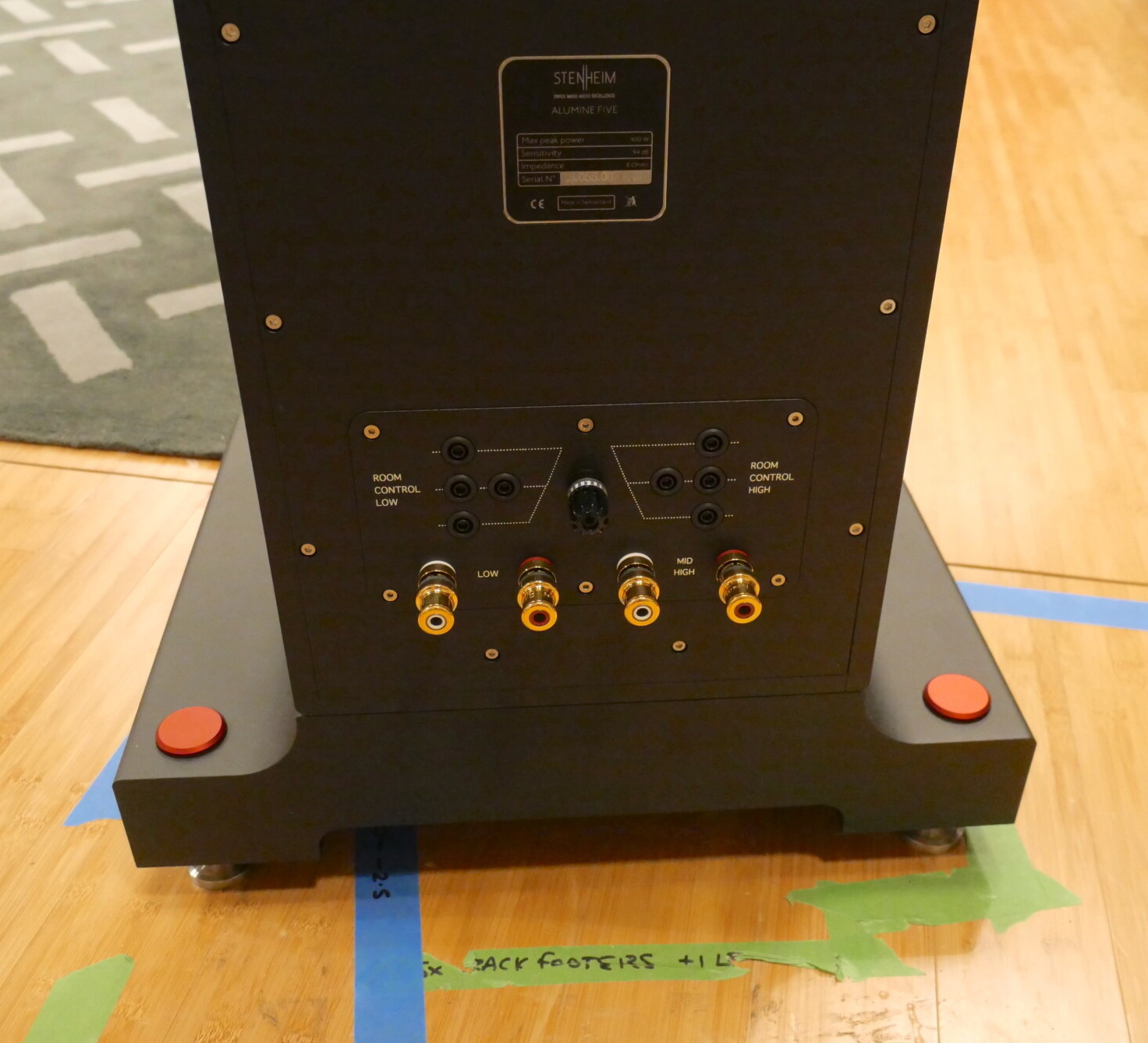
The SX also gets Room Control adjustments to its crossover as standard (they’re an option on the SE). A set of 4mm/banana sockets are provided for the bass and treble legs, with a jumper allowing users to boost or cut output at either or both ends of the spectrum by plus or minus 1dB. The supplied jumpers are certainly discrete, but as usual, replacing them with proper bi-wire jumpers (Nordost Reference Jumpers in this case) wrought an obvious improvement in focus and clarity. Other than that I settled on running the high-frequencies flat and lifting the bottom-end – something that in itself indicates the nature of the improvements in the A5-SX over the SE.
Finally, all A5s now come with an additional 4mm binding post, positioned centrally, above the speaker connections. This is a grounding post, allowing users to connect the speaker cabinet to a parallel ground – such as a Nordost Qkore 1 – to eliminate or at least diminish the impact of eddy currents in the metal cabinet panels. This isn’t a new thing and owners of speakers with aluminium enclosures have long understood the benefits of grounding them. What the binding post does is make it easier. Just hook up a standard ground wire, rather than trying to wedge a spade underneath one of the cabinet’s fixing bolts – a solution that is both awkward and ugly. Just don’t be tempted to hook up a parallel ground to one of the speaker’s negative/black terminals: you will be connecting it directly to the amplifier’s output stage, with potentially explosive consequences!