
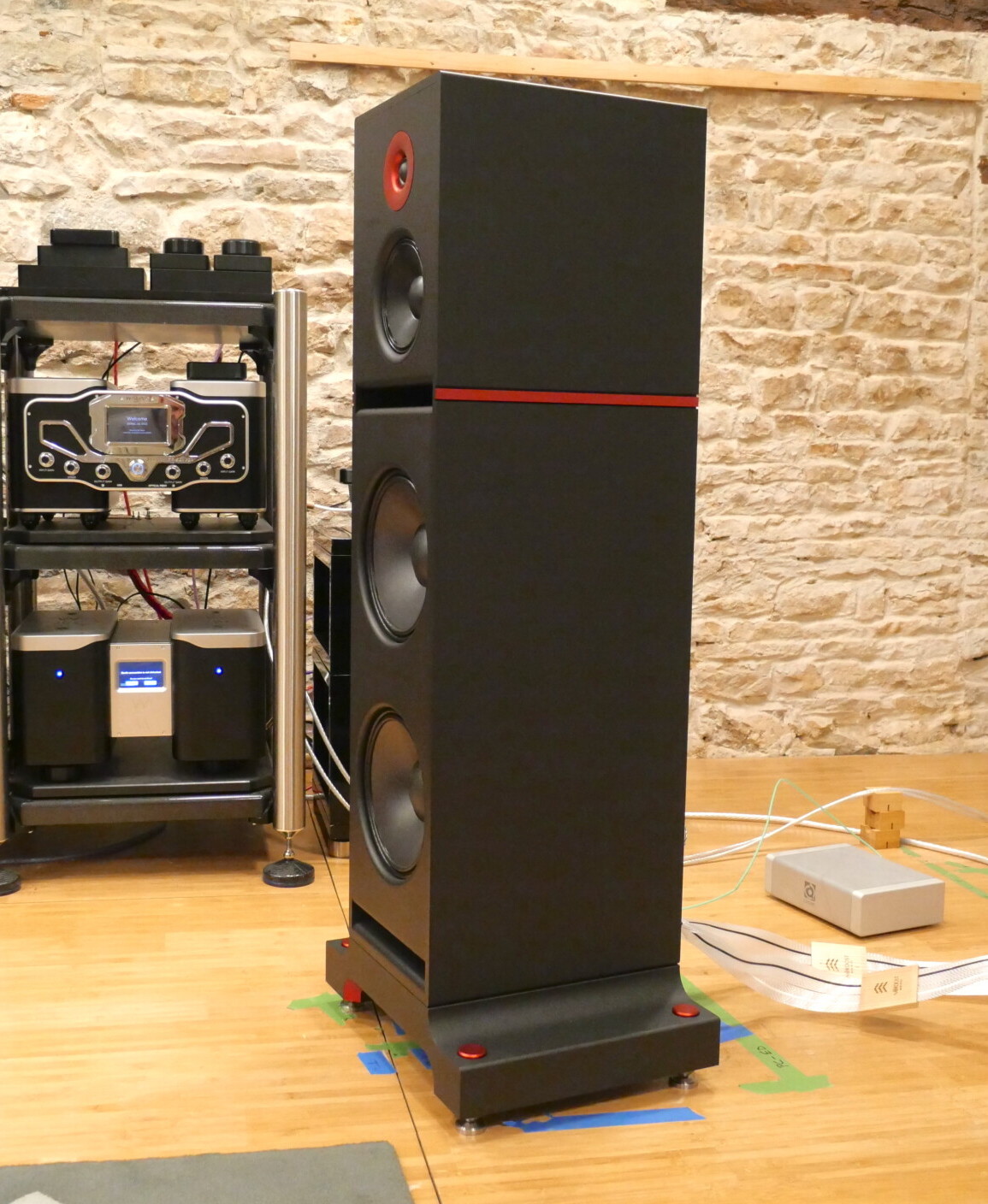
On the other hand, a stellar front-end is going to be allowed to really strut its stuff. I used the A5-SX with CH and Wadax digital front-ends, the Grand Prix Monaco turntable, with both Kuzma and Origin Live tonearms, Fuuga and Lyra cartridges. The speakers clearly demonstrated the differences between and relative strengths of the different source components, all blessedly free of major flaws or aberrations. But one thing that emerged early was the sheer musical connection between the Wadax Studio Player and the A5-SX. In terms of musical communication and integrity, these two transducers mated like hand and glove, achieving a performance level, communicative engagement and expressive range that I’ve not achieved or had demonstrated previously at or close to this price level. The musical articulation, temporal and dynamic response of the speakers made the most of the Studio Player’s strengths, while the holistic sound, fluid temporal and spatial coherence of the Player kept things together and firmly on track. Here was a combination that was both price-appropriate and greater than the considerable sum of its parts. Put four channels of your preferred amplification in between and you are well on the way to a system that punches well above its weight. Just don’t forget the line-stage, or you’ll dilute the benefits of the A5-SX’s bottom end clarity, linearity and control.
Building on brilliance…
The Stenheim Alumine 5 was something of a revelation when it was launched, setting the standard for ease of drive, bandwidth and communication. It has continued to maintain that enviable position, extending its already impressive performance envelope and musical capabilities with the introduction of the SE version. Now, the SX takes things a step further: In fact, more of a giant stride. If the A5 allowed the music to breathe and the SE added transparency, dynamic range and musical expression, the SX brings clarity, immediacy and purpose – to the performance. The obvious benefits here might be sonic, but those are not nearly as significant as the musical impact.
Few performers invest their playing with as much personality and emotional energy as Patricia Kopatchinskaja. Few recordings or systems can communicate that emotional range and intensity, but playing the Panufnik Concerto For Violin And Strings from her recent Alpha recording Exile (with Camerata Bern, Alpha Classics 1110) her performance is unmistakable. When she plays, it’s as if every fibre in her body, every shred of breath and feeling wraps around and focuses on her instrument. The A5-SX is one of the first speakers (certainly the first at its price) to capture the angular energy, attitude and intent of a performer once seen never forgotten. It makes this difficult music accessible and captivating, the performances on this disc, compelling and fascinating. The Wyschengradsky String Quartet No.2 is scintillating – shocking, stark, exciting and dramatic by turns – just exactly as it is played live!
Such results are of course, dependent on set-up and the driving system. I’ve already touched on the issues around and preferred topology for that system. Be aware that, just as the A5-SX can be a window onto and into your recordings, it’s a window onto your system too. Ignore best practice, coherent cabling and house-keeping at your peril. The Stenheims won’t slap you on the wrist, but the faint whiff of disapproval is hard to miss. While the A5 (in all its guises) has always been rewarding of set-up, the SX base, with its rock-like stability, selectable spikes and comprehensive accessories, delivers the tools to really get the positional, attitudinal and physical aspects of speaker performance nailed on. Adjustments are so easy and their results so clearly audible that, with the SX base installed there really is no excuse for less than optimum set up.