

For some time before the QPoints arrived, I’d been listening to Bach’s Sonatas for Violin and Continuo (Harmonia Mundi HMM 902698) with Isabelle Faust on violin, Kristian Bezuidenhout on harpsichord and Kristin von der Goltz playing cello. My high hopes of a great sounding CD had initially been dashed, the sound being both a bit thick and at the same time edgy, as period performances can sometimes seem. It was the first disc that I loaded into the Wadax Studio Player after adding the QPoints to the system, and I was seriously surprised by the sonic and musical result. A photograph in the CD booklet showed the three musicians triangulated, with Faust standing to the left, von der Goltz seated to the right and Bezuidenhout seated behind and between the two string players. With the QPoints turned on, the imaging snapped into place — the violin and cello were no longer swimming, blended into an indefinite acoustic. With the QPoints in play, the three musicians were precisely located in space, while the violin in particular, took on a delicacy that was not present without the QPoints activated. Gone was the stridency that had previously be-devilled the performance, the music as a whole taking on a sense of clarity, shape and pattern that was missing before.
Sticking with three instruments, I switched genres, queuing up Ralph Towner’s Travel Guide (ECM 2310), a jazz trio composed entirely of guitars. That combination of three similar tonal palettes challenges the recording engineer to ensure that the individual instruments maintain their individual identity and tonal signature, rather than taking on each other’s timbre, and worse yet, timing. The live and vibrant sound immediately identifies this as a Manfred Eicher/ECM recording, devoid of acoustic damping, a production decision that leaves the three guitars to overlap and clash. But once you flip the switch on the QPoints, the three instruments snap into focus, with the three inner voices and their interlocking rhythmic pattern clearly delineated.
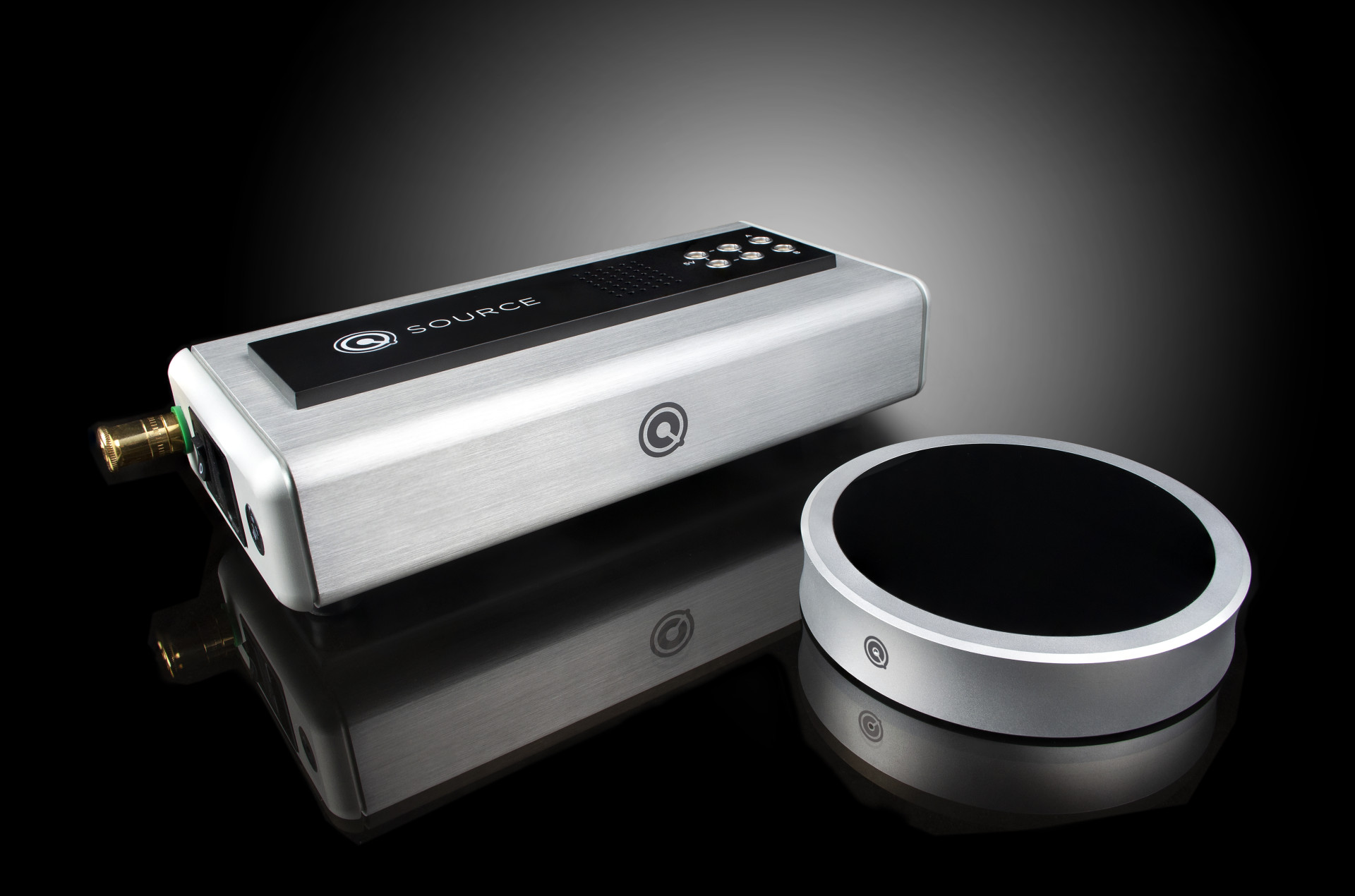
If the QPoints could restore that much order with just three instruments, how much better (or worse) would they fare with an orchestra’s worth of instruments? Instead of jumping straight into something much more complex, I turned to the Second Movement of Beethoven’s 7th Symphony. The allegretto is dominated by the strings, building from basses and celli to embrace the violas and violins. I started out with the recently released Kirill Petrenko/ Berlin Philharmonic performance, Disc 2 of a 4-disc, hybrid CD/SACD box set (BPHR 200353) issued on the orchestra’s superb house label. The intensity of the music increases as layer upon layer of sorrowful string sound is laid down. With the QPoints activated, not only is it easier to hear and separate the individual contribution of each string section, but there’s also a far greater sense of musical momentum. That momentum takes on an irresistible quality, as if each musical strand or instrumental element is more closely bound – or yes, one could say “synchronised” – creating the powerful sense of musical purpose that makes this music so compelling: far more compelling with the QPoint’s resonance synchronization.