
You’ll also notice that the shelves have a pronounced (around 45 degree) bevel undercutting their edges. While you might assume that this is a stylistic choice, in fact, past experience has shown that this has a worthwhile impact on sound quality. It’s no coincidence that the Quadraspire racks (which weren’t originally designed for audio purposes but happened to hit on the ‘magic’ combination of aluminium/non-magnetic uprights and curved shelf profiles with bevelled edges) benefit from the feature. Yes, it lightens the appearance – but it also sounds a lot better…
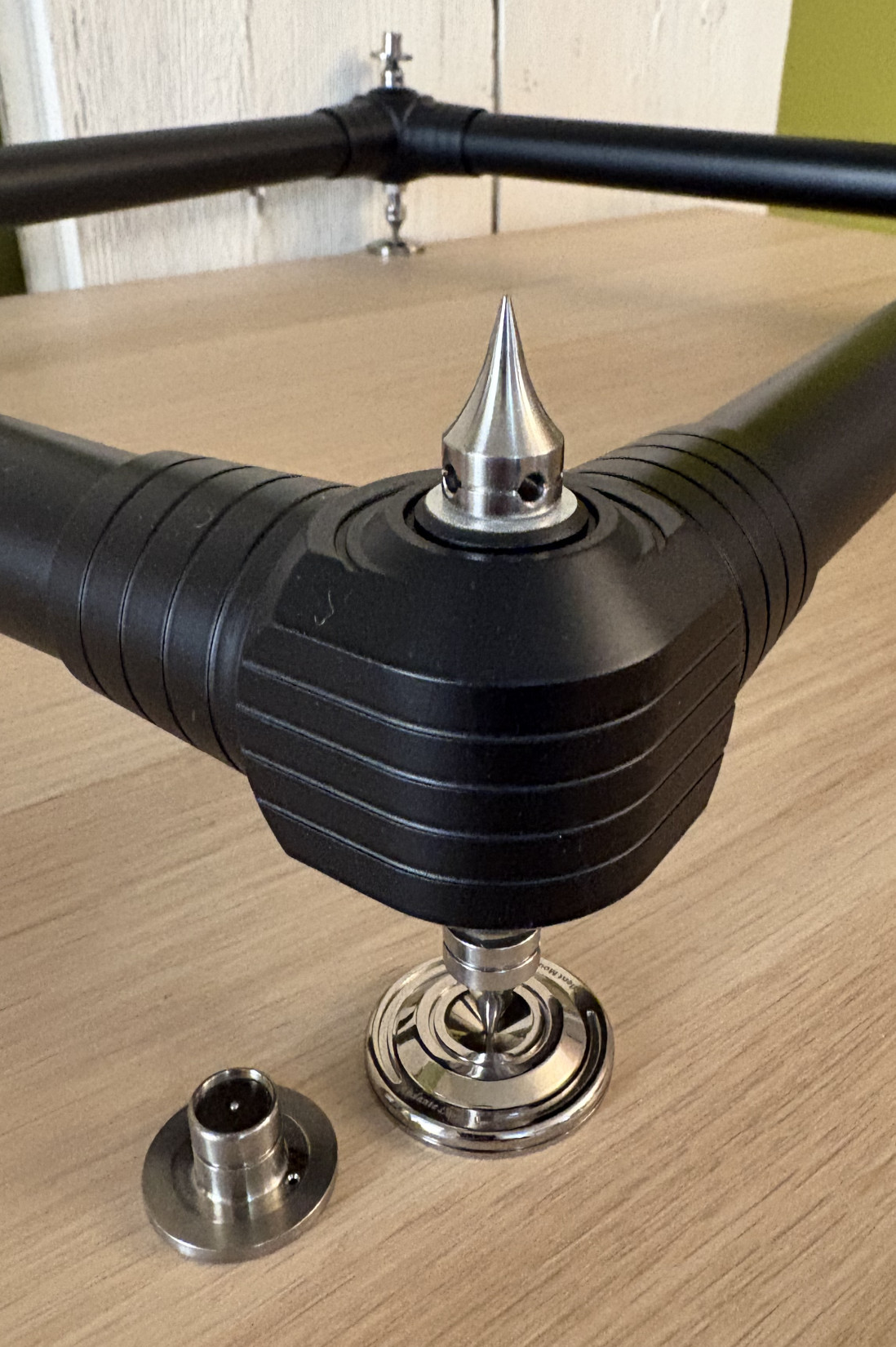
But the really clever part is in the interface between the shelf and the spikes it sits on. Each spike is fitted with a ‘top-hat’ that sits over its tip. This uses a titanium interface disc that sits on the spike, with an alloy sleeve that extends down and then out into a broad flange. Rather than sitting on the spike, a well in the underside of the shelf sits over the top-hat and rests on the lower flange, thus ensuring both a point contact between the frame and the supported surface and a large area material interface with the ‘soft’ wood. This eliminates any risk of the spike embedding itself in the shelf, disturbing the level and the even transfer of energy across all four contact points. It also drops the shelf down the height of the spike, reducing the vertical space consumed by the mounting arrangement. The top-hats are supplied in matched sets of four (again, to a tight ±0.05mm tolerance) for each level, ensuring that equal contact and perfect level are preserved.
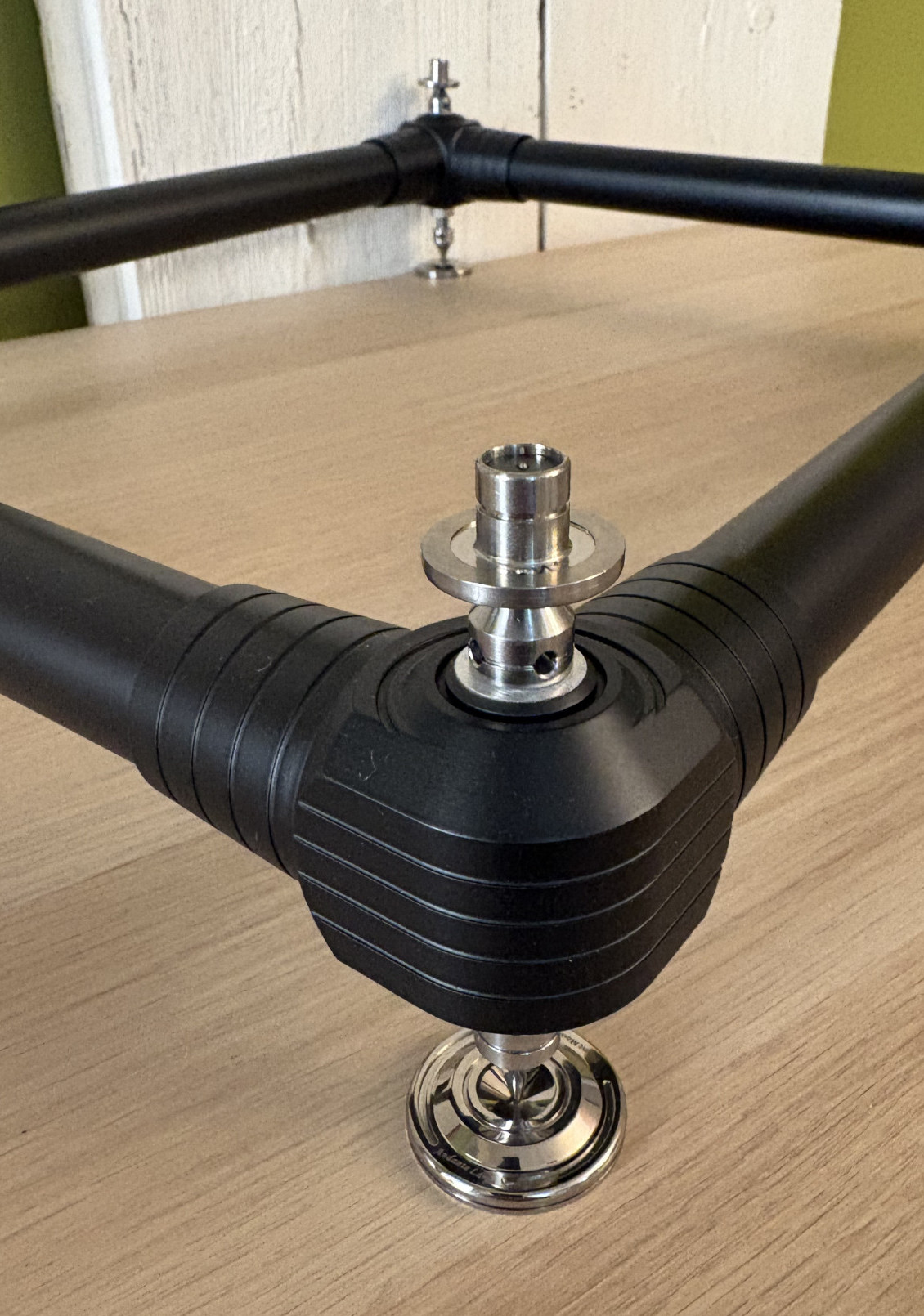
While the shelf support spikes are mounted in-board of the bottom and intermediate lugs, the shelves featuring corner cutouts to fit around the legs and maximise their area, the top lugs locate the spikes in the central boss, a step that has the dual advantages of a direct path from point contact to upright, but also simplifies the CNC requirements by eliminating the angled spike seat. Although the wider stance of the top spikes and lack of corner cutouts makes the top shelf appear bigger, in fact it has the same width and depth as the intermediate levels, just without the inset legs. The extra real-estate is welcome, especially when it comes to some of today’s larger turntables, with widely spread ‘legs’, separate motor housings and extended arm boards for seemingly ever-longer tonearms.
Plywood shelves might seem rather low-tech compared to the composite, constrained layers and exotic materials used in high-zoot support platforms, the Andante Largo shelves are, once again, deceptively simple. Yes, the material itself is carefully selected, but don’t underestimate the significance of the complex shape of the central cut-out(s) or the bevelled edges. Experience shows that both have a surprising influence over the final sound and in this case, neither has been arrived at by chance. Meanwhile, in the simplest of all possible benefits, the smooth, flat top surface and absence of a separate, cosmetic layer means that each shelf affords the perfect interface for the equipment couplers so crucial to optimising a system’s interface with the rack and maximising the performance of the whole.
Options
As well as the three different shelf colours, Andante Largo offers the Grand Tower frame in a choice of silver or black finish and a host of different configurations.