

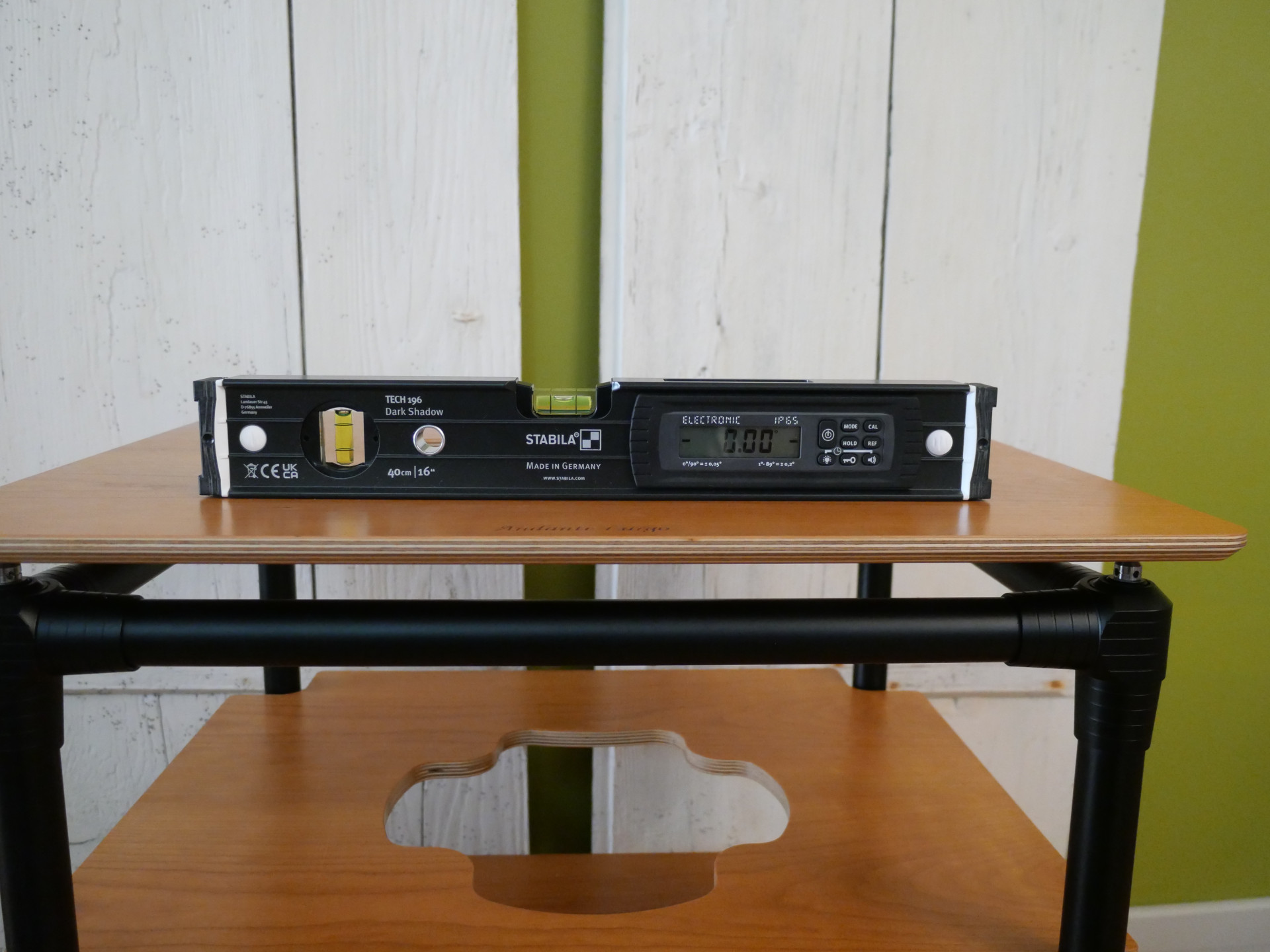
Along with the racks, I employed Andante Largo’s SM5-TX footers between the bottom spikes and the floor, with SM3-TX footers between equipment spikes (such as those on the CH components) and the shelves. Apart from their titanium material and two-part, non-resonant construction, one thing to note about the SM5-TX is the two holes drilled on opposite sides in their vertical edges. Andante Largo supply a bent wire ‘caliper’ that fits into these holes, forming a handle that allows you to turn the footer under the spike. With the rack levelled on the footers, turning the footer ensures that the tip of the spike mates solidly with the bottom of the well in which it’s sitting. It’s something that you can feel (in the resistance/smoothness of the rotation) and hear in the settled stability of the sound.
Any rack design has to deal with a whole host of operational variables, from siting to the size of the room, the nature of the supported equipment to the nature of the supporting surface. As I’ve already said, I got to use the Grand Tower racks with a plethora of different equipment, from solid-state and hybrid to pure tube, high-mass or high-value to the low-mass, acrylic-cased Tom Evans products. I’ve used the racks on solid floors and suspended wooden floors. I’ve used them in a range of different rooms. Throughout the journey, they’ve been a model of stability, not only retaining their set-up but bringing the same quiet confidence to the music, whatever the system or circumstances. The only thing I haven’t done is run them with a serious full-range system – but more on that later.
Generally speaking, putting equipment onto a rack, any rack (as opposed to generic, domestic furniture) brings clarity to the system’s performance, cleaning up the sound, improving dynamics, noise floor and timing. But once you start comparing racks, although there are often clear differences in terms of separation, noise floor and the dynamic range that goes with it, musically, it’s the temporal domain that is key. Simply extracting more information is pointless if that information isn’t properly assembled and presented. The real importance of a rack lies in the sense of organisation or pattern it brings to the sound and the resulting access and understanding it brings to the music. Once that’s in place, gains in terms of more information and detail that fit into and enhance that pattern start to make sense. It’s in exactly this regard that the Andante Largo racks excel.
If I had to choose a single word to sum up the benefits that the Grand Tower supports bring to a system, it would be ‘proportion’. More than a place for everything and everything in its place, they reproduce the natural relationship (size, location and relative energy) between the instrument and/or voices in a recording. Listening to a system sited on the Grand Tower racks, I’m always struck by the natural perspective, the coherence and integrity of the musical picture it projects. But more than that, I’m struck by the easy sense of musical flow, the explicit sense of rhythmic pace and articulation with which it invests the performance. There’s nothing forced here – unless the musicians are doing the forcing – and if things get awkward, it’s because that’s the way they were played.