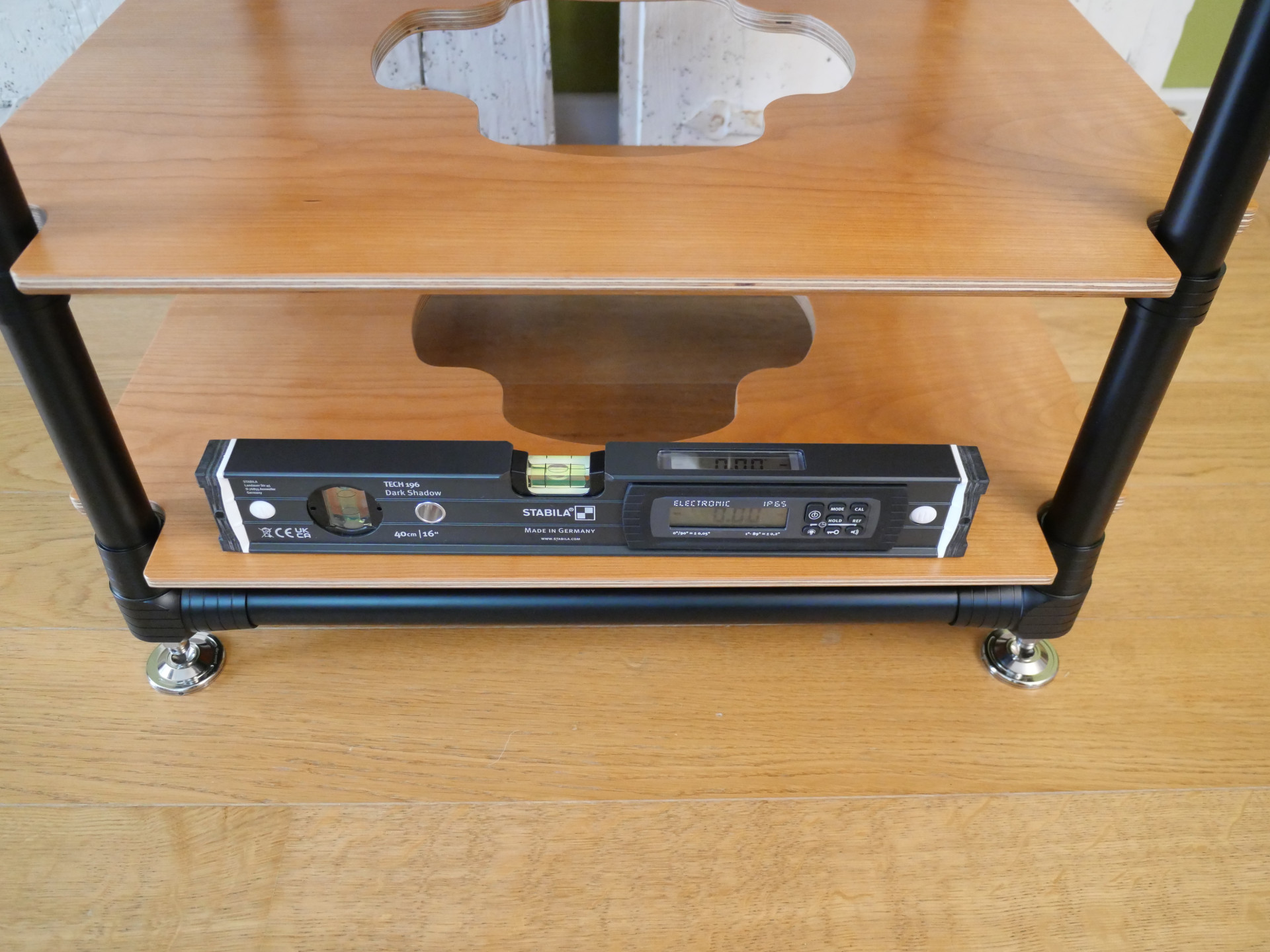
Now repeat the exercise on the HRS and although the drum has more body and texture than it did on the PRS, it still sounds hollow and detached compared to the Grand Towers. Yes, it’s more detailed and dimensional, but the added separation and starker contrast to the background heighten the musical disconnect. It’s an effect that’s even more obvious when it comes to the tambourine that sits to the left of it. The strike and rattles are beautifully defined, but for all that extra resolution and obvious sonic difference, it’s a step backwards in terms of musical integration. The Andante Largo racks don’t just maintain the location and proportion of the instruments, they justify their presence by binding them to the rhythmic core of the track, making sense of their contribution. It’s this ability to keep different musical elements in proportion and bring them together, irrespective of level or frequency, rather than pulling them apart that makes these racks special. By combining clarity and coherence, they offer insight into the music as well as an overview of it: what is being played as well as how it’s being played.
Turn to a challenging classical recording and it will tell you everything you need to know. Gidon Kremer’s concert recording of the Tchaikovsky Violin Concerto (with Yuri Temirkanov and the Symphony Orchestra of the USSR, VIC-2049, a Japanese RCA pressing of a Melodiya recording) certainly has its sonic issues, but the playing is peerless, from both the soloist and orchestra. Temirkanov’s mastery of weight and balance offers the perfect accompaniment and underpinning to Kremer’s virtuoso display. The solo instrument is bold and solid, front and centre as he carves his almost physically sculpted lines. The Andante Largos’ sense of proportion extends to shifts in micro-dynamic level and instrumental attack. The bow has purpose and texture, a poised substance that is emboldened by the effortless fluidity with which the system is able to trace and respond to dynamic shifts. At the same time, the soloist stands in front of a stable, beautifully defined and widely spread stage, within a consistent and contiguous acoustic. The recording itself doesn’t do the sound of the solo instrument any favours. But what so often presents as shrill and harsh, is now integrated into that acoustic space, maintaining the fragile edge in the playing but ameliorating the harsher edge in the sound. The result is a breathtakingly immediate and compelling performance – just as it should be. The soundstage is incredibly wide, with beautifully defined boundaries, the convincing three-dimensionality underlined when incidental knocks and shuffles amongst the orchestra are effortlessly reproduced, locating both the culprits and the floor of the stage. The recording of the solo instrument itself might be over-voiced and less than perfect, but its presentation here is the perfect example of the way in which the Andante Largo racks’ innate sense of integration translates into inherent musicality. Natural perspective, natural proportions, natural tonality and naturally scaled dynamics, ultimately, it’s the picture as a whole that convinces and Andante Largo’s holistic approach delivers just that.