
What do these semantic ruminations actually suggest about the El Diablo and the music it produces? Let’s take each of those descriptors (and its implications) in turn…
Expansive
Listen to the El Diablos and it’s likely that the first thing to strike you will be their generously proportioned presentation. Whether it’s an acoustic recording or a well-constructed studio session, the Peaks offer up the instruments and performers within a large and impressively defined acoustic space – one with boundaries (where appropriate) as well as space around and between instruments. It’s a direct function of their bottom-end delivery and voicing.
We are accustomed to seeing bandwidth limits quoted in loudspeaker specifications – normally ±3dB – without necessarily stopping to consider what that number does (and doesn’t) tell us. A bit like a sensitivity rating based on a single random spike in the output, somewhere in the audible range, there are lies, damned lies and claims concerning bass extension. When it comes to a speaker’s bottom-end its about far more than a measurable output level: it’s about the linearity of the output and the energy generated. That -3dB figure might be perched on a bump in the low-frequency output, with a substantial dip above it. There might be almost no bass output below it. Then there’s the question of how useable that bass output actually is? Too much bass can be just as (if not more) musically destructive than too little. Again it comes down to linearity and energy levels – factors that are simply not covered in a single number specification.
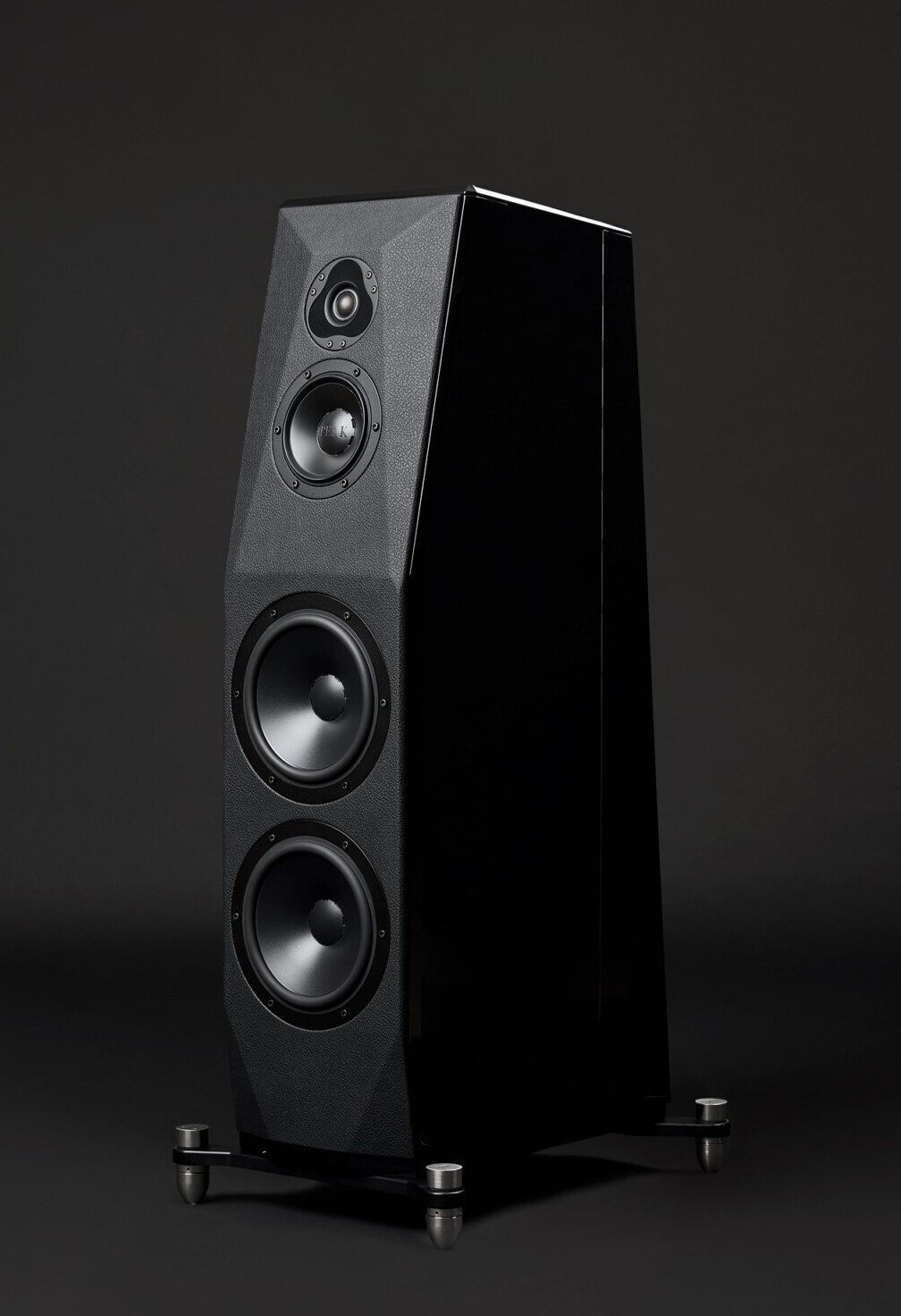
This whole question is complicated by the use of multiple bass drivers. Boundary reinforcement means that the output from the lower of two vertically arrayed drivers will be greater than and different from the one above it – a situation that’s further exacerbated in loudspeakers that use differential bass drivers, a topology that’s becoming increasingly common, with various Wilsons and Stenheim’s Alumine 3 being examples. It’s an arrangement that tends to create loudspeakers that are extremely position (and room) sensitive. As outlined above, the design team at Peak has been exercised about this very question, encouraged by the issues with integrating the potent lower-frequencies generated by earlier El Diablos into smaller or more difficult spaces. Their solution has proved spectacularly successful, maintaining both low-frequency extension and output, while improving linearity and tractability (set-up).
For a speaker with such (relatively) compact external dimensions, the El Diablo possesses a bottom end that is both deep and powerful. That’s reflected in its modest 90dB sensitivity (the Stenheim A5-SX claims 94dB, albeit from a larger and more imposing cabinet) a factor off-set by the impedance compensation executed in its crossover, which delivers an essentially flat 5Ω load to the amplifier(s). It also helps explain the speaker’s predilection for bi-amping. Which in turn brings us to our second descriptor…
Expressive
The El Diablo’s bandwidth and linearity generate a serious sense of musical substance, while at the same time, the flat impedance characteristic eases the amplifiers’ task, encouraging enthusiastic dynamic tracking and temporal security. The Peaks sound remarkably agile and responsive to input, given their middling sensitivity. The bandwidth delivers a place for everything, the responsive nature puts everything in its place. Combined with their rich tonal palette and the well-developed harmonic envelope that goes with it, they map shifts in musical density and energy with a disarming ease: Such ease that you don’t hear them doing it, as they slip into the musical background. Listening to the Peaks gives you a real sense of real people playing real instruments, the way they vary their input and the way that the affects the energy generated. You hear it in the texture and attack of violins and the embouchure of a horn player. You hear it in the woody, sawing texture of bowed double bass and the quivering membrane that is a timpani’s skin. But perhaps you hear it most of all in the diction and articulation, phrasing and intent of vocalists.