
A velvet hand in a velvet glove…
By Roy Gregory
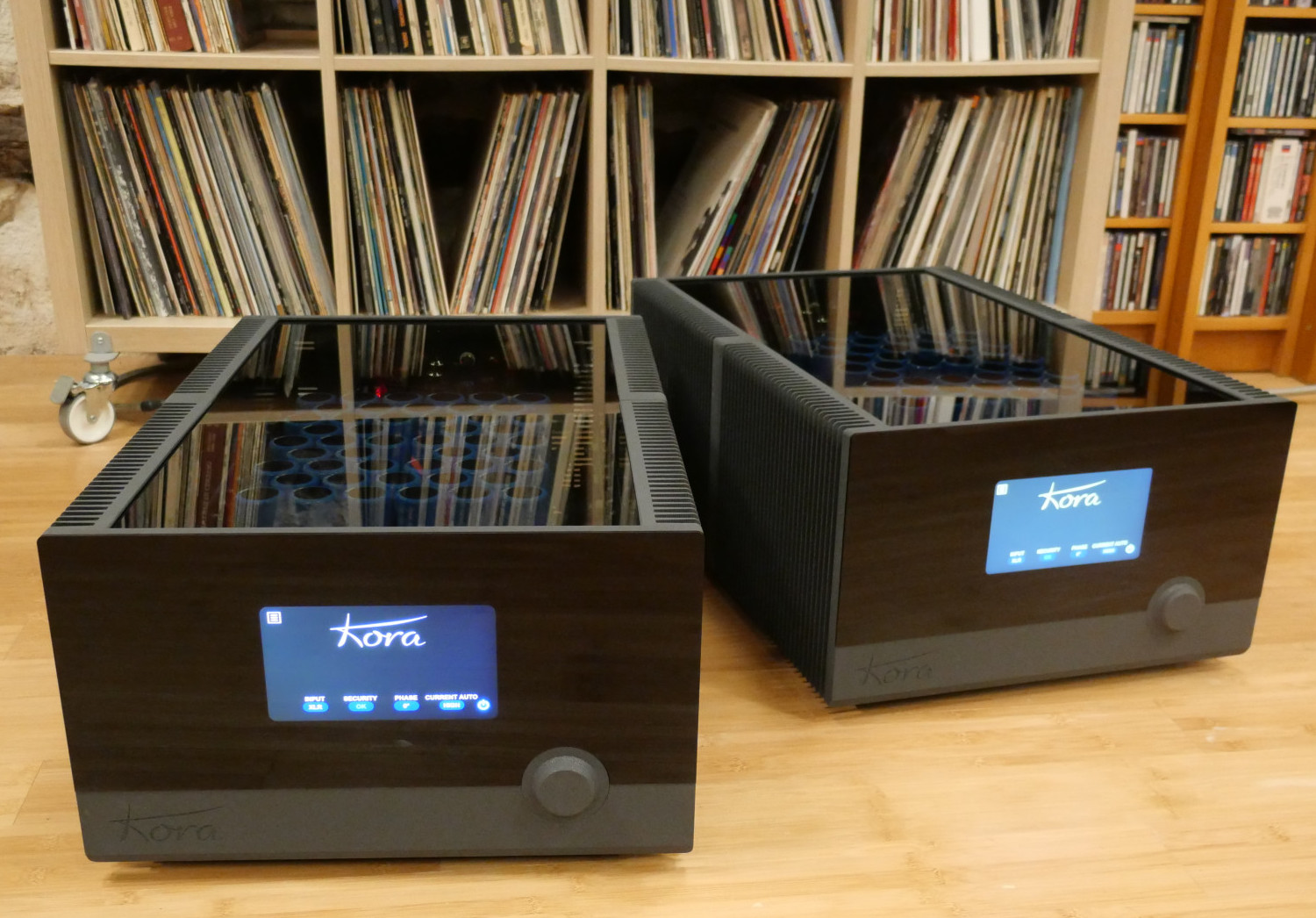
The hi-fi world is one littered with obfuscation, contradiction and confusion, a market littered with too many products that flatter to deceive, fail to deliver or simply aren’t quite what they seem. Just try keeping count of the ‘Class A’ amplifiers – that aren’t: the hybrid amplifiers that claim to offer the best of both worlds – but don’t; the ‘revolutionary’ breakthroughs or innovations that will transform performance – which we’ve seen before (at least if you go back far enough); the French products that are decidedly different, distinctly interesting – but ultimately fail. They’re common enough boxes and, at first glance, the Kora CSA-1200 (1channel, 200Watts) mono-bloc amplifier might easily tick them all. But in this case, and at all but €60,000 for a pair of these impressively powerful and beautifully finished amps, it’s well worth a second glance at a story that’s more interesting and convoluted that it first appears.
Kora (the company) has been around for several decades, but changed hands in 2017, when it was acquired by Bruno Vander Elst, a long-time and highly regarded consultant to the wider French audio industry. He used the established brand as a launch pad for a new range of products based on an entirely new tube amplification topology, an inherently stable, balanced arrangement of two twin-triodes per channel that ran the tubes from a precise current source and at around 20% of their current capability (around 2.5-3.0mA, rather than the more usual 10mA) to produce a balanced output. The tubes were operated so far within their comfort zone that Kora claimed that tube quality and even tube type are virtually irrelevant, performance and linearity being defined by the circuit rather than the devices. Functionally, it’s a topology that mimics an op-amp, a self-contained amplification stage that can be dropped into a wider circuit context to fulfil various functions. This “Square Tube” circuit (four twin-triodes creating a single, stereo amplification stage) found its way into a range of powerful but surprisingly affordable, hybrid integrated amplifiers, followed by a DAC, CD player, line-stage and beefy Class AB power amp, acting as a driver or output stage. More recently, the company has launched a range of up-market, hybrid topology, Class A designs, of which the CSA-1200 is the flagship model.
The Square Tube has finally reached the high-end…
Although the Kora Class A amps are clearly hybrid designs, the company is quick to point out that they are actually “tube amplifiers”: by which they mean that all of the amplification is done by the tubes in the Square Tube stage. The solid-state devices in the output stage supply only current, no gain. I heartily wish I had a pound, euro or dollar for every page expended on the subject of Class A operation. On the surface you’d think it was pretty straightforward, but the deeper you dig into sliding bias, pseudo-Class A and various other ‘clever’ versions of a simple if brute force approach, all of which claim all of the advantages whilst avoiding the economic and ecological disaster of running an amplifier at full output on a constant basis, the more mired the Class A label becomes. Kora’s approach is rather more pragmatic. They simply run the output stage at two different current levels, allowing the user to switch between them, or the amp to switch automatically according to signal amplitude. In high-current setting, there is sufficient current available to run the output stage at full power (200Watts) into an 8Ω load. As the load drops (and the power demands increase correspondingly) the output stage will start to operate in Class B, but in normal operation and at reasonable listening levels and speaker loads, the CSA-1200 should sit comfortably within the Class A envelope under all but the most severe demands. Yes, it’s yet another ‘tricky’ approach to Class A operation, but it at least has the advantage of an attractive simplicity and practicality. It certainly stops the amps running at BBQ temperatures – unlike other, brute force Class A designs I’ve used, amps that really did get too hot to touch!