
Of course, that cuts both ways. Turn to Isabelle Faust’s il virtuoso, il poeta (works by Locatelli, with Giovanni Atonini conducting Il Giardino Armonico – Harmonia Mundi HMM 902398) and the Koras deliver a performance that is full of vitality and directed energy. Faust’s instrument is rich, solid and there’s an almost physical sense of her bowing. The harp’s harmonics, so often submerged in the orchestral landscape are here, beautifully developed and uncannily natural. Yet the performance as a whole doesn’t have the spatial spread and definition of the CH, with its unforced sense of separation and instrumental location, the clarity with which it invests the ensemble backing to underpin its own immediacy and lively dynamics. In this context, the Koras are left short on depth and acoustic definition. The continuo instruments sound muddled and congested: they’re all heading in the same direction but exactly who is where and who is leading is rather less apparent. But, ohhhh – that pace and purpose, direction and intent – and that solo instrument… It’s a musical vision that’s summed up in the first movement of the Violin Concerto Opus 3, Faust’s instrument – completely separate in space and harmonic identity – jousting and exchanging phrases with the band, the echoes and inversions coming with thrilling pace and dexterity. Seldom has the extravagant bowing required to play this demanding piece been so readily envisioned. Rarely has the band’s response seemed so enthusiastic.
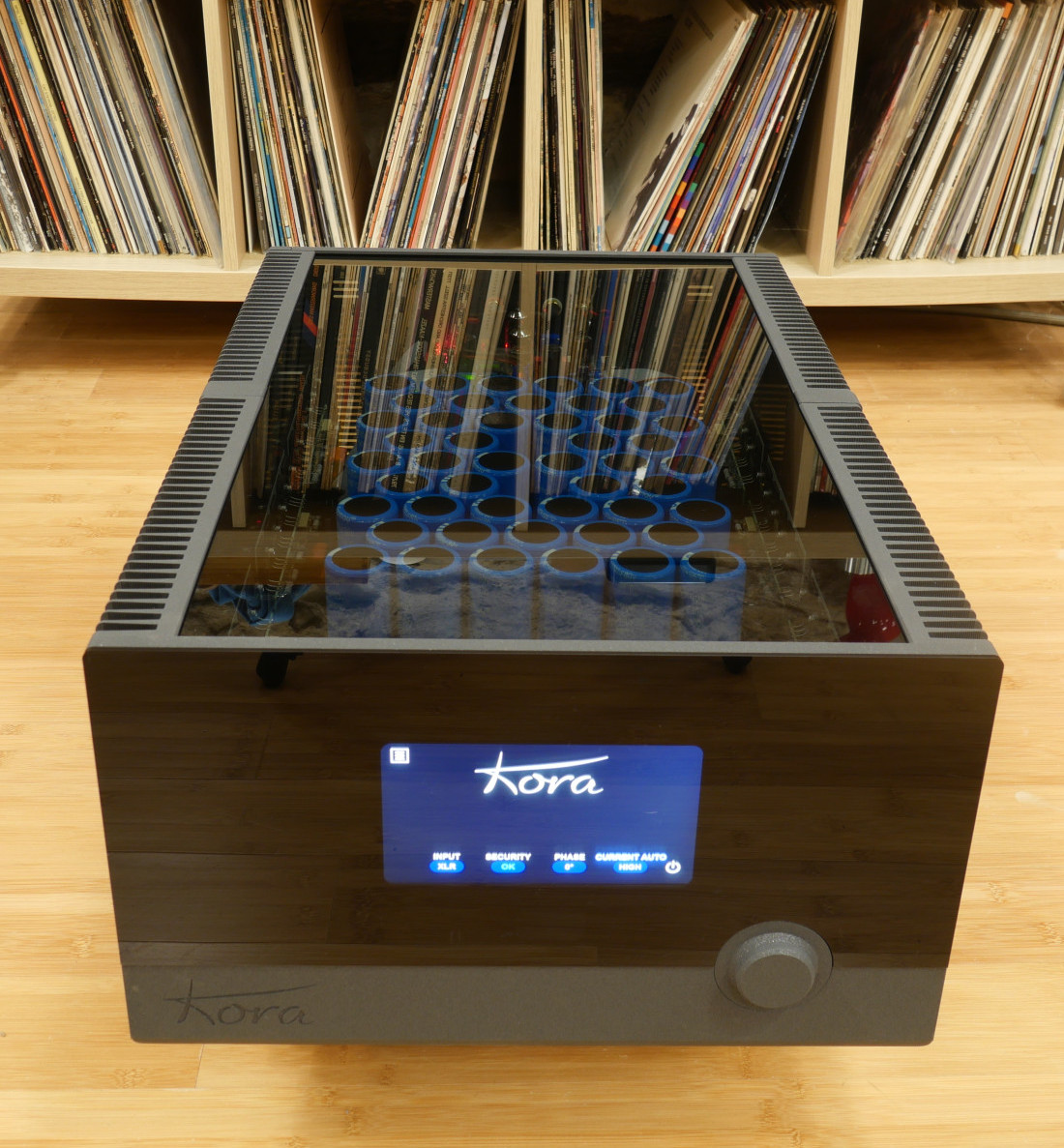
ou’ll listen to a lot of amps before you come across one that projects this sense of human agency with such clarity. The Koras seem to have an effortless grasp of the musicianship behind the music itself. The Second Movement from the Rodrigo Concierto de Aranjuez (Yepes, Argenta, the National Orchestra of Spain – Decca SXL 2091) is a perfect case in point, showcasing both the Koras considerable strengths and the spatial/presentational compromises that go with them. Yepes’ guitar is bold, central and richly solid. The strummed opening chords rarely sound so present or complex. When the solo part enters the elongated, plucked line that characterises the movement, the work that he is putting into each note, to build each phrase, is almost painfully apparent, even if, at the same time the notes aren’t placed and spaced with the same precision and transparency that the CH amps achieve. There isn’t the dynamic range and discrimination, attack and clear variation that the bi-amped M1.1s deliver (albeit at a price!) while even a single CH running in stereo easily betters the Kora’s transparency and locational precision. With the CSA-1200s the classic deep but truncated soundstage of the early Decca stereo recordings isn’t presented as such, the orchestra more of a wash behind the soloist, than distinct instrumental ranks layered in depth and clearly located in space.
As a whole, it’s a presentation that encapsulates the Koras’ virtues perfectly, from the rich tonality and bodily presence of the orchestra to the intimate projection of Yepes’ playing. What’s actually even more impressive is that this superior intimacy is relative to amps I’ve chosen specifically because I value that specific ability and they excel in this regard. Both the VTL and the CH capture the humanity behind the sound and do it better than most – but the Kora trumps them both. The soundstage, whilst well-developed in terms of expanse and scale (and arguably with a more natural perspective than the one that’s actually on the recording) simply isn’t transparent or defined enough to qualify as reach out and touch. Yet touch you the music does. This isn’t reach out and touch the musicians: it’s reach out and touch their energy and, more importantly, their emotions.