

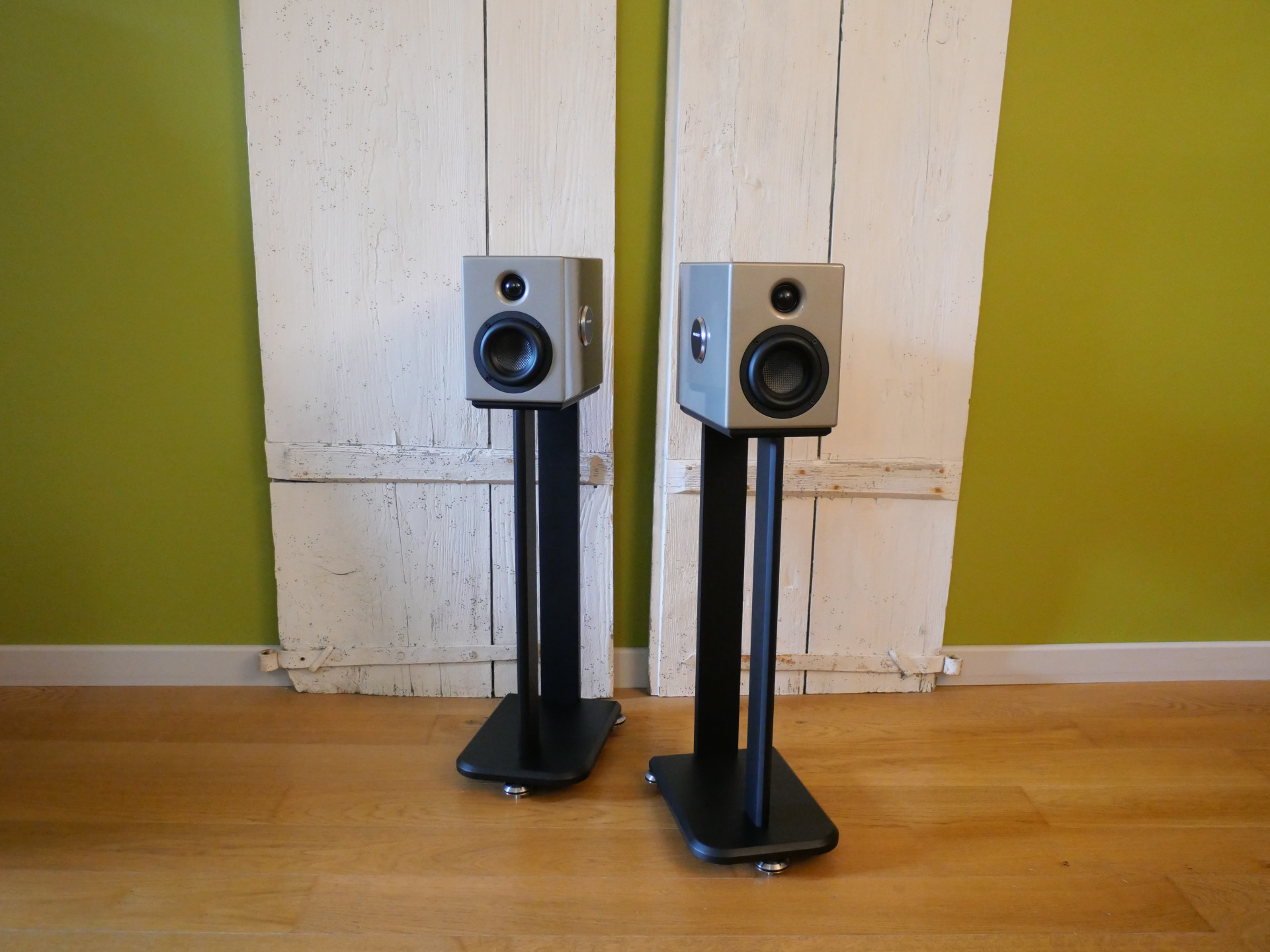
The original Kan used a classic, thin-wall, ply-wood enclosure (actually, the same enclosure as the LS3/5a) but modified the KEF B110 bass unit and swapped out the tweeter for the more dynamic 19mm Scanspeak. It was voiced for near-wall placement, with a distinct step in its frequency response, using boundary proximity to reinforce the bass. The crossover was tuned for low-loss dynamics and timing integrity, rather than a flat response and tonal neutrality. There was a dedicated, 24” space-frame stand that followed the low-storage ethos of the cabinet design and it quickly became apparent that near-wall wasn’t enough. To get the best from the Kan you needed to physically brace it against a solid rear surface.
Just how ‘different’ the Kan was, certainly compared to classic speaker designs is clear from a comparison with the BBC monitor whose cabinet it pirated and whose price it matched. The Linn speaker offered 6dB greater sensitivity, partly due to a pronounced midrange hump. Free-space frequency response offered -3dB points at 130Hz(!) and 16kHz. Compare that to the 90Hz to 20kHz range of the 3/5a. While wall correction gave a -6dB point of around 70Hz (59Hz for the 3/5a) it exhibited a distinct high-frequency droop, but played considerably louder than the BBC speaker. It also suffered a minimum impedance of 4.5Ω – hardly frightening by today’s standards, but enough to make many contemporary amplifiers go weak at the knees.
Reviled by some, mocked as the “Tin Can” by others, it was hard to argue with the little Linn’s musically engaging, immediate and communicative performance – even given the occasional excesses of its ‘Scan-squeak’ tweeter (okay, so I’m being generous when it comes to the top-end…). I’m not sure anybody would describe the Kan as a perfect speaker (despite the number that found themselves on the end of active NAP 250 or 135 systems – the high-end benchmark of their day) but that isn’t the point. What the Kan demonstrated was the yawning chasm between the demands of recorded music and then current thinking on loudspeaker design and the measurement techniques employed to guide it.
Out of kilter?
Indeed, if such a small loudspeaker can be so musically compelling, how much speaker does one really need: or more significantly, when does one need it? We might all want large loudspeakers, but would we actually be better off using smaller ones? As one’s system evolves, would it be musically more cost-effective to leverage the monetary and performance benefits of a simpler speaker, rather than reaching for the biggest and most expensive one that we can (almost) afford? Our ability to measure loudspeakers has evolved considerably, although there is still no measurement for sound quality. But the lessons of the Linn Kan hold true today. A speaker’s frequency response is interesting, but it’s far from the be-all and end-all of musical performance. Instead, the ability to preserve the pattern and timing of the music’s energy is what really counts – and that brings us right back to the virtues of simplicity…