Theory and practice in the misunderstood world of equipment support
By Roy Gregory
Equipment support (so often – and incorrectly – termed “isolation”) is one of the most misunderstood and compromised aspects of audio system performance. That it has a profound effect on that performance is easy to demonstrate. Just as easy to demonstrate as the confusion and compromises that impact most rack and platform designs. Yet get equipment support right and it makes a fundamental contribution to both sonic and musical performance. Sonic AND musical performance? The two are far from being the same thing – especially where supporting surfaces are concerned…
Like many of those products that exist outside the signal path, the product category emerged or was in use, long before we really understood its significance in performance terms. Everything from extension leads and speaker cables through to equipment racks and the shelves that sat in them had become essential parts of our systems before we stopped to ask what influence they might have, or damage they might be doing. Arguably, that developmental path has had a greater impact on rack design than any other component, simply because racks are, at least at first glance and in the first instance, a practical solution: we have to have somewhere to sit our expensive (and potentially messy) audio components, especially if they are going to ‘fit’ into the domestic environment. As a purely practical element, cost was also a concern: you didn’t want the price of your rack eating into the budget available for those all-important electronics.
In recent years (predominantly the last decade) audiophiles have started to appreciate the importance of equipment supports, even if their understanding still lags behind. For most buyers, the focus remains firmly on both isolating their components from the ‘noisy’ outside world and on the rack’s appearance. It is all too often considered as furniture rather than an active contributor to the system’s performance. This dual personality has imposed its own developmental arc. We might have moved on from welded-steel frames and MDF shelves to more sophisticated materials and solutions – aluminium, stainless-steel or composite frames, with multi-material, suspended or constrained layer platforms – but the resulting racks are often, still, severely compromised when it comes to their core function.
Audio racks – an overview…
Look at the majority of racks on the market (beyond simple welded steel structures) and you can divide them into four basic categories. As always, there will be outliers and esoteric ‘reinventions’ but if we look at racks in terms of energy management, they pretty much fit these four boxes:
- Clamped shelf designs (Quadraspire and Blue Horizon PRS)
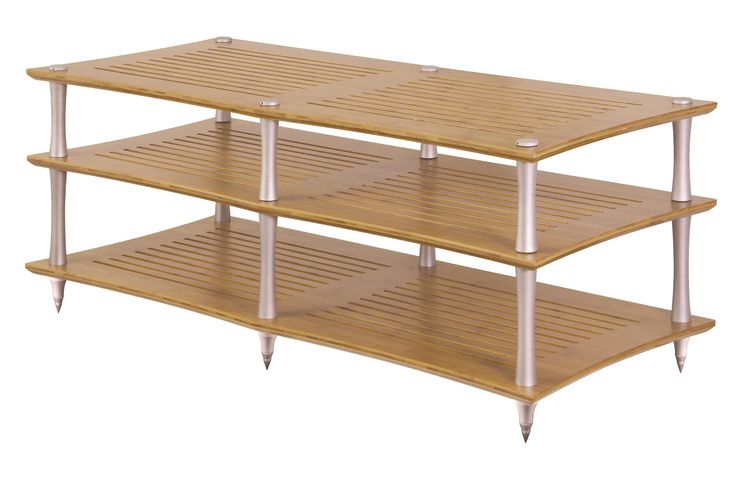
Racks that fix shelves between threaded legs to create a versatile, modular and adaptable solution. They are affordable and can be surprisingly effective, especially if they use non-magnetic uprights and some form of dispersive shelf material.The well-regarded finite-elemente racks are a variation on this theme, with horizontal rather than vertical clamping.
- Stackable designs (SolidSteel and Mont Audio)