
Boxing clever…
By Roy Gregory
One of the more significant recent audio trends is the rise and rise of parallel devices that sit outside (or alongside) the signal path. With products from Entreq and TriPoint, CAD and Nordost, parallel grounding is now pretty much de rigueur in serious systems, while active or passive noise dissipation in audio networks is the latest, emerging trend. Step back a little further in time and Vertex AQ brought mechanical dissipation to cable looms, an approach that has transmogrified into the current Quiescent product line.
How effective these various products are depends on their efficiency, which in turn depends on the materials and technology applied. With RF absorption and dissipation playing a significant role in the development of stealth technologies, there’s a whole host of exotic and semi-classified, high-tech materials just waiting to soak up any errant RF noise loitering in your ground planes. At the other end of the technological spectrum, you can – quite literally – create a box of ‘ground’. Lace that earth with carbon and iron filings and its ability to absorb ground noise increases significantly. Likewise, laboriously construct a non-conductive but random mechanical matrix adjacent to a conductor and you’ll bleed off any physical energy passing down the physically as well as electrically conductive metal ‘path’.
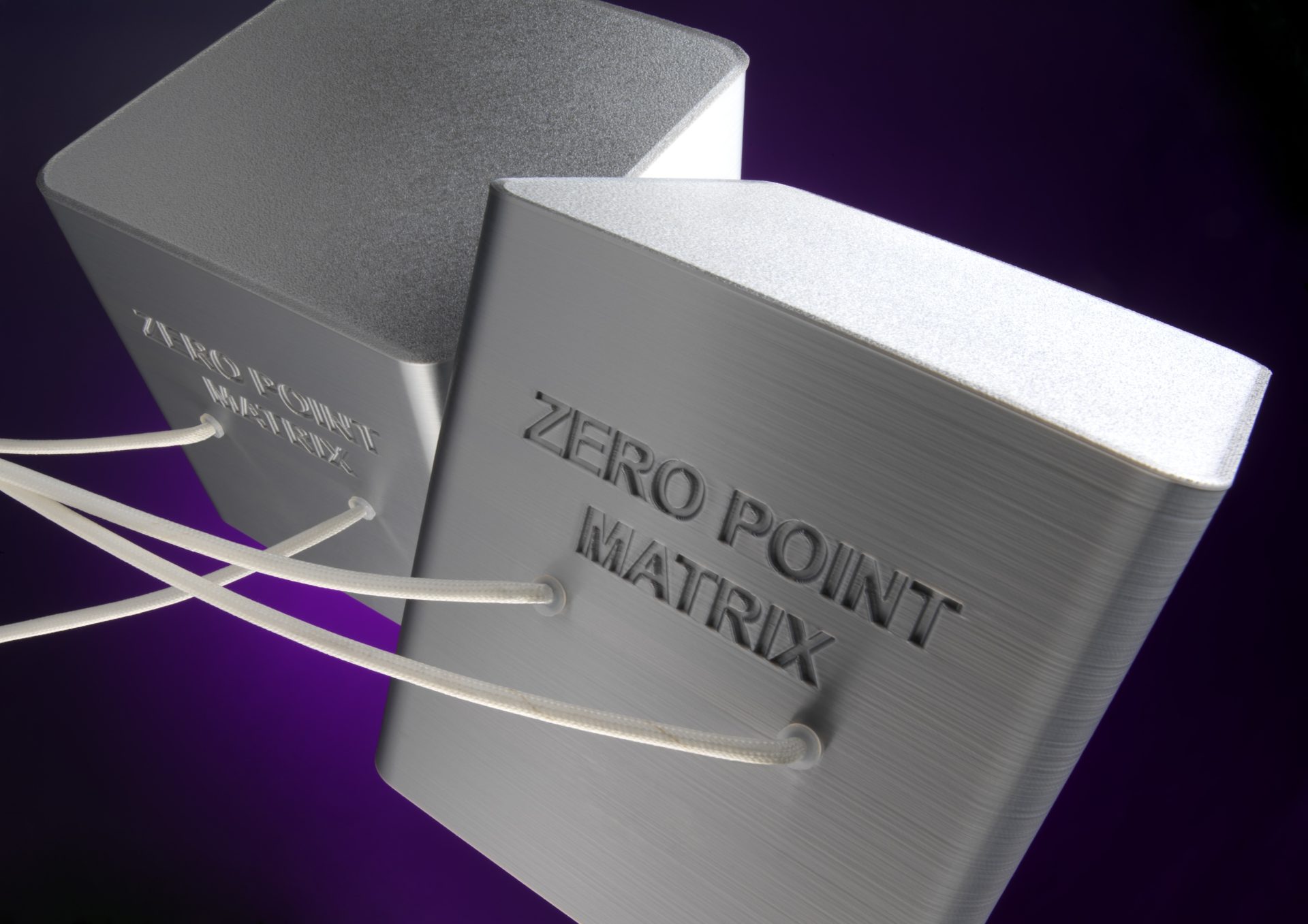
Alternatively, you could just refer back to electrical engineering theory and create a passive network to absorb high-frequency energy that’s ‘riding’ on your signal path. That’s essentially what many of the excellent Chord ARAY devices do. Not only is it a proven approach, it’s also space and cost effective as well as being open to physical and electrical refinement. Take the execution as far as seems (at least semi) sensible and you wind up with an audio-related product that is compact and astonishingly effective: you end up with a ZeroPoint Matrix 1.
The Matrix 1 is ZeroPoint’s first and, so far, only product. It comes from a solid engineering, rather than audiophile, background. As an electrical engineer, designer Gabriel Ganesh was intrigued by the lengths his girlfriend’s audio-obsessed father was going to in order to improve the sound of his system – including hooking up a series of operationally obscure boxes with theoretical obtuse explanations attached to them. The inevitable, “Why don’t you just…” question, met with the equally inevitable, “Well, if you think you can do better…” response – and so the Matrix 1 was born. That was quite a while, a lot of listening and more than a few prototypes ago, but the essential form and theory were all there, right from the start.
So, what is the Matrix 1, how do you use it and what does it do – in theory and in practice?
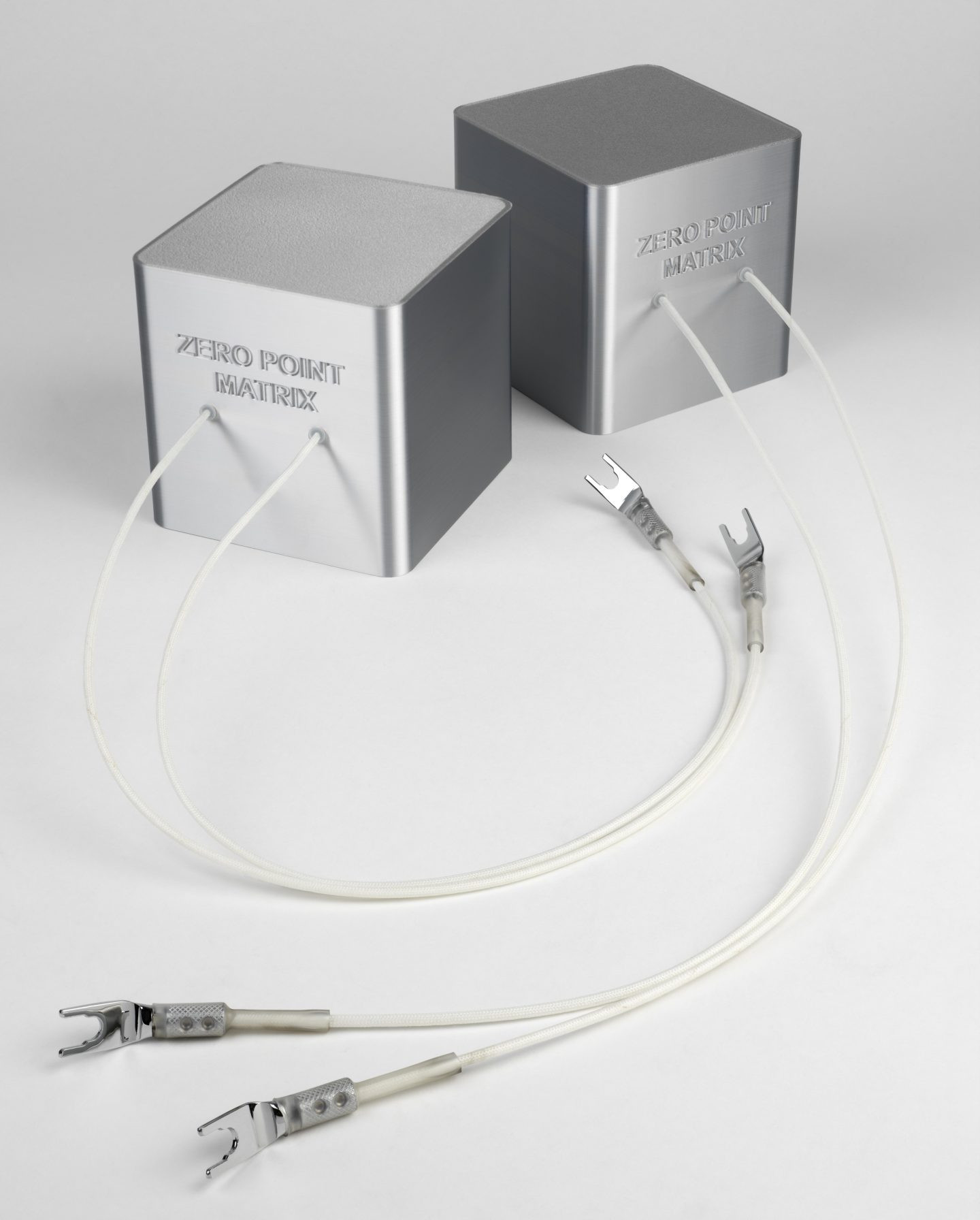
Physically, the ZeroPoint product is easy to describe. An 11cm (a little over 4”) cube with radiused vertical edges, it is available in black or silver finish. Two leads are connected by 3.5mm headphone-type jacks to one vertical face and these are terminated in either spades or 4mm banana plugs that you connect to your speaker terminals. Inside the box is a passive network built from carefully selected and hand-wound components. This is designed to absorb and dissipate spurious high-frequency signals picked up or generated by your electronics or loudspeakers and the aerials – I mean cables – joining them all together. Don’t forget, a large part of what a hi-fi system does is pass signal through a wire sitting in a magnetic field… Throw in the intrusive RFI that has become ubiquitous in our domestic environment and it’s hard to overstate the significance of the problem. It might be small in scale but it attacks and erodes audio quality and musical performance at a fundamental level.