

Beyond carefully selecting the components employed, where things get really clever is in the internal construction of the Matrix 1. The network elements act to take electrical energy and dissipate it as heat. To increase the efficiency of that process, the network is potted inside a 3D printed box. The walls of the box are formed as a complex, random, fractal matrix, massively increasing both its surface area (and thus heat dissipation) and resistance to resonance. The latter matters because the ZeroPoint also acts as a mechanical sink, connected as it is to the most energetic part of the system, short of the driver diaphragms themselves. The material used in the 3D printing process is a carbon loaded resin, creating a shielded structure, further preventing induced noise from impacting efficient dissipation. All that effort and engineering will cost you £1,500 a pair – which might seem like a lot for what is an apparently plain set of resin boxes, but it’s a fraction of the prices being asked for by the competition…
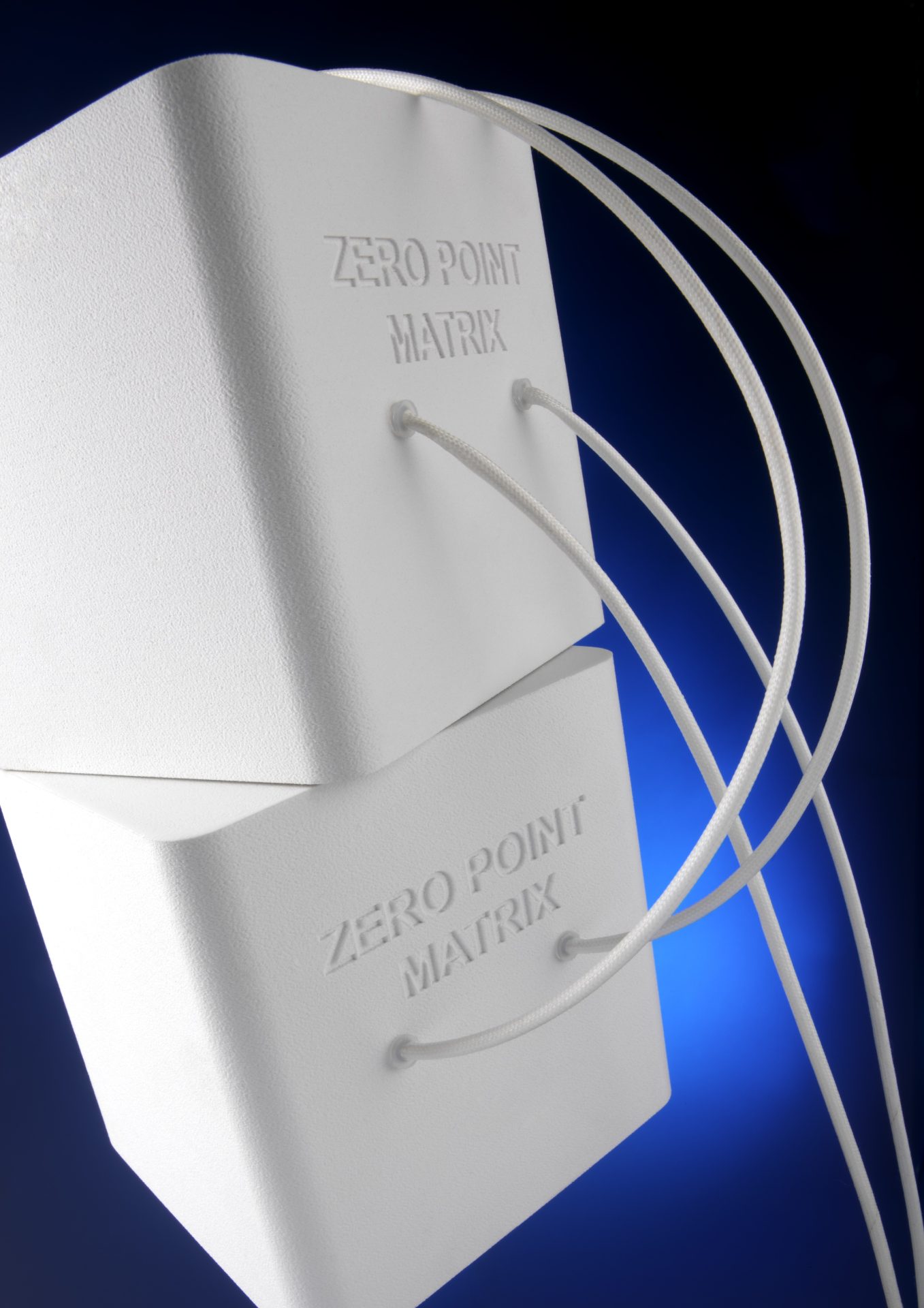
Overall, ZeroPoint’s Matrix 1has succeeded in applying solid theory, leveraged with modern production techniques, materials and a dash of audiophile thinking (when it comes to components selection). It’s compact, discrete and versatile. The detachable leads can be swapped out if circumstances or speakers change, while the Matrix 1 can also be sprayed in any RAL colour to match an existing speaker if required. Although the speaker terminals are the most effective place to deploy the ZeroPoints, they can be doubled up, used on multiple speaker terminals, applied to amplifier output terminals (the other end of the speaker cables) or possibly, further upstream, although that requires more experimentation and different cable terminations. So far, trials on unused digital inputs and outputs have proved extremely promising. The only caveat lies in compatibility issues with those rare amplifiers that float DC on their outputs (the Kodas are the only example I can think of off the top of my head, but there may be others: if in doubt, check with your amp’s manufacturer).
Despite the range of options when it comes to application, I limited myself to employing a single pair, but I did use them on a whole range of systems, with ‘full-range’ speakers from Vienna Acoustics, Peak and Living Voice, Wilson, Göbel and Diptyque, sub-woofers from PureLow and Avantgarde. Rather like super-tweeters, the Matrix 1 might impact high-frequency noise, but you are going hear its impact most clearly in the tighter, cleaner, more agile, transparent and informative bass – and the clarity, space and scale that grow from there. Plug in the ZeroPoints and it’s like you just cleaned up the low frequencies – or moved several models up the speaker manufacturer’s range!
What was really impressive was not just the sonic and musical benefits of the Matrix 1, but their sheer consistency. I used the ZeroPoint boxes in a whole host of different systems and locations, systems whose cost and ambitions varied enormously, but nowhere did they disappoint or fail to convince. Even in relatively modest set-ups, their impact was musically significant, transforming the music’s ability to engage and communicate. Yet at the other end of the spectrum CH 10 Series or 1 Series, paired with Peak, Göbel or Wilson speakers) the results were just as dramatic and, if anything, even more worthwhile. Throughout this odyssey I found myself relying on a couple of different discs, if only to measure relative impact. Yet the results were utterly consistent, irrespective of system. They might have varied slightly in scale, but their substance was always the same.