
King hereafter?
By Roy Gregory
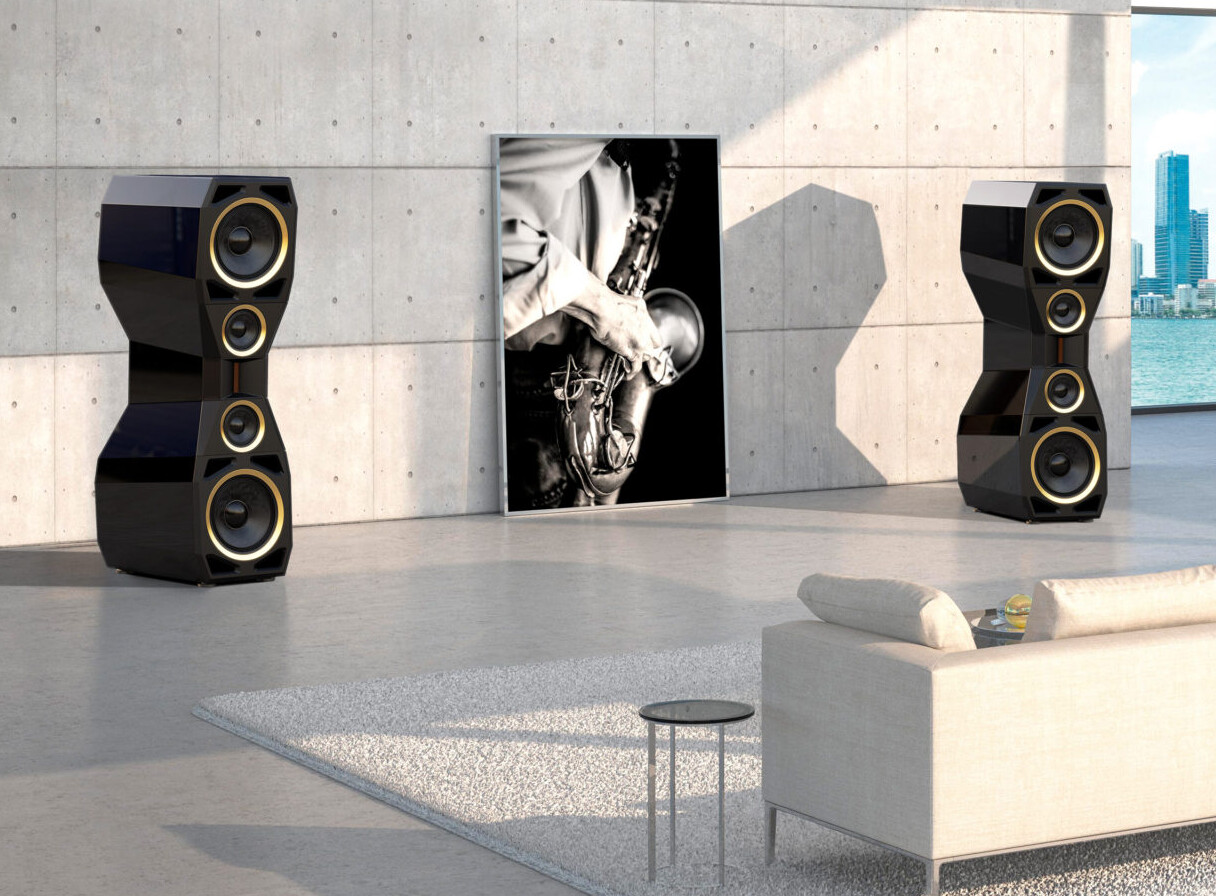
As a product, as a theoretical construct, the high-end loudspeaker is a whole bundle of contradictions. It employs the oldest and most established technologies in electronics and audio, mature theories that should make the design task easier. But it also embodies directly conflicting mechanical requirements that make it arguably the most compromised of all audio components. It has to move, but it also has to remain still. It has to make noise but also be quiet. It is the nexus where physics and mechanics, acoustical and electrical theory collide. These conflicts make designing a genuinely high performance loudspeaker no easy task, one that involves balancing the inevitable compromises and, sadly all too seldom, clever solutions.
It helps explain why there are so many different approaches to building high-end loudspeakers and why, amongst all audio products, loudspeakers have the longest shelf-life – almost regardless of their inherent flaws. If a speaker can do just one thing and do it well, it will find an audience. Back that strength up with a few other attributes and/or a good story and you’ve got it made. If designing loudspeakers is all about compromises, the end results all too often reflect that all too clearly.
In one sense, loudspeakers are the physical embodiment of that old saw, “The thing that made Pink Floyd unusual is that they had two good ideas: most rock bands exist on only one.” When it comes to loudspeakers, new thinking and new approaches are few and far between, often implemented at the expense of other important considerations. Few companies manage a truly rounded and all-embracing approach to the issue of loudspeaker design – but one that does is Göbel High-End. For Göbel, it’s all about controlled resonance, as a brief look at their design trajectory will attest.
Start as you mean to go on…
The company’s first products were based around an innovative, wide-bandwidth, bending wave drive-unit. A flat diaphragm, roughly the size and shape of the original iPad, it was capable of operating from 170Hz to 31kHz, a range demanding a sophisticated understanding and control of the driver’s resonant behaviour, achieved through the innovative combination of materials and coatings. Combined with multiple, conventional bass drivers, it produced a family of slim, elegant and remarkably musically coherent loudspeakers that remain in production today, although the company’s focus has largely shifted to the ostensibly more conventional Divin series. I say “ostensibly” because, despite the use of multiple moving-coil drivers and ported enclosures, there’s very little that might be described as conventional about the Divins…
For starters, they’re big. Even a physically compact Divin speaker, like the Comtesse https://gy8.eu/review/gobel-divin-comtesse-loudspeaker/ is astonishingly heavy and employs a way bigger than average 8” midrange driver. Even in these days of larger midrange diaphragms, that’s unusual and represents a 30% increase in swept area of a 7” unit, almost twice the swept area of a 6” driver. Their cabinets are heavily angled and facetted and, as they get bigger, employ fully symmetrical driver arrays. Those two aspects of the designs are revealing. On the one hand, if the bending wave-based Epoch Aeon speakers had an Achilles’ heel, it was a lack of dynamic range – hence the Divin’s large diameter drivers (and the sensitivity that goes with them). But if you are going to avoid throwing the musical baby out with the sonic bath water, you’d better maintain musical coherence and control the resonant behaviour of the big boxes that inevitably result. Like I said, for Göbel it’s all about controlling resonance – whether you are generating or dissipating it.
Let’s start with those drivers…
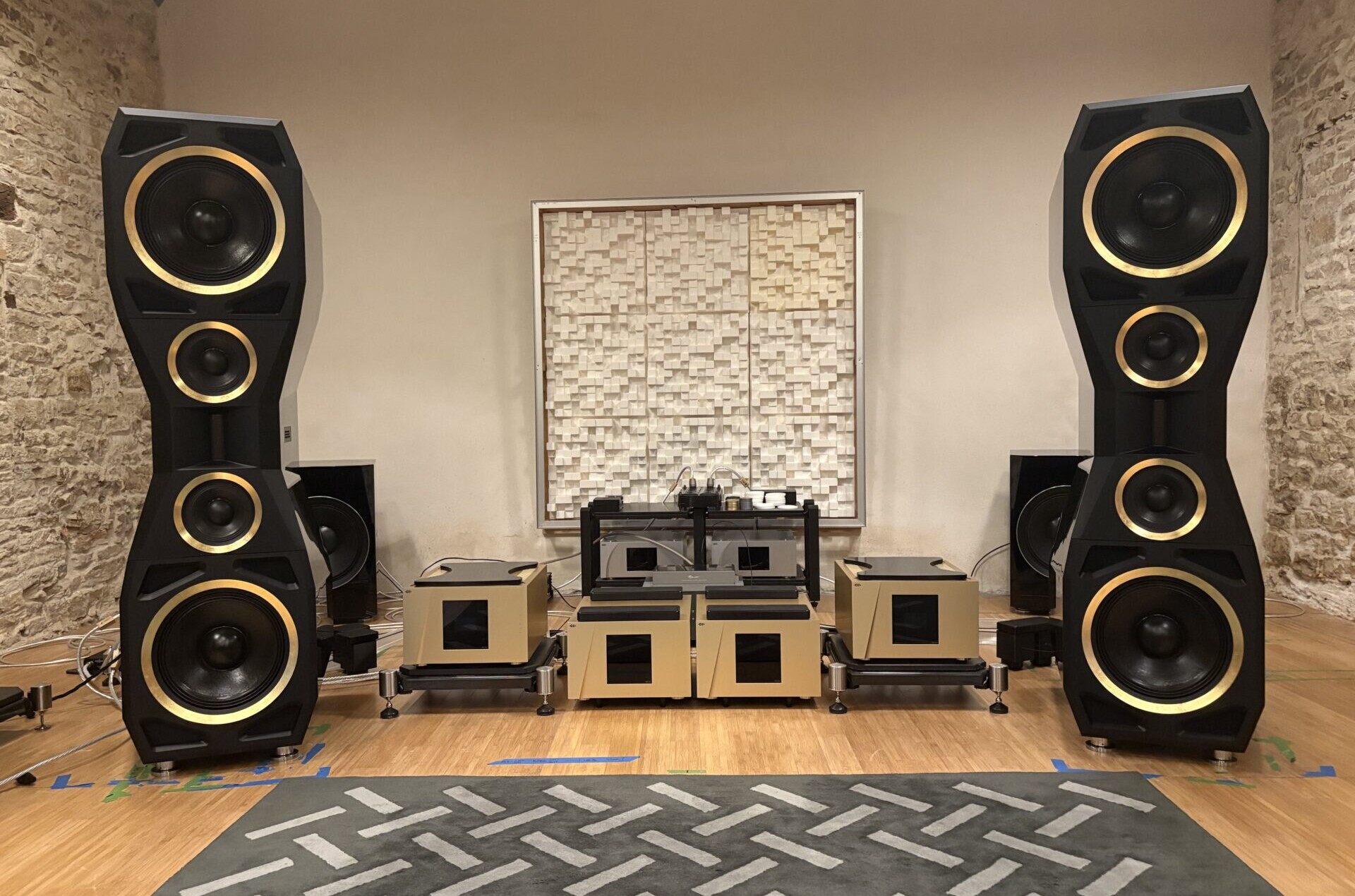
Take one look at a pair of Divin Monarques and it’s hard not to be impressed by their sheer size. These speakers are huge – and dominating their appearance is the symmetrical array of large diameter drivers flanking the centrally mounted, AMT treble driver with its substantial aluminium wave-guide. They’re big and (in this instance) trimmed with real gold leaf. If that’s a little ostentatious for you, you can have (silver coloured) platinum leaf or soft-touch black paint. Whilst gold isn’t normally my thing, here it works, partly because it helps to break up what would otherwise be a massive, looming, black presence, partly because it tones with the champagne (sauternes?) finish on the M10s. You pays your money and takes your choice, but I’m reasonably confident that the driver trim can, just like the colour of the genuine polyurethane piano lacquer on the cabinets, be adjusted to order.