

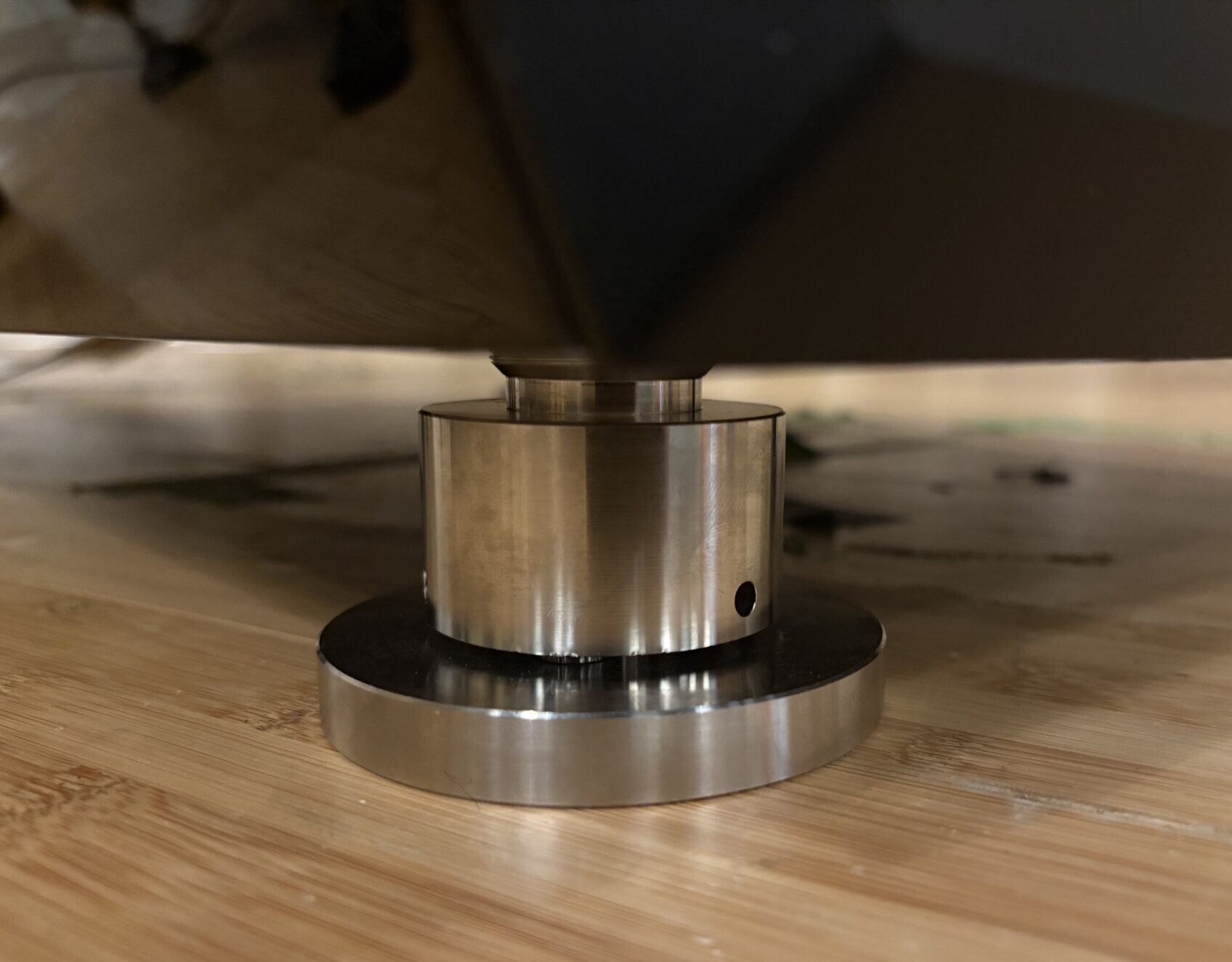
Finally, I’d like to mention the feet that Göbel fit to their speakers. These perform the dual functions of providing a mechanical ground for the cabinet and the precise attitude adjustment that’s so vital to extracting the maximum performance from any loudspeaker. Their high-quality stainless-steel and ceramic construction, large area footprint and 35mm fine-pitch threads are a joy to work with, as practical as they are effective. They’re such a contrast to the nasty, soft metal spikes supplied with most (even seriously expensive) speakers. You know, the ones that are almost impossibly notchy to adjust on their course-pitch threads and whose tips go blunt or fold over as soon as they contact a hard surface. The fact that Göbel also supply up-stands/central posts for their feet in three different heights as standard (12mm, 32mm and 52mm) is further proof of how much thought they’ve put into the problem of actually delivering the performance they promise in the customer’s home.
But what does it all mean?
While some of these design elements can be seen in other speakers, some are genuinely unique. But what’s even more unusual is to find all of these elements combined in a single speaker design. If Göbel’s design credo is “Leave no stone unturned”, the Monarque and their other speakers make a convincing case for both their diligence and its effectiveness. As much as the details make for a great story, it’s the musical performance, the musical performances that these speakers deliver that justify their cost.
I’ve expended considerable time and effort on these speakers already, with an introductory piece and two long articles dedicated to describing the set -up and installation of both the speakers and the system driving them – not to mention the physical effort of dealing with so much stupidly heavy equipment! Only an exceptional result would justify all that oxygen. I’ve already (strongly) suggested that the Monarques are indeed something special. It’s time to go further than that. Göbel’s new ‘flagship-lite’ loudspeaker sets an important new benchmark for performance at a key price level. It could (and should) be a game-changer, not just at its elevated cost, but further down the company’s range too. Such a statement demands justification – and now, finally, is the time for that.
When we talk or think about a system or product improvement, we tend to expect or express it in terms of sonic ‘mores’: more bass, more width, more depth, more detail, more dynamic(s)… It’s especially true of speakers, where the name of the game, whether you are a customer or a manufacturer, is to get more out of a given package. The bigger the box the truer that is.
It’s easy to understand why.
Not only are these quantitative differences easily heard or demonstrated on an immediate basis, they play into our comparative model of product assessment. Even more importantly, in an activity where we spend so much of our time battling uncertainty, such emphatic changes are a welcome relief. What’s more, invest in a large loudspeaker and it’s reassuring to hear a large sound. With buyer’s remorse and inter-web trolls lurking just over your left shoulder, bigger is definitely better when it comes to that sound. Except that, more often than not, it isn’t…