

Now is also a good time to talk about dynamic coherence – not just the extent to which dynamic levels are defined and shifts in level are tracked, but the way in which those proportions are preserved across the frequency range and almost irrespective of volume. Returning to Who’s Next for a moment, play ‘Won’t Get Fooled Again’ and even at a low level is its bluesy, propulsive quality is undiminished, Moon’s drums are just as powerfully insistent, John Entwhistle’s heavily worked bass line clear and undulatingly pitch perfect. Like other high-sensitivity speaker designs, the Monarques manage to breathe life into the recorded performance without resorting to high levels to do it. In fact – and also like other high-sensitivity designs – it is easy to lose track of just how loud or quiet the system is playing. It’s a seriously undervalued attribute, not just because it allows you to play the system quietly with no loss of musical impact, but because of what it tells you about the speaker’s ability to track the dynamic demands of the signal.
Having said that, it would be remiss of me to skate over the time spent playing electronica and movie soundtracks at neighbour threatening levels – and that through two-feet of solid stonework! The ability to rise to the ramping intensity, bandwidth and level of discs like the Gravity and Thin Red Line soundtracks, to capture the repetitive, almost hypnotic beats of Kraftwork’s topical Tour De France or the sledgehammer synth bass that underpins The Pet Shop Boys Introspective (the triple 12” please!) is an impressive indication of just how dynamically coherent the Monarques are – the linearity of their bass output and how that translates to their ability to project low-frequency leading edges and substance. Electronica may or may not be your thing, but presented with the Divin Monarques it soon becomes another in a long line of musical temptations.
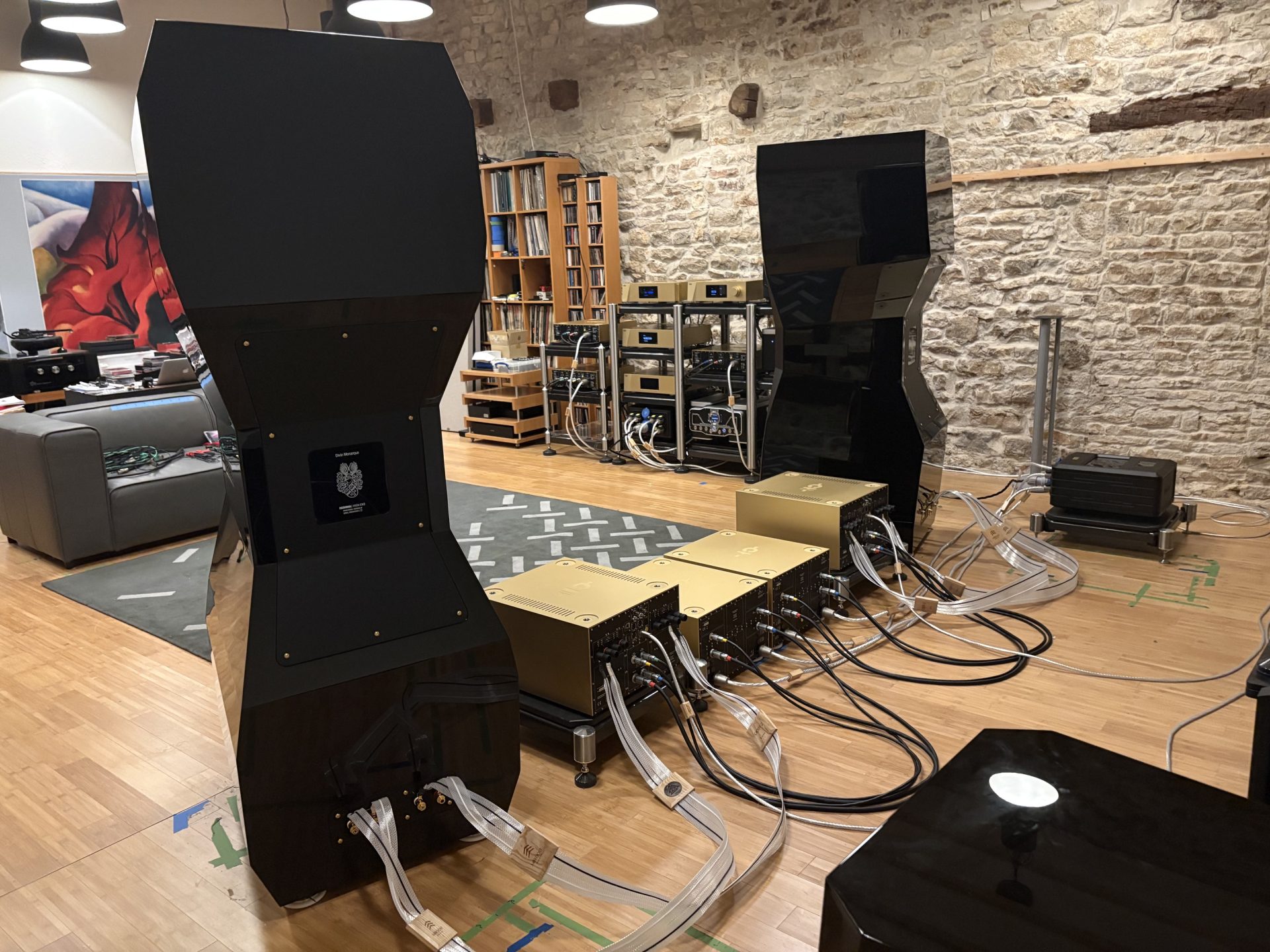
It’s an impressively complete and rounded performance, just as you’d expect from a speaker that establishes new levels of musical coherence. While there are other speakers that can match the low-colouration levels and integration of the Monarque – notably the Rockport Lyra – or exceed its dynamic response (the Avantgarde Trio G3) I’ve yet to find one that can match the Göbels sense of inner balance and musical proportion. Key to that is its insistence on higher-than-average sensitivity. Too often, integration and low colouration are bought at the expense of musical energy and dynamic response. The Monarque’s combine a large swept area with powerful motors, sophisticated diaphragm coatings and low-loss surrounds and internal damping to deliver convincing scale and dynamics without the loss of continuity, linearity or integration that generally bedevil high-sensitivity systems. They maintain bandwidth through the simple (if costly and demanding of engineering expertise) expedient of a genuinely large internal volume, with both the cabinet and the enclosed air-mass controlled with an almost Jesuitical discipline.
A Majestic performance?
All told, it’s a performance that makes the Monarque the best balanced, most tractable and most convincing – in fact, just the plain best – Göbel speaker yet. Better than the Majestic? The Majestic I loved so much a few short months ago? It is. Although it can’t match the big Majestic system, with the same electronics and a six-pack of subs for sheer scale or maximum level, this system with the Monarques is more intimate, more communicative, has greater humanity and a more accessible and even more inviting presentation. Given that so much of the cabinet construction, thinking and driver technology is common to both designs, it raises the inevitable question of just how big a contribution is that heavily revised crossover making? Having spent considerable time on refining the slopes and components – and even more time on the out-of-band characteristics – the result is a subtle but musically deeply significant improvement in overall linearity and phase coherence. Given the experience with other companies that have trodden the same path – notably Focal and Living Voice – I’m in no way surprised by the musically fundamentally nature of the improvements, the extent to which the speakers sound more natural and expressive, the music more communicative and intelligible. It’s all about perspective and proportion: the sense of having a natural viewpoint and ‘seeing’ a natural picture; the dynamic, dimensional and temporal proportions within that picture. Temporal proportions? Absolutely. What we’re talking about here is the space between notes, the ratio between sound and silence – and this is one silent speaker when the music needs it to be. Collectively, this balance of virtues brings you closer to a more convincing performance, a more complete sense of the original event, a sense that transcends the system reproducing it.