

Let’s start on the outside, with the Monarque’s striking shape. Although the hourglass profile and the reasoning behind it are shared with the Noblesse and Majestic, the new model is, to my eyes at least, the most attractive and physically balanced of the three, with an almost sculptural quality to its appearance and proportions. Like the Noblesse, the cabinet is a single, monolithic construction. Like the Majestic, it mixes materials, with CNC-machined aluminium baffle plates joined to a laminated, multi-layer, melamine-based carcass. The constrained-layer panels absorb and dissipate energy, but also concentrate it in specific frequency bands, making it easier to deal with. Their shape also eliminates parallel edges and internal standing waves, at least for the most part: it’s hard to totally eliminate parallel edges on the baffle and rear panels, without resorting to Geary-esque extremes! But by varying the size and shape of the panels, their resonant behaviour can be controlled, predicted and strategic bracing can do (most of) the rest. To that end, the cabinet walls reach a maximum combined thickness of 105mm/4”. The result is a remarkably rigid and well-behaved enclosure that adds little of itself to the performance and is even less noticeable. So much so that, listen with your eyes shut and it’s a surprise to be confronted by such large speakers when you open them.
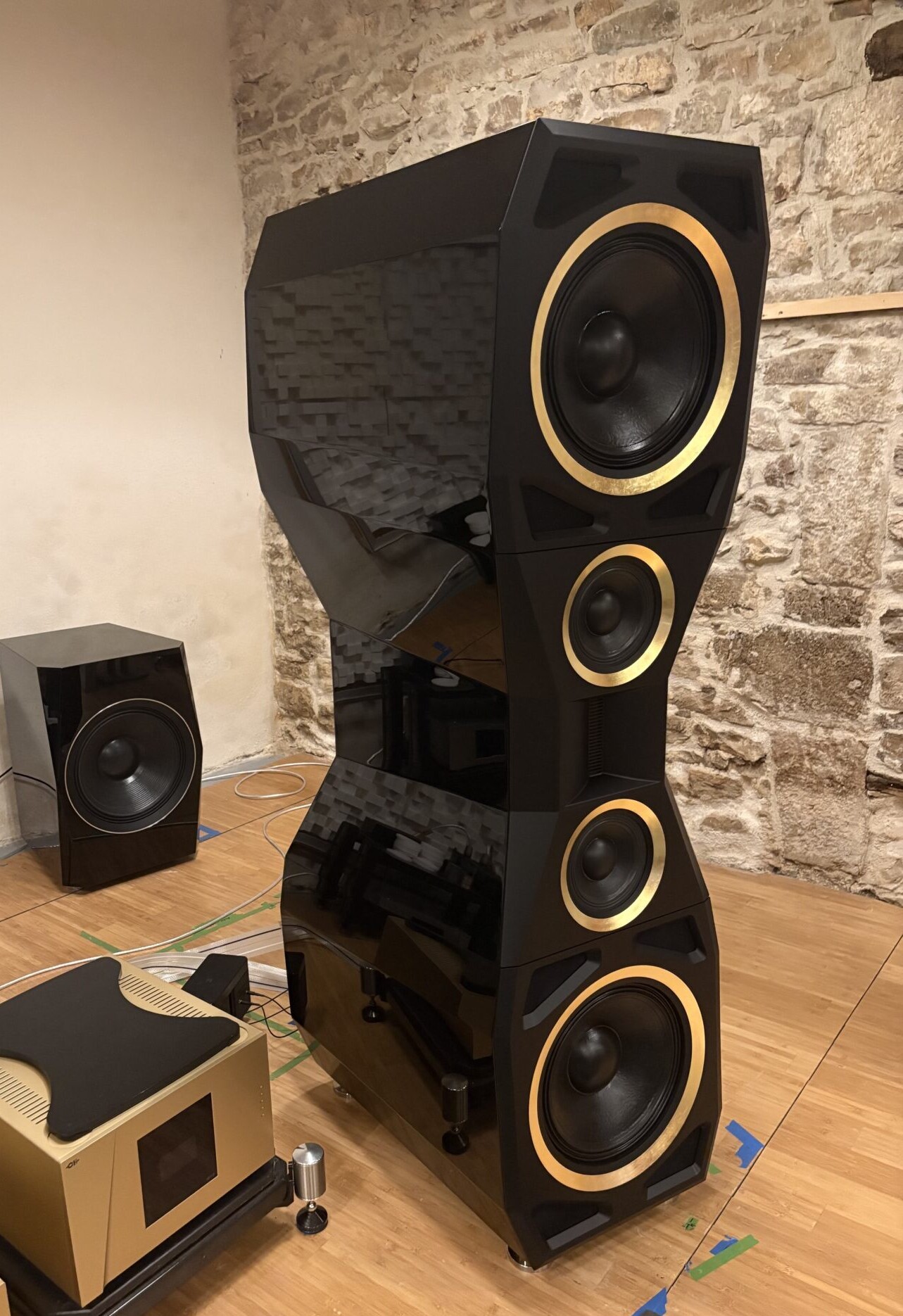
Those strikingly angled panels with their heavily bevelled edges reveal the internal construction, with six separate enclosures, one for each driver and the crossover. The tapered walls and sloping internal baffles create chambers without parallel surfaces to help eliminate standing waves. The internal air mass in each chamber is further controlled by targeted application of Helmholtz resonators and rigid, ceramic foam that dampens velocity without absorbing energy. That energy, properly deployed is crucial to the speaker’s output and dynamic response.
The Divin speakers all employ symmetrical porting. In the larger systems, that takes the form of four carefully shaped ports arranged around each bas driver. It’s an unusual arrangement that ensures symmetrical behaviour within the enclosed air-mass and equally distributed forces on the driver diaphragm. Single, large, off-set ports tend to allow the resonant energy generated by the standing waves that exist in the air-mass within a conventional enclosure to escape, producing audible distortion. Many designers handle this problem by placing them on the rear-baffle, creating a delay between the distortion and the impulse that generated it, minimising its distracting influence, if not its effect. But that’s a kludge, at best, and ignores a secondary and in many ways far more significant issue. An off-centre port will also generate an uneven resonance within the enclosed air-mass, which in turn acts to de-centre the driver, producing a significant increase in noise and distortion. Göbels symmetrical front porting promises not only lower distortion, more pistonic output from their bass drivers, but maximises both the musical energy generated and its integration into the output of the system as a whole.
Stitch that!
Holding the whole, massive edifice together, is the crossover and I’ve left it until last for a reason. As I’ve already described, it’s housed in its own, separate chamber, located behind a machined and profiled aluminium baffle. Within the enclosure, each leg of the point-to-point wired network is individually potted and isolated on vibration mounts, while the components employed read like a guest list of the great and the good when it comes to specialist audio parts: Just as you’d expect. But littering your network with audiophile fairy-dust does little to guarantee magical performance. It ain’t what you use, it’s the way that you use it – that’s what gets results. It’s also what makes the Monarque more than a little special. If most of what I’ve described so far is common to the other Göbel Divin designs, the cross-over isn’t. The Monarque delivers a significant step up in overall dynamic and musical coherence when compared to its siblings – and that’s down to refinements in the crossover topology and componentry.