

Balanced – implying that all of its qualities are present to an equal degree. That’s easily understood but its implications are less so.
Which brings me to “3D”: a term normally used to refer to width, depth or height, collectively, physical dimensionality: that isn’t the sense here. We’re talking the musical rather than the physical realm. In this instance the three dimensions are temporal, spatial and dynamic – and that’s a whole different world with its own, distinct rules.
Finally, there’s that word “performer”, a term chosen specifically to embrace the sense of musical performance and, in turn, expressive range.
Now look again at that description and what it suggests about the Divin Monarque. Here you have a speaker where its ability to portray music in a spatially, rhythmically and dynamically balanced way heightens its musical and expressive capabilities. That ability is directly attributable to the speaker’s design choices and execution and is reflected in its unusual specs – not that they tell the whole story.
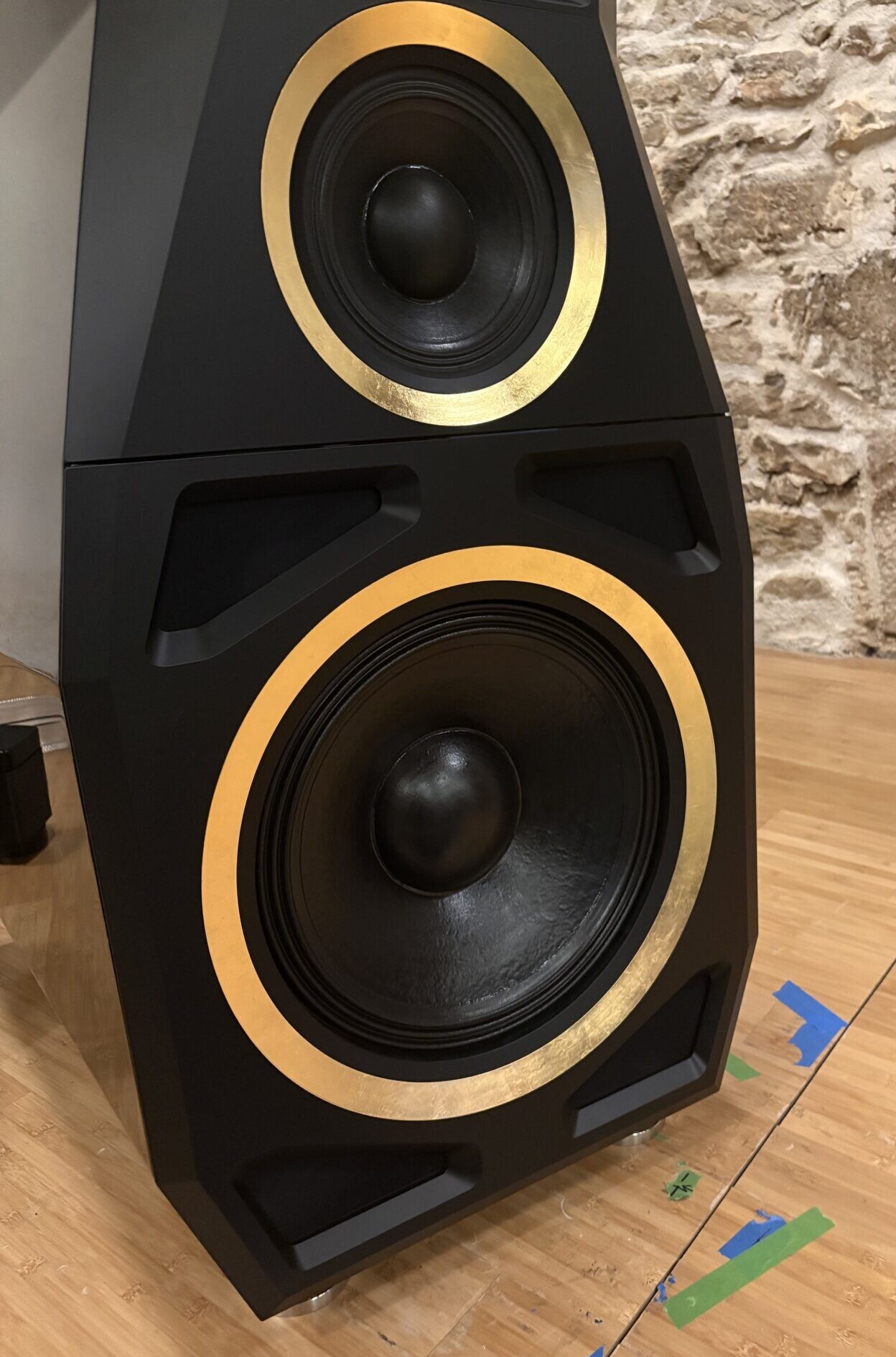
Stand in front of the Monarque, take in its imposing dimensions and then, look at the specs on paper. You might be disappointed by the quoted low-frequency bandwidth. Don’t be! By opting for a higher-than-normal sensitivity and massive swept area, rather than squeezing the last few Hz of low-frequency extension out of the system, Oliver Göbel has opted to create a system capable of delivering musical energy with equal attack and dynamic range, right across its useable output. He’s further doubled down on that by creating a crossover with non-reactive electrical characteristics, which make the most of the driving amplifier, taking that further still by offering and encouraging the adoption of bi-amped operation. The result is a more informative, more natural bottom end, with greater musical power and impact than those numbers might suggest – or speakers with more impressive numbers actually deliver. This is real bass in real time.
Everything in its place…
The curved, symmetrical driver array delivers time and phase coherent output, while the fixed relationship between the drivers allows both acoustical coherence and incredibly accurate pair matching. The output of each completed system is fine-tuned in an in-house anechoic chamber that’s 6m on a side, allowing accurate and repeatable measurement down to 80Hz. On top of which, the company has unlimited access to an even larger chamber, for product development purposes. When you are pair matching to within ±0.2dB, it’s essential to have fixed relationships between the drivers. In itself, that’s incredibly impressive, given the assumptions that underpin stereo reproduction, but it also gives the lie to the configurable/adjustable approach that’s adopted by other manufacturers. If the physical relationship between the various drivers in a system is almost infinitely variable, while there’s a single perfect setting to fix their output correctly, there’s an infinite number of settings that will be just plain wrong. How do your do like those odds?