

Take a successful, balanced speaker and extract more bass, or more dynamics and ‘slam’ and those changes will come at a cost. That cost might be in terms of drive characteristics or integration, musical coherence or overall balance, but wherever you are expected to pay, you can assume the price will be high. Taking an existing performance envelope and trying to stretch or extend it, often in a single direction, rarely ends well. Yet it’s a popular developmental path, if only because its easy to do and to demonstrate/hear. I think of this pursuit of sonic extension as an outward looking attitude and its almost universally prevalent. You can lean a speaker’s performance towards the impressive (at the expense of integration and musical integrity) and all too often that’s exactly what happens. It’s part design and it’s part set-up, but it’s increasingly common at shows, a tendency led by the larger and more respected brands that should know better.
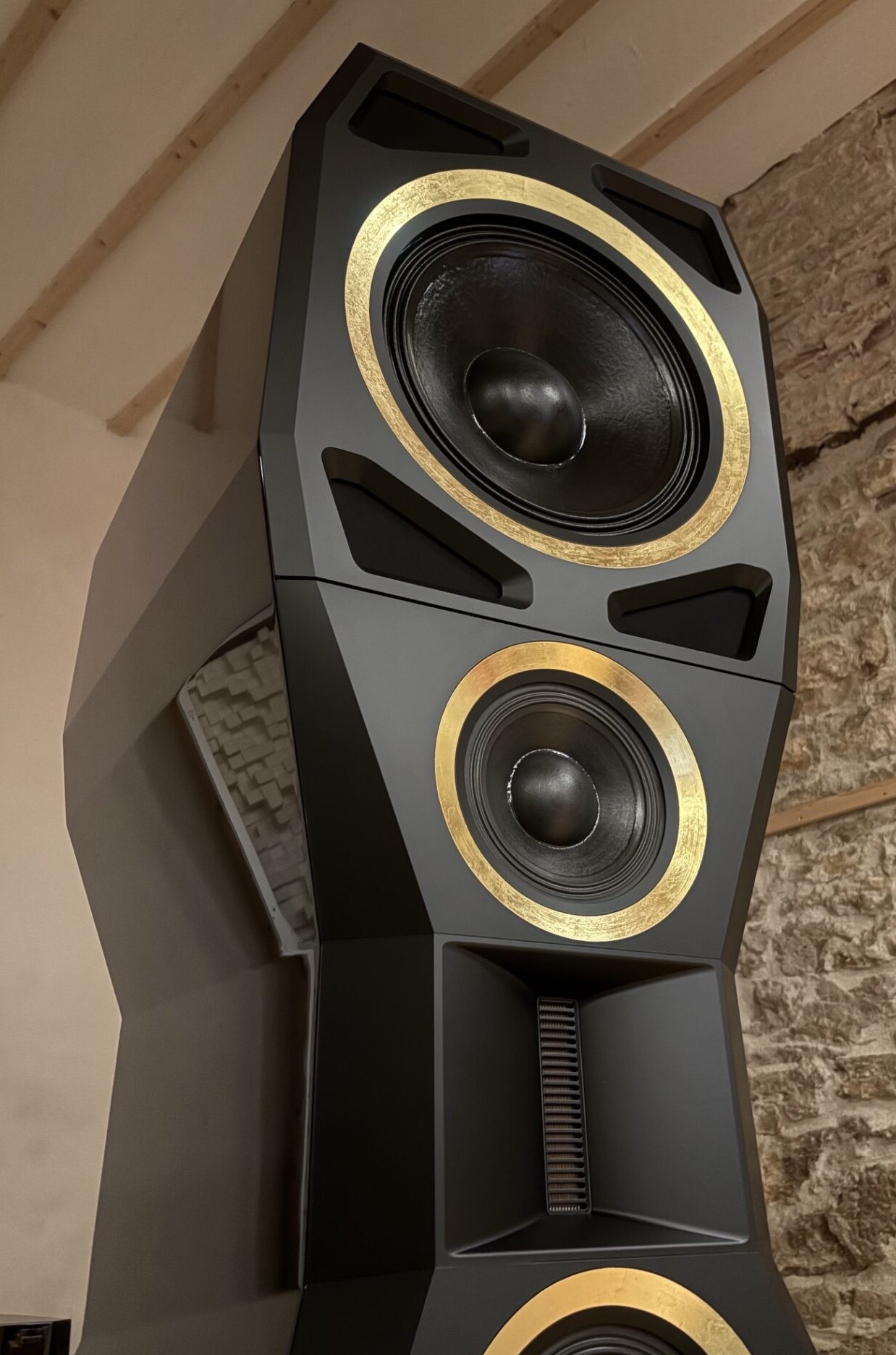
Now let’s look at the Divin Monarque. The core elements and construction are predetermined by the previous models. So, once the performance envelope has been defined by the physical elements – a cabinet and drivers large enough and powerful enough to deliver 96dB sensitivity and extension to 21Hz – the focus switches inwards, maximising the performance within that envelope. Of course, a big part of the design process is balancing those characteristics. 96db is plenty sensitive, especially for a conventional, reflex loaded cabinet. It demands some pretty special drivers with exceptionally powerful motors. It also demands a large enclosed volume. The Monarques are certainly big and, given their size, extension to 21Hz (±3dB) is less than might be expected – at least, until you take that high sensitivity into account. At which point the speaker’s balance of virtues is thrown into stark relief. This speaker’s musical goals are as distinctive as its looks. Yes, you can take it and bend the performance out of shape, aiming for the huge and spectacular to match its size and appearance, but to do so is to severely limit their potential. This speaker is all about balance and in that regard, it knows little or no competition.
Like I said earlier, I’ve spent a lot of time discussing both the system driving the Monarques and its overall set-up. Throughout those articles, the equipment selected and the process itself, the single guiding principle has been consistency. Whether you are talking cables, supports, grounding or electronics, the level of continuity achieved is exceptional and far from the rule. It wasn’t easy to achieve, but the results are more than worthwhile, reflected in an astonishing level of musical coherence – and nowhere is this more apparent than in the musical delivery of the speakers.
A whole that thrives on the sum of its parts…
If I had to sum up the Monarque in a single phrase, I’d describe it as, “a musically balanced, 3D performer.” Although, having said that, I suspect that most readers would misunderstand or misinterpret the intent in that statement. Break it down and it consists of three separate characteristics, each defined from a musical perspective: