

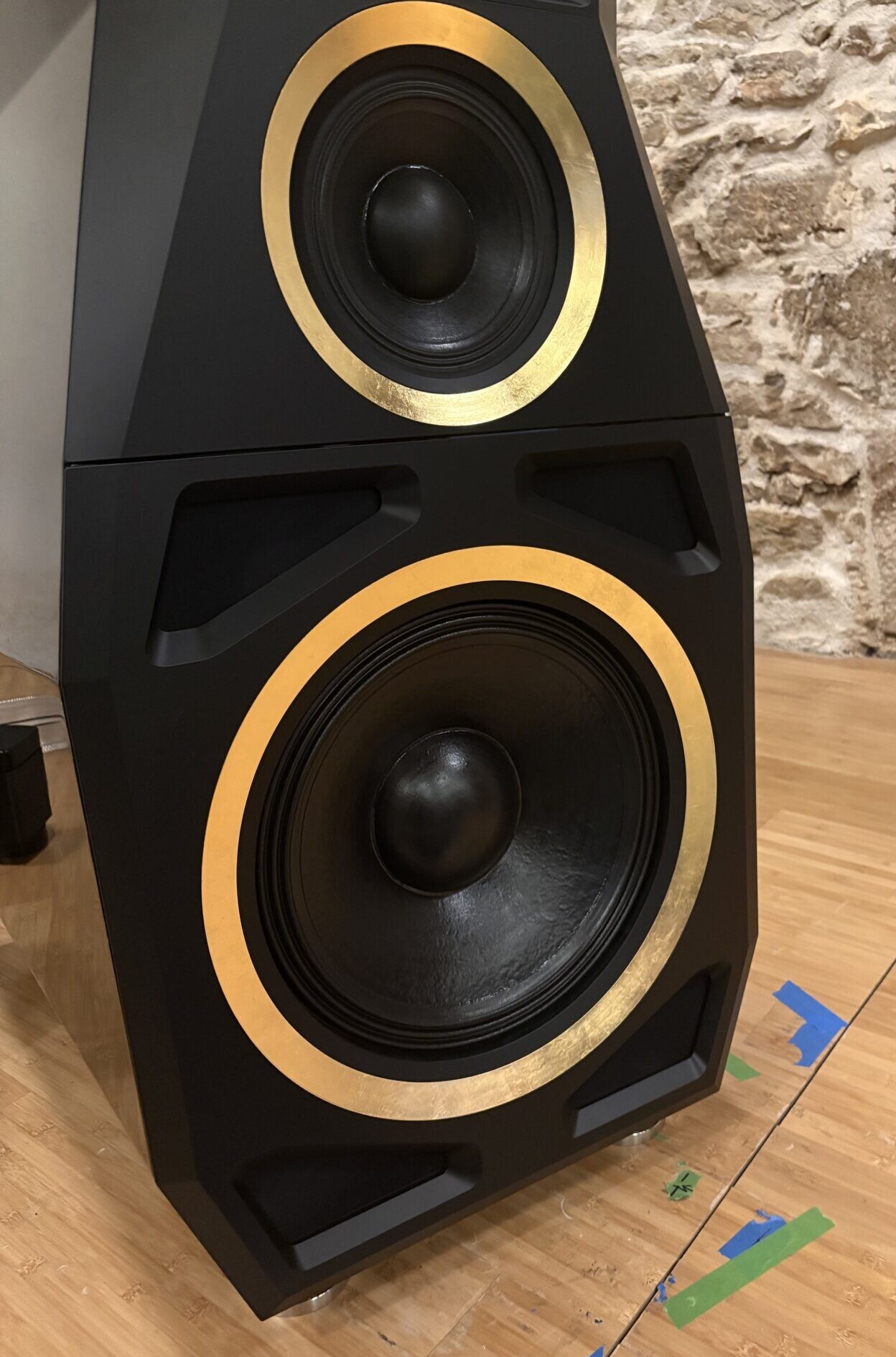
While the drivers might seem like both the most obvious and conventional thing about what is an ‘unusual’ looking loudspeaker, look more closely and you’ll realise that they are anything but run-of-the-mill. Purpose built with electrical and mechanical characteristics to suit each speaker design, the reinforced pulp cones (carbon fibres for the 15” bass units, glass fibres for the midrange) are heavily treated with unique, specially developed and frequency specific coatings, a direct result of those evolved for the bending wave driver and essential to control the resonant behaviour and audible signature of such large cones. The cones are terminated with pleated fabric surrounds, to avoid the damping and subsequent loss of energy associated with rubber surrounds. They’re built onto large-diameter, double-sided voice coils, driven by powerful neodymium magnets, an arrangement that is both efficient and allows for massive venting and thus thermal stability, avoiding the often-underestimated impact of thermal compression, especially when handling the serial, large excursion demands of repeated orchestral tuttis or synth/bass lines. These bass cones don’t flap or wallow around the way most 15” drivers do. In fact, watch and you’ll barely see them move – although more on that later.
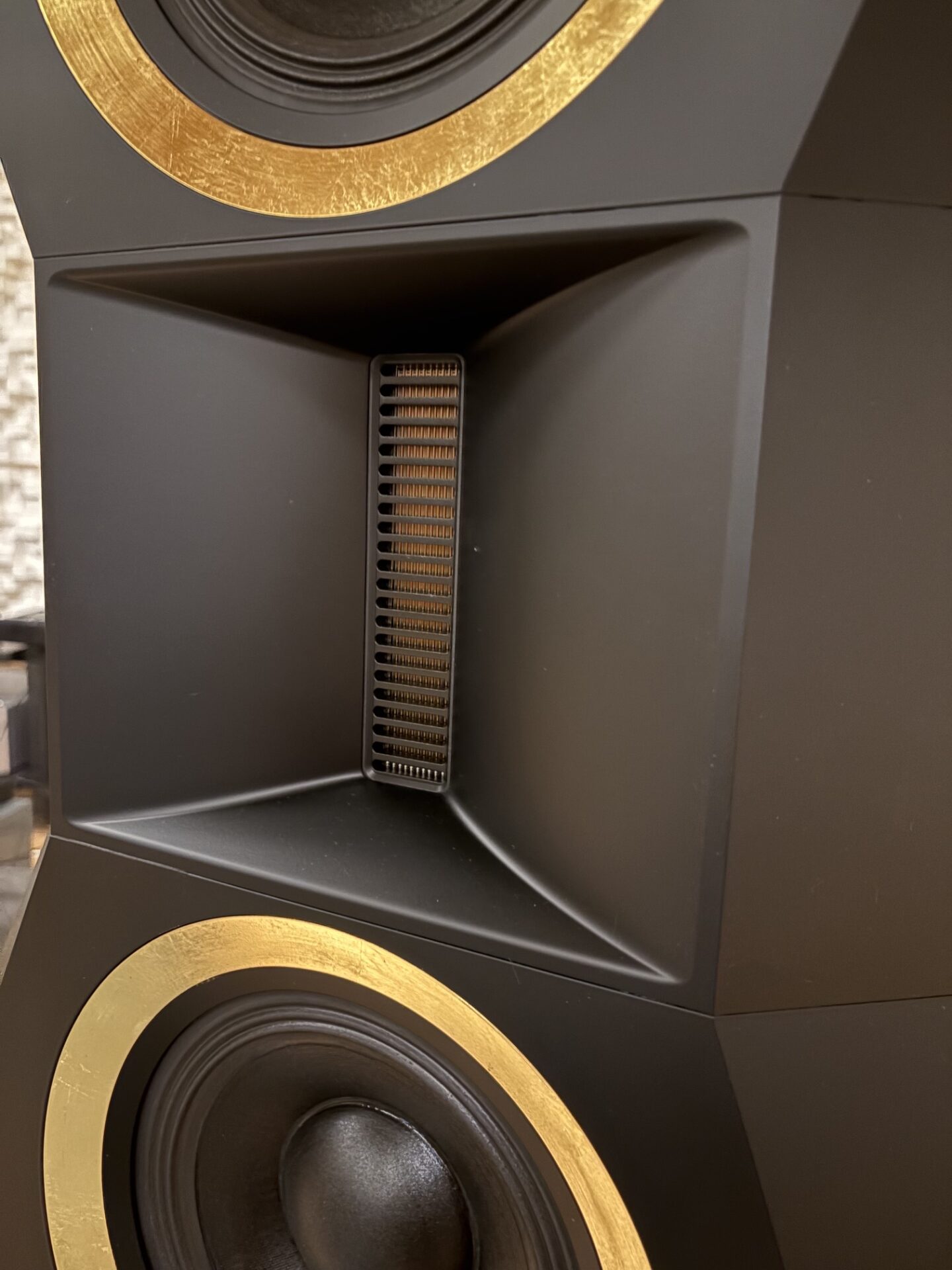
The 8” midrange unit operates from 120Hz to 1600Hz and, together with the AMT driver is common to all of the Divin speakers. The only difference is the size of the AMT’s radiating area and matching wave-guide, which is increased to match the twin midrange drivers in the Noblesse, Monarque and Majestic. The AMT driver is sourced from Mundorf and is heavily modified with a new rear chamber and horn flare to optimise its frequency response and dispersion.
’ll get to the cross-over in a while, but it’s appropriate to look at the system characteristics here. Together, the five drivers, with their combination of efficiency and large swept area, deliver both bandwidth and dynamic range. Göbel quote figures of 96dB sensitivity and 21Hz to 24kHz for the Monarque. They also quote an amplifier friendly 4Ω load, with a non-reactive nature and a minimum of 3.2Ω. That should make the Monarque both responsive to input and encouraging for the driving electronics, important considerations when it comes to system performance, considerations that are seldom addressed by the silo-like approach of too many speaker designers.
What’s in the box…
So much for the bits that move: what about the bits that are intended to stay still? Did I say that they’re big? Fully 194cm tall, 54cm wide at the front, 68cm wide at the back and 84cm deep: that’s 6’5” tall, by 21.6”/27” wide, by almost 3’ deep! That’s definitely big. With an all-up weight of 380kg each (an elevator worrying weight of almost 850lbs) it would be easy to assume that Göbel has taken the time-honoured (but largely ineffective) high-mass approach to cabinet design. But the sad fact is that it’s almost impossible to build enough mass into a (remotely portable) speaker to dissipate the considerable internal energy that even a system of modest bandwidth generates. 21Hz and 96dB: forget about that! In this case the high mass isn’t an end in itself, but an end result of the construction and materials involved. It’s also only half the story. A loudspeaker cabinet isn’t just the box itself, but the air mass it contains and both need to be controlled.