
In terms of circuit topology, the P1.5 moves from the P1’s two active stages with passive EQ, to the P10’s three active stages with the two-stage passive EQ sandwiched between them. It’s a shift that delivers a step-change in noise performance: Input noise is cut by 6dB on the current sensing inputs, 4dB on the voltage sensing input, while available headroom increases by 6dB and 5dB respectively. Those numbers come close to matching the P10’s astonishing noise performance and promise a genuine lift in musical performance to go with them. Gain steps on the current-sensing inputs are 3dB (rather than the 5dB on the P1)
But there are also major functional changes. The P1.5 gains the three extra optional EQ curves previously only available on the P10 – NAB/NARTB, Capitol/AES and, by far the most significant, Philips. While Philips recordings sit low on the collector’s horizon that’s partly because of the relative rarity in the USA and the fact that they haven’t sounded great – unless you have the correct replay curve. But with a classical roster to rival the likes of DGG, including artists such as Alfred Brendel, Claudio Arrau, Henryk Szeryng, Arthur Grumiaux and Mitsuko Uchida, conductors like Colin Davis and Sir Neville Mariner, access to the Philips curve promises a musical bonanza for classical listeners.
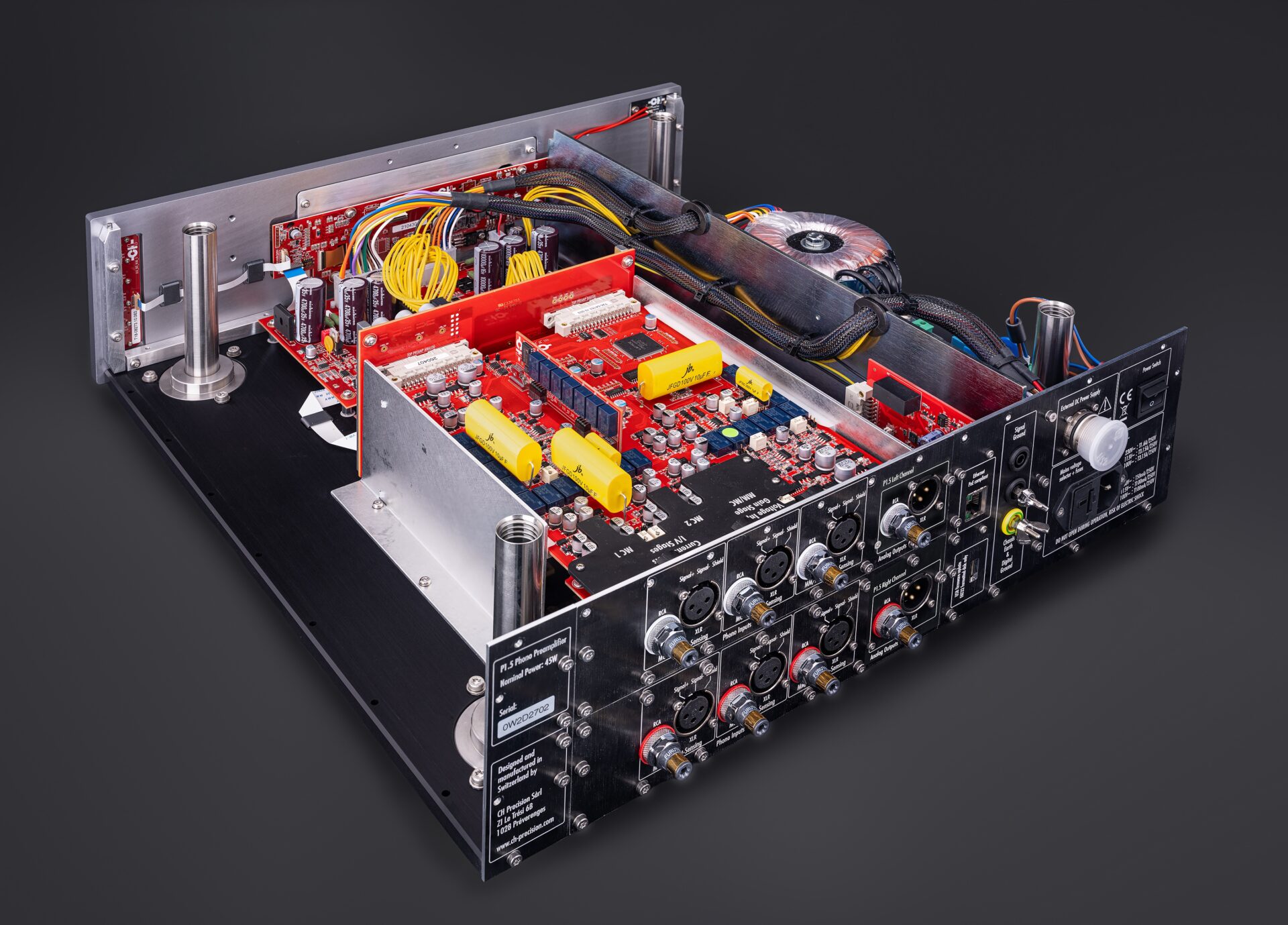
The P1.5 also adds the switchable absolute phase and mono facilities, previously only available on the L1. But being a phono-stage, CH has further optimized the mono mode with three settings, optomised for stereo cartridges playing a mono disc, twin-coil mono and single coil mono cartridges. Best of all (and I can’t believe I’m writing this, given my antipathy to all things remote control) the P1.5 is now IR remote capable, the small hand-held controller allowing users to select EQ curve and phase (as well as other things) from the listening seat, without network connecting the unit and employing a tablet.
Against that operational laundry list, the changes incorporated in the L1.5 might seem less than impressive, as the unit stays functionally identical. But the topological changes to the circuit and the board layout promise to be musically fundamental – just as they proved with the L10. The big changes in the circuit revolve around new, diamond input topology derived directly from the 10 Series, the elimination of global feedback and improved DC regulation.
In both cases, upgrading an older unit demands the replacement of not only the two main left/right circuit boards, but the back-plane to which they connect and which transmits functional commands and DC feeds, as well as the display. By the time you’ve removed the original parts from a P1/L1 chassis, you are pretty much left with the base-plate, the power supply and the space frame that supports the input boards – and an awful lot of Torx-head machine screws. Like I said, this goes way beyond a simple board swap…
