

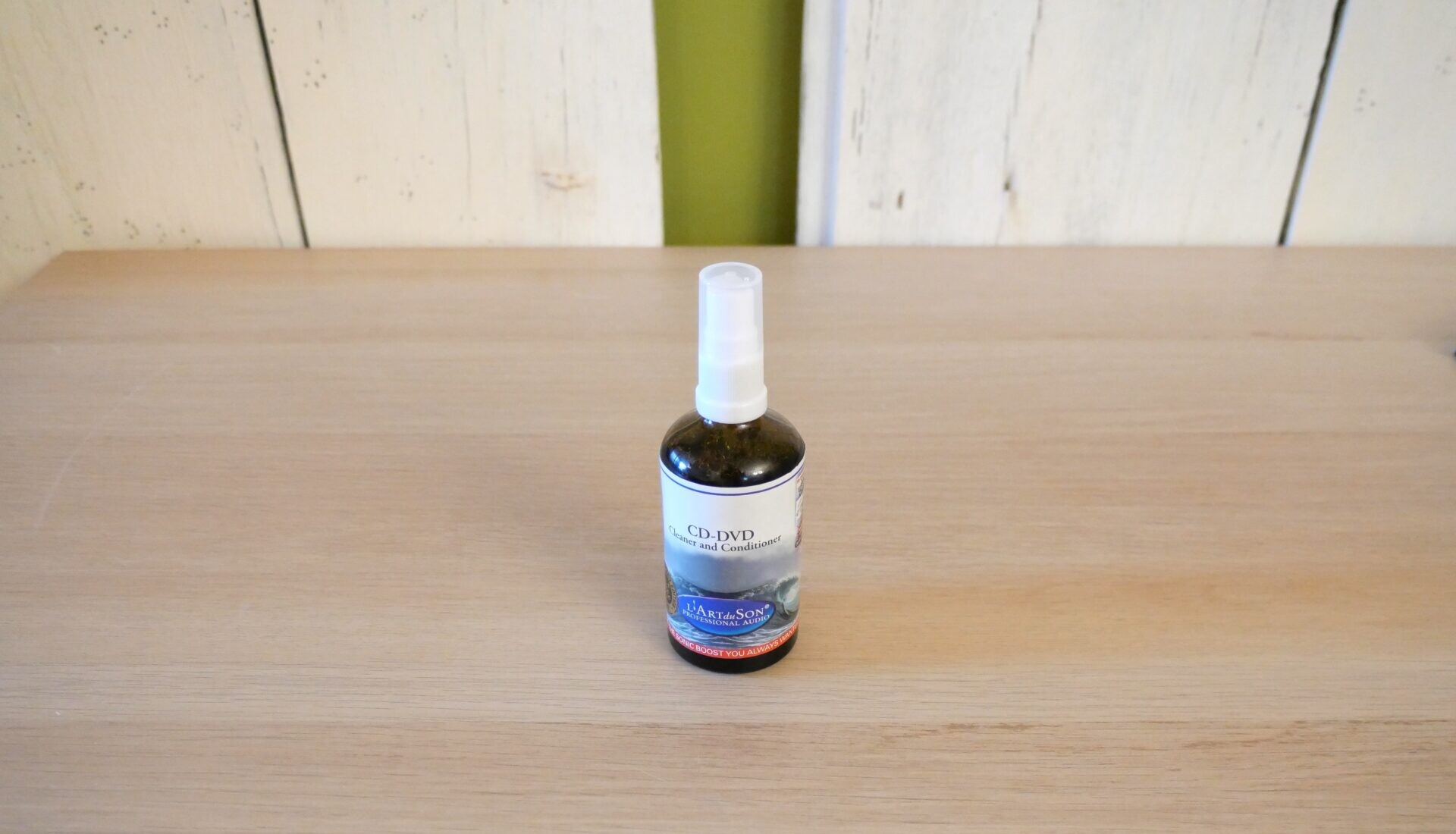
The record cleaning concentrate was followed, in 2004, by the optical disc cleaner and conditioner that I’ve so recently rediscovered. Supplied in a small spray bottle, buy some and you’ll be parted from around €50, although, despite the low volume of fluid contained, each bottle should clean around 300 discs. The process itself is perfectly straightforward. Spray a small quantity of the fluid onto the surface of the disc and then use a finger to rub it all over both sides, before wiping it off with a soft micro-fibre cloth or, as Ms. Schöner recommends, a Kleenex paper tissue. When drying the disc use gentle, radial strokes, working from the centre outwards – and that’s it. The disc is ready to play. Just avoid cleaning clothes or paper towels that are in any way rough or abrasive, as they’ll leave radial scratches on the disc’s surface.
Compared to an untreated disc, what are you going to hear? I’ll use the track ‘Strike The Viol’ from the Christina Pluhar/L’Arpeggiata disc Music For A While (Erato 08256 463375), with its mix of voice, percussion and acoustic instruments. Impressive enough straight out of its jewel case, with its lively dynamics, musical energy and presence, cleaning the disc brings order, detail, subtlety and a far more convincing presentation. Right from the opening drum beat, you are more aware of the texture of the skin and the volume of the instrument. The soundstage is more expansive, separation and dimensionality both significantly improved. Raquel Andueza’s voice is more focused, more articulate and significantly more natural. Tonality and articulation are improved across the board, but particularly as regards the vocal and the solo clarinet, where the fingering and the shape of the lines is far more explicit and expressive. In fact, natural and expressive are the two words that best encapsulate what is a genuine musical transformation. The band are better spaced but musically tighter, instruments are more identifiable with more natural timbre and texture, the whole performance more immediate, more organic and more expressive. Andueza’s vocal gymnastics are less forced and even more remarkable.
Nor is this result untypical. You can expect a similar lift in musical presence and communication whatever the disc, whatever the genre. The horns on jazz recordings gain a pristine clarity and purity, the drums on rock recordings, texture, volume and pitch. Guitar lines are more precisely etched, pianists more sensitive and articulate. It’s a simple case of releasing more of what is on the disc, more easily – thus making the player’s job that much easier and the results that much more natural. On the Wadax or CH, the benefits, once heard are impossible to ignore, but even on more modest players, they are still substantial.
When L’Art du Son refer to the fluid as a conditioner, they’re not kidding. The liquid actually acts on the polycarbonate surface to improve the optical impedance and cut down reflective and diffractive affects. That makes it a long-lasting treatment and, although the cleaning aspect is also significant, this is not a step that demands repetition. Like the lathe, it’s a one-time thing – at least unless your disc gets unusually filthy, at which point a second go-round might well be necessary. One thing that is worth noting, is the specific interaction with polycarbonate: that means that although the fluid will clean the surface of an SHM disc, it won’t have the same impact in terms of improved optical performance – although that’s the schtick with SHM discs anyway!
