

While the Kan still divides opinion to this day, modern drivers, measurement techniques and materials mean that we can apply its lessons without the same, potentially crippling compromises. Small cabinets are inherently stiffer and less resonant than ones that use larger panels. They weigh less too. That means that they store less energy and the energy they do store is released at higher, less musically damaging frequencies. Two-way crossovers are far easier to engineer than three-way, generally offer the driving amplifier a more benign load (and an easier time), while it’s also easier to seamlessly combine smaller drivers than really big ones. The limited bandwidth of smaller speakers is obviously a limitation, at least in absolute terms, but brings its own benefits in the real world, in terms of easier low-frequency matching to rooms, making it considerably easier to maximise system performance. There’s a lot of generalisations in there, as well as the assumption that smaller/cheaper speakers tend to be boxes, but there is also enough push in the direction of compact two-ways to put meat on the bones of the argument.
All of which begs the question, why has the audio community turned its back on compact, two-way loudspeakers? Two-way ‘bookshelf’ designs used to be the single most common speaker format: now they’ve all but disappeared at anything but the lowest price points – an apology until you can afford a ‘real’ floorstander. But like a lot of things in audio, we seem to forget more than we learn. We’re too quick to dismiss stand-mounted speakers and a number of new models winging in from left-field are serving as a timely reminder of their strengths, to anybody who cares to listen.
Current thinking…
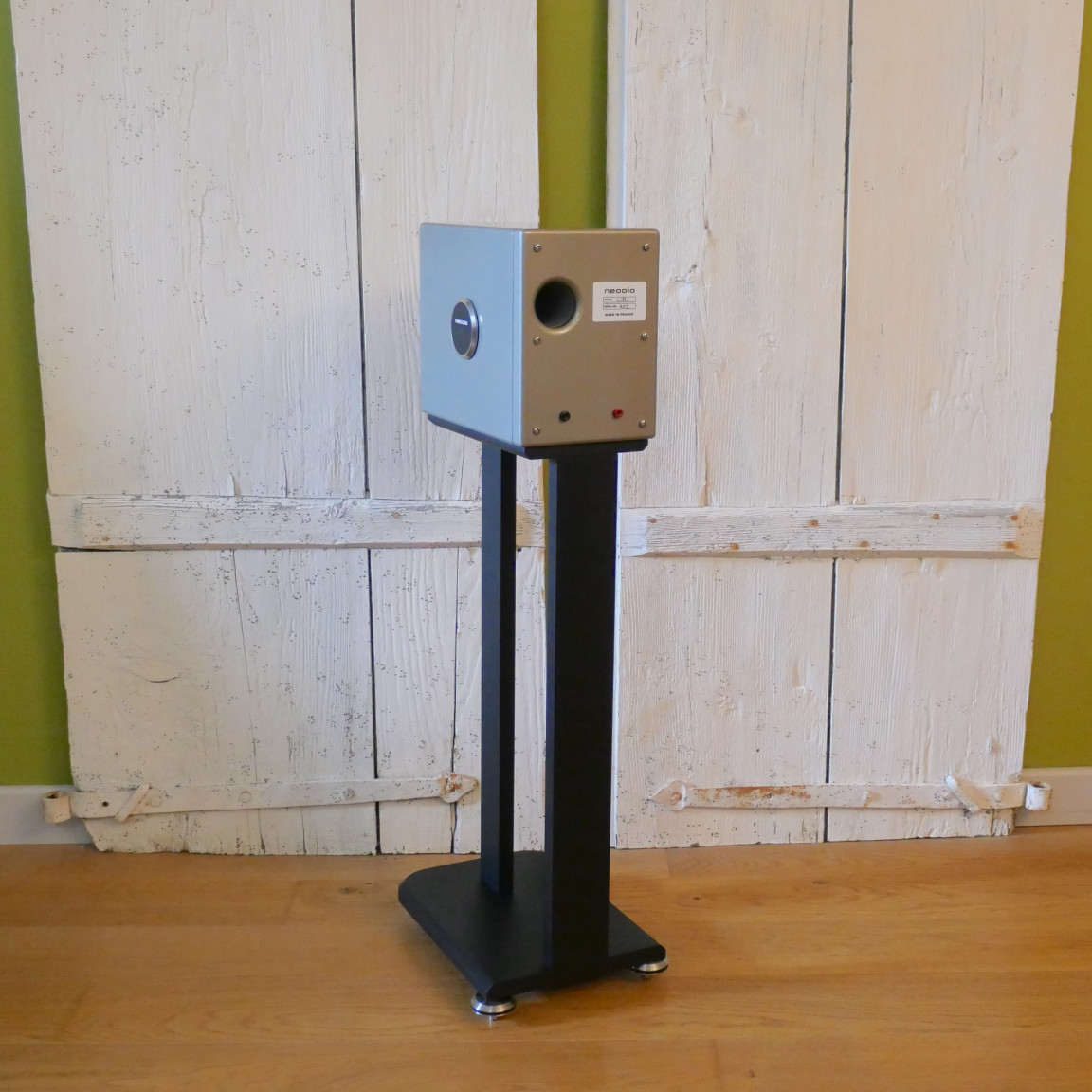
If there’s a spiritual successor to the Linn Kan, it’s Neodio’s Lilli loudspeaker. A true miniature that embodies much the same design path and many of the same priorities as the Kan, Lilli is in many ways, a modern equivalent to the iconoclastic Linn model – albeit one that opts for different solutions, different materials and different technical compromises. Sit the two speakers side-by-side and the differences are stark. Listen to them and, although they sound quite different, their musical strengths are surprisingly similar.
I covered Lilli’s vital statistics in detail in an earlier piece https://gy8.eu/blog/neodios-lilli-loudspeaker/ but the salient points are the two-way topology, critically damped, thin-wall (but thick-baffle) cabinet, simple 2nd order crossover and physically time-aligned drivers. There are also matching, low-mass stands. The ultra-long-throw bass driver and the length of the reflex port produces low-frequency extension that flirts with 50Hz, even in a free-space location. The crossover uses quality components, but they were selected on the basis of exhaustive listening, rather than price – meaning it wasn’t always the most expensive option that proved the most successful. Perhaps more importantly (and more in keeping with the Kan) Lilli never met MeLiSSA, or any of her close relatives. She was developed entirely as a result of basic measurements and a lot of listening. The basic recipe might be essentially simple, but there’s a lot of art (as opposed to science) involved when it comes to really successful speaker design. In fact, with small speakers, it’s possible (and pretty much always has been) to get by on art alone…