

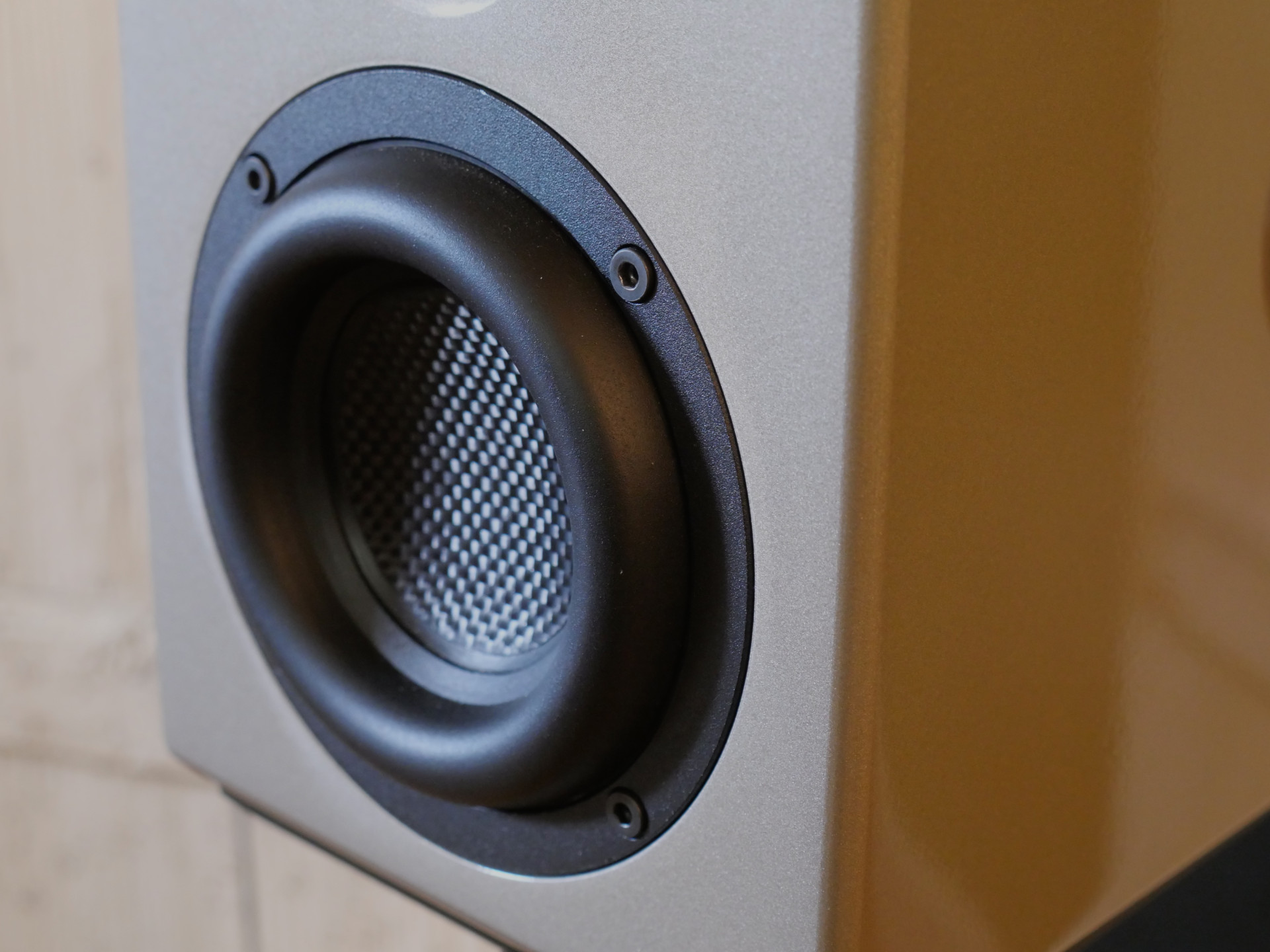
My first experience with Lilli involved listening with the price-appropriate Heed Lagrange amplifier. That was enough to convince me that there was something a little bit special and different going on within the confines of this diminutive cabinet. This time around, I went straight for higher priced, higher quality amplification, using both the TEAD Groove/Vibe/Linear B pre/power combination and the Levinson 585 integrated. She might not present a particularly awkward load, but at 82dB sensitivity, she does demand a reasonable amount of power. The Linear B’s 80 Watts with minimum GFB were sufficient for most purposes, sounding spectacularly direct and communicative on smaller scale acoustic music, most rock and pop and all but big-band jazz. But running large-scale orchestral music encoded at lower levels on SACD (the recently released Noseda/LSO Shostakovich cycle, LSO 0907, for example) more sheer beef was necessary…
Critical listening…
The other thing that became obvious from that earlier listening was just how critical Lilli is of not just partnering equipment but set-up too. You simply can’t afford to take liberties with cable consistency or the system’s house-keeping. You will hear every change you make. To that end, the optional Harmonie footers on the stands should be considered essential, while investing in Neodio’s own cables, if not obligatory, certainly helps to guarantee results. I revisited both the latest Neodio cables and the complete Nordost Blue Heaven 3 loom that I’ve been working with recently, both delivering excellent performance. I also revisited that original near-field set-up – a tight, equilateral triangle (around 2.5m on a side) with the speakers heavily toed in to cross ahead of the listener. Once familiar from the likes of the Celestion SL6/600, it’s a layout that’s rarely seen these days – another indication of just how rare compact speakers have become. Move much further away from the speakers and they start to sound start to sound less dynamic and increasingly bass-shy with distance. Up close and personal is the way to go with Lilli, letting her draw you into her sound-field.
Talking of sound-field, it’s a good place to start with this little speaker. Listeners are fond of talking about the superb ‘imaging’ of mini-monitors. Yet this is both a ‘thing’ and a misnomer. Looking at Lilli in situ, with her incredibly narrow front baffle and acute toe-in, it should come as no surprise that she throws images outside the width of the speakers. However, close your eyes or, better still, switch off the lights and you will be surprised by just how wide that soundstage is – and how completely the speakers disappear within it. In fact, it’s as surprising as it is occasionally startling. At Stéphane Even’s suggestion, I also hooked up the Lillis to the TV system, driven by a Cyrus/PSX amplifier. He sees AV applications as a serious secondary use for his little speakers and, having experienced just how intelligible they render even modern dialogue (with the current fashion for actors who mumble and murmur) let alone how real incidental sound effects appear, beyond the confines of the screen/system, often outside the room, I can understand why. Items being dropped, doors opening, knocks and bangs all have a remarkable presence and are readily identifiable. So much so that you need to be careful how widely you space the speakers in this context, or the spread distracts from rather than adding to the on screen events. While the little Neodios might come up short on major explosions or train wrecks, if you are watching more cerebral material, they really elevate both individual performances and material as a whole.