

It’s a quality that carries over to musical programme, but also one whose contribution needs to be examined or understood. Back in the TEAD-based set-up, play Steve Dawson’s ‘Sweet Is The anchor’ (from the album of the same name, Undertow RecordsCD-UMC-028) and the quiet count-in that precedes the opening piano chords is way, way left, its distant nature matching its location. The spread of incidental sounds, studio announcements and the pitch note that run into Buddy Holly’s ‘True Love Ways’ (From The Original Master Tapes, MCA DIDX-203/MCAD-5540) are separated, precisely located and spread across the wide soundstage. The tape ops and control room are clearly separate, each with their own PA speaker, the band and strings/sax, disposed within a single space, with their own conductor. It’s not that I’ve never heard these details before. It’s just that Lilli makes them so much more apparent. It’s this effect that bears examination.
“Imaging? I want to know why the musicians are on stage – not where…”
Soundstage, image specificity and acoustic space/dimensionality tend to get collapsed into a single performance category – ‘imaging’. However, in reality they are quite distinct, if related, qualities captured in the recording and reproduced by the system replaying it. Of course, not all recordings are created equal – and not all systems are equally capable of reproducing them. Let’s start with sound-staging – the ability of a system to recreate the layout (width and depth) of the musicians making the recording. Image specificity defines how precisely you can locate a sound-source, in space and distinct from other instruments or voices. Dimensionality is all about the physical volume of instruments or singers, the air and space around and between them, the space in which the performance as a whole takes place – including side and rear walls, the height of the space and the floor or any staging. A really convincing 3D rendition requires all three aspects of spatial reproduction working in concert. More often than not, a system offers partial but uneven presentation of all three. Most systems manage a reasonable lateral spread, but image specificity is a rarer quality, while a natural and coherent sense of depth and dimensionality are unusual, the latter dependent to a large extent on system bandwidth. So, it should be no surprise that while the epithet “images like crazy” might well be applied to Lilli, that ‘imaging’ is largely confined to width and specificity. The depth dimension is slightly flattened (even with considerable attention expended on toe-in angle) while dimensionality and acoustic space really don’t feature at all. In that last regard, she’s exactly like most other compact speakers – but when it comes to locating and separating performers and instruments, she’s up there with the best. Which helps explain the explicit nature of her musical presentation.
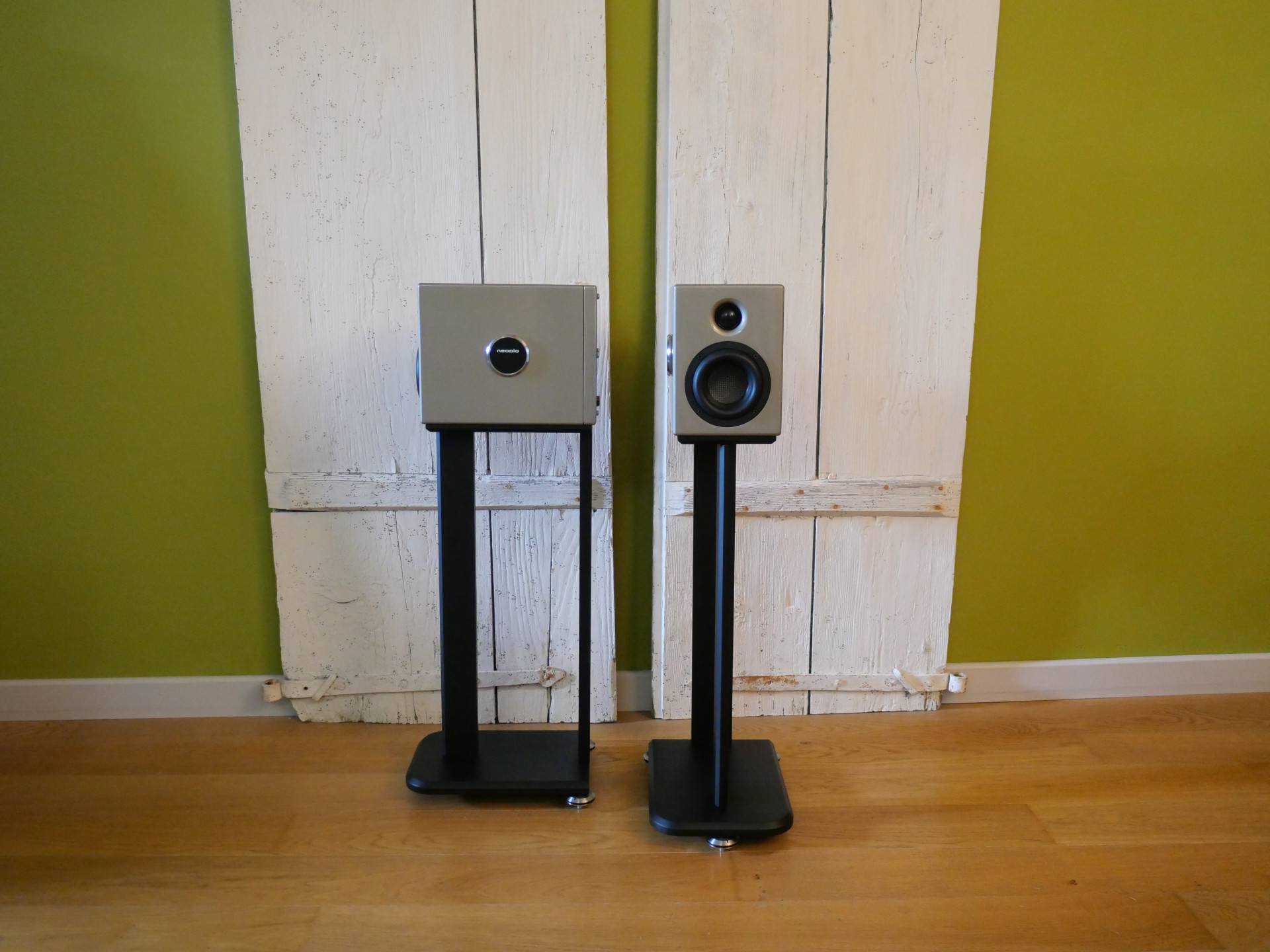
But there’s more to Lilli’s sense of musical clarity and purpose than just lateral separation. The perennial problem of box speakers is stored energy. The drivers vibrate to generate acoustic output, but that output has an equal and opposite equivalent that is projected into the enclosed air volume and, ultimately into the cabinet structure itself, along with direct energy bled from the driver baskets and motors. That mechanical energy either has to be dissipated by the box or it finds its way back into the drivers, where it muddies and confuses their output. There’s no box like no box, but that leads to no bass either, at least in small speakers. But if you have to have a box, the smaller it is, the easier it is to control its rigidity and behaviour. Boxes don’t come much smaller, or better behaved, than Lilli’s – at least, not unless you are going to spend vast amounts on exotic materials or complex composite structures. Neodio takes the inherent benefits of those small panels and improves their mechanical performance still further with thoughtful construction. Thick front and rear panels provide a firm launch pad for the drivers, thin walls store less energy while the polymer damping discs on either side help dissipate what does enter the cabinet.