
How do shows count their visitors – and should we care?
By Roy Gregory
After every show, members of the press can expect a missive that can generally be filed under fiction. The elements are utterly predictable: a clarion call claiming “another outstanding event”, a few quotes from exhibitors or visitors and a set of numbers (rooms/exhibitors but more importantly, visitor numbers) that are always slightly higher than the previous event. It’s a cycle that reached its nadir with the numbers published for this year’s Vienna Show, the predictable claim of “more visitors than Munich” a jarring contrast to the actual experience of wide open, uninhabited spaces/corridors and rooms that you could walk into at will. In the light of this “Who’s kidding who?” alternative reality, the recent post-Warsaw release from organiser Adam Mokrzycki made interesting reading.
Below the attendance numbers and breakdown quoted for this year – all unsurprisingly higher than last year’s figures (although in the case of Warsaw, I’m prepared to believe that) – was the following “note on attendance numbers” and how different shows calculate them.
| A note on attendance figures
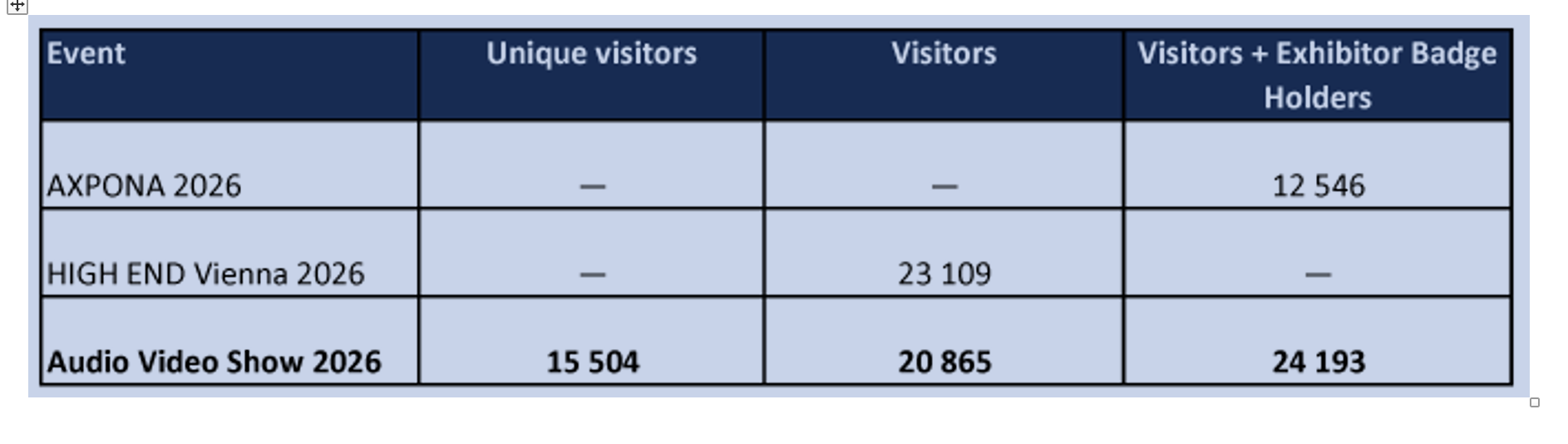
The organisers of major audio shows use different attendance reporting methods, so their published figures are not directly comparable. Audio Video Show (Warsaw) traditionally reports the number of unique visitors. Each person is counted only once, even if they attend on two or three days. This figure includes ticket holders, invited guests and accredited journalists, but excludes exhibitors. Using this methodology, Audio Video Show 2026 welcomed 15,504 unique visitors. HIGH END Vienna reports visits (visitors) rather than unique visitors. A person attending on two days is therefore counted twice, someone attending on three days is counted three times, and so on. Whenever people attend on more than one day, this methodology produces a higher figure than counting each person only once. Applying this method to Audio Video Show 2026 would give a total of 20,865 visits. AXPONA uses an even broader methodology: in addition to visitor attendance counted as visits rather than unique visitors, it also includes admissions by exhibitor badge holders. Applying this method to Audio Video Show 2026 would give a total of 24,193 admissions. The table below presents all three figures for Audio Video Show alongside the published results for HIGH END Vienna and AXPONA. |
|
|
|
| We provide this information so that exhibitors, media and partners can assess the scale of each event for themselves. A meaningful comparison requires an understanding of both the published figure and how it was calculated. |
Now, I can’t verify these statements, although the inclusion of exhibitors within visitor numbers has long been rumoured, sometimes using the ambiguous smokescreen of ‘attendees’. As a regular show goer over the years, it’s impossible to ignore the fact that events are physically shrinking, no matter how you massage or goose the numbers. Which is more important or significant – an increase in exhibitors or a decrease in rooms? There’s any number of ways that the figures can be increased: count the brands rather than the companies exhibiting them; count all the brands that a distributor represents, rather than the ones he is actually showing; ignore shared rooms, counting the exhibitors sharing the space, rather than the space itself; simply inflate visitor numbers – it’s not like anybody is auditing them! I could go on… and on…
