
 As well as the drive-units evolving and developing, the understanding and communication between the three-man design team has evolved too, with greater understanding of each members capabilities, contribution and the the possibilities that result. Ehrenholtz is quick to point out the contribution of the complex cabinet structure and internals (the work of Per Kristoffersen) while access to advanced measurements, including the Klippel system, as well as the skill and experience to interpret the results (courtesy of Karl-Heinz Fink) has been invaluable. Is the SunFyre best described as a a third generation Peak product, or as a mature Peak product? Either label applies, although I think we can be confident that there are more generational changes to come.
As handsome as the SunFyre undoubtedly is, the real proof of the pudding is in the listening and initial indications are impressive. The midrange is notably natural and articulate, dynamics are responsive without seeming forced, bass runs deep and is sure-footed. Best of all, integration is seamless and the speakers sonically disappear, throwing a convincingly coherent acoustic and well defined stage. Peak’s traditional virtues (tonal neutrality, well-developed harmonics, rich tonal colours, body and scale) remain intact and if the new speaker can’t match the impressive weight and scale of the flagship, that’s hardly surprising, given the smaller cabinet and bass drivers. It will be fascinating to see how the finalised SunFyre performs in a larger space, starting in Vienna where it will be playing on the end of a CH Precision D10, C10, T10 digital front-end, the L10/M10 amplifier and the Innuos Nazare/Flow streamer (with direct, HD-Link to the C10).
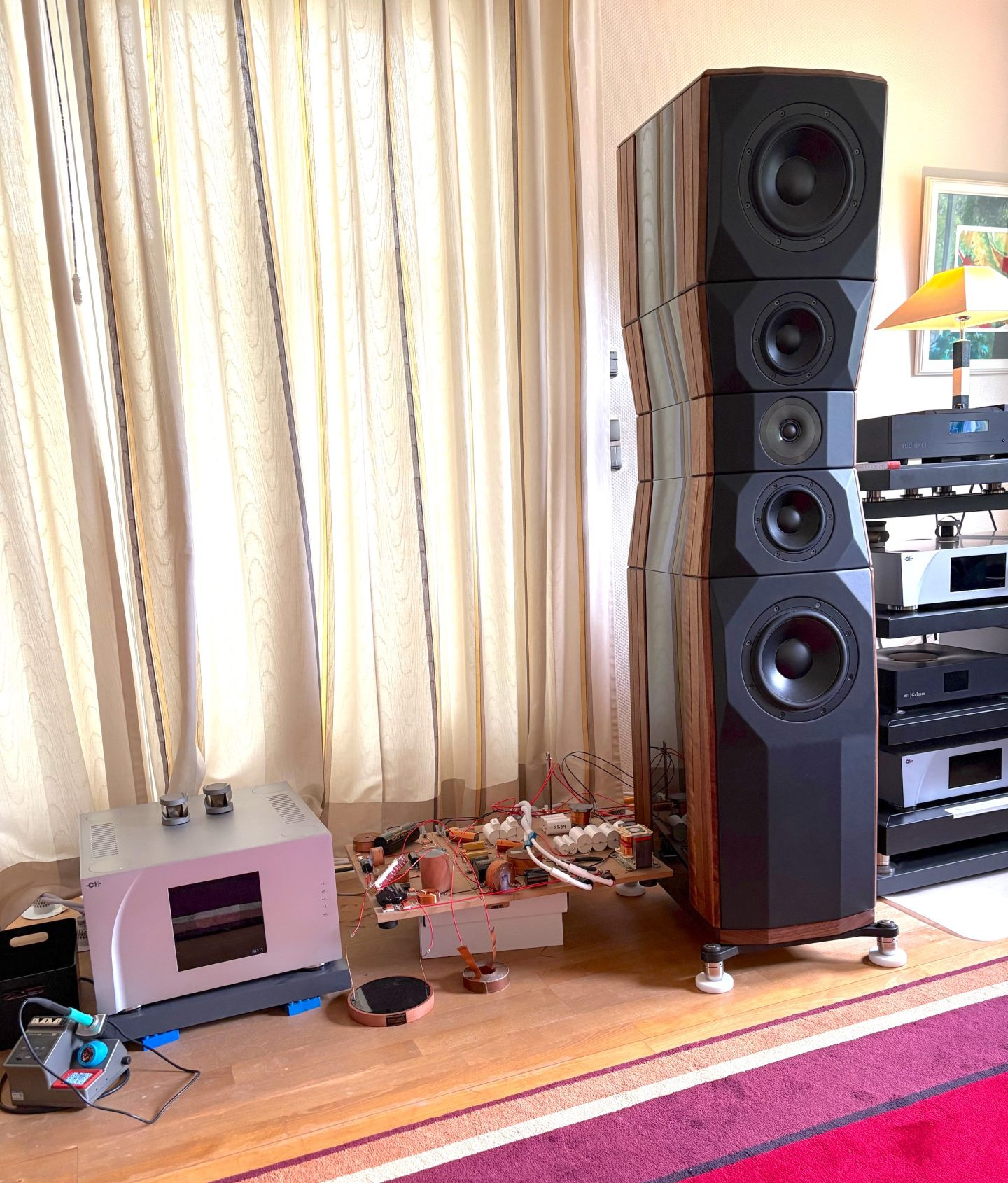
But perhaps the most interesting news of all is that, in developing the SunFyre specific drivers, Peak also took the opportunity to create system-specific versions for both the El Diablo and Sinfonia. Outwardly indistinguishable, I’ve had the new Sinfonia at home, alongside the original model and the improvements in clarity, transparency, articulation and dynamics are not subtle. The bass performance is particularly impressive, a combination of the new driver and improved port configuration. I’d expect a similar jump in performance from the El Diablo, which given the larger speaker’s already impressive sense of scale and dynamic response, should prove very impressive indeed.
Not as impressive, however, as the fact that existing models will be updatable. This will be a factory upgrade, which means returning the speakers to Peak, but you’ll get the new drivers, new crossovers and ports, as well as a new serial number to reflect the update. Price will be around €12,000 for both the Sinfonia or El Diablo, reflecting the fact that the larger model’s twin bass drivers can be revised rather than replaced completely. I’ll be reporting on the new models (as well as the value of the upgrades) shortly, but it certainly seems that Peak Consult is going places – and they all seem to be in the right direction.