

And so it goes: it doesn’t matter what you play, Bach to the B52s, the recording opens out, the voices and instruments gain body and identity, the music gains sense, immediacy and a more powerful connection, be that the intricate patterns and symmetry of a baroque violin concerto or the manic rock rhythms of Athens’ finest. As per previous experience I tried the second pair of B2 Orange in various locations – under the speaker cables, on top of CD players, power supplies and amplifiers – but the one I finally settled on was under the power strip, where everything gets the benefit. But they didn’t stay there long…
Intrigued by the B2 Orange’s clear superiority in terms of musical impact when compared to the already impressive original, I wondered how effective it might be if used outside its comfort zone. Could its (considerably) increased efficiency overcome less than ideal circumstances? I hadn’t tried the original B2 on the Göbel Divin Monarque, following its failure to make any real impression with the much smaller Divin Comtesse. Placing a pair of those original B2s on the larger speaker now, the results were much the same: a very subtle improvement in air and focus, and slightly more fluidity to the ensemble and solo playing. But you needed to listen to pick the differences, differences which would easily be swamped by aberrations in set-up or speaker positioning.
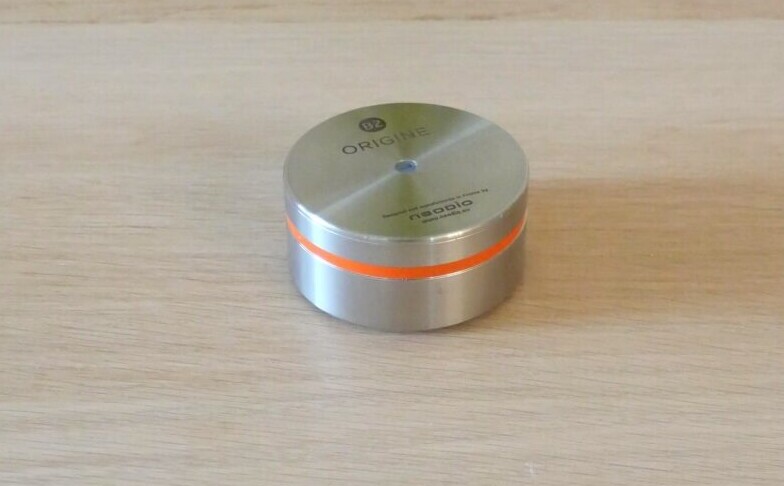
Swapping to the B2 Orange wrought an immediate improvement. Where the original B2’s impact was virtually undetectable, the Orange was very detectable indeed. Despite the melamine cabinet material, the lacquer finish, the symmetrical driver layout (which places the B2 well away from the tweeter) and the astonishingly well-behaved cabinet, the effect of the B2 Orange placed on the top front centre of each cabinet was low-key but very worthwhile, adding dimensionality, immediacy and a more natural sense of shape and flow – these last, areas in which the system already excelled. This may have lacked the dramatic gains in bandwidth, dynamic range, harmonic development and musical impact that the Oranges bring to a wooden cabinet, but the musical benefit was just as fundamental.
Playing the Batiashvili, Tchaikovsky Violin Concerto (with Barenboim and Staatskapelle Berlin, DGG UHQ-MQACD UCCG-41048) the increase in air and musical tension, the phrasing of the orchestra, the natural pace and momentum in the opening tutti all led, with a now wonderful inevitability, to the soloist’s opening phrases. It’s in the solo violin that the step up in articulation, fluid phrasing, sense of purpose and sensitivity in the playing are most obvious, elevating the quality and emotional impact of Batiashvili’s performance. The improvement in temporal integrity is not the most immediately obvious difference you can make to a system, but it is utterly fundamental to the shape and pattern of the piece being played and just how convincingly it’s reproduced.
These are not smack you in the face differences. They are all about less: less intrusion, less mechanical influence, less information loss. They are by their very nature, submerged in the fabric of the performance. But they are the difference between a very, very good system and no system. The B2 Orange seems able to strip away the last artefacts of reproduction, the smeared fingerprints of electronics and speakers, the limitations of the storage medium and replay. It seems to be able to do it regardless of cabinet material: it just makes a bigger difference that’s more obvious with wooden enclosures. It allows the system and in particular the speakers, to step from the character and limitations of recording and replay into the sense of the performance.