
In living colour…
By Roy Gregory
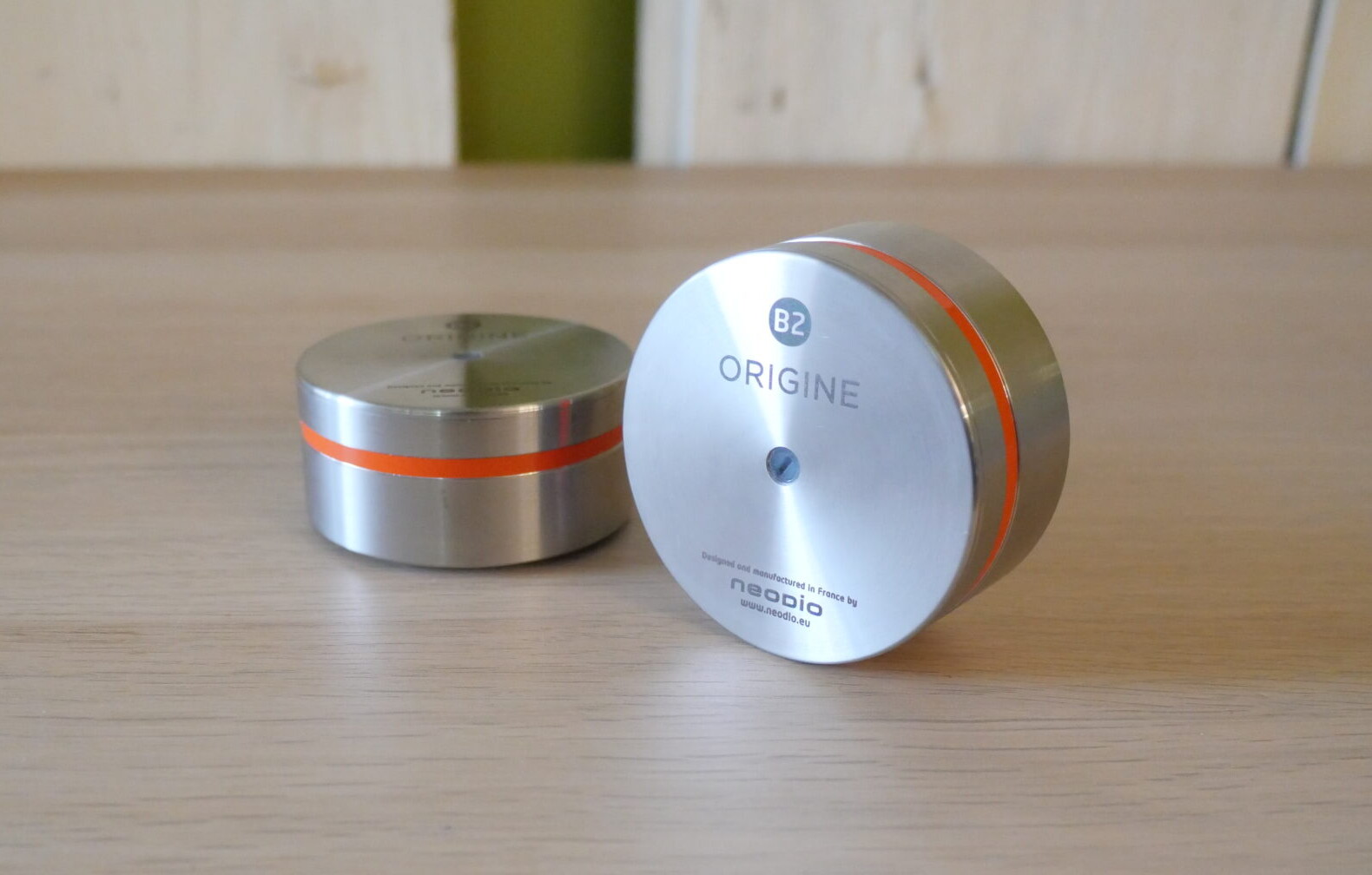
For those in the know, Neodio’s original B1/B1 Evo /B2 quickly established themselves as ‘go-to’ equipment supports/system treatments, used to control parasitic resonance in components and eliminate the distortions they generate. While originally employed solely as a footer or support product, in which role it was already impressive, the arrival of the B2 (and the equivalent, upgraded B1 Evo) with their significantly higher efficiency, not only created a significant lift in performance, it opened up a whole host of new applications. Suddenly, it became a case of trying the B2s anywhere and everywhere. The dense, dumpy, 65mm/2.5” ‘drums’ could be placed beneath equipment or on top – of a speaker cabinet, chassis or rack component. They could be placed on the floor or even on surrounding furniture or features, such as a mantle-piece between the speakers.
I covered the B2 and its various applications at length when they first appeared – https://gy8.eu/review/the-neodio-origine-b2/ . If you aren’t familiar with that report, or your memory needs refreshing, I’d recommend revisiting it to get the background and basics of using the Neodio B2s to greatest advantage. I’m not going to repeat that voyage of discovery here, save to observe two things:
Since then, the B2s have remained an ever present in the various systems that have graced the Gy8 listening rooms, but especially the Reading Room. Since their arrival, no power strip has ever touched the floor, while equipment is regularly to be seen sporting a squat, silver cylinder sat at some point on its top-plate.
Secondly, everything that applied to placing the B2 also applies to the new B2 Orange (and presumably the more affordable B2 Blue too). So, no need to describe that exploratory path again. Instead, I can concentrate on the differences between the two products and the benefits that accrue.
Despite the three different designations, the B1, B1 Evo and B2 were essentially the same product, the B2 being an improved version of the original, the Evo designation given to B1 units that had been upgraded to B2 status. Now comes the next step(s): the B2 Blue and B2 Orange, visually differentiated by the coloured bands around their circumference. The B2 Blue effectively replaces (and improves on) the original B2, with the price rising from €250 to €300 each. The Orange is a higher performance variant, priced at €450 each. They are available in sets of two, three or four. As with the previous models, there’s an M6 thread in the ‘top cap’ of each B2 and you can order them with M6 or M8 threaded adaptors. If you require a different thread, a wide range of options are available online. We received a set of four B2 Orange for review, enough to ring the changes.
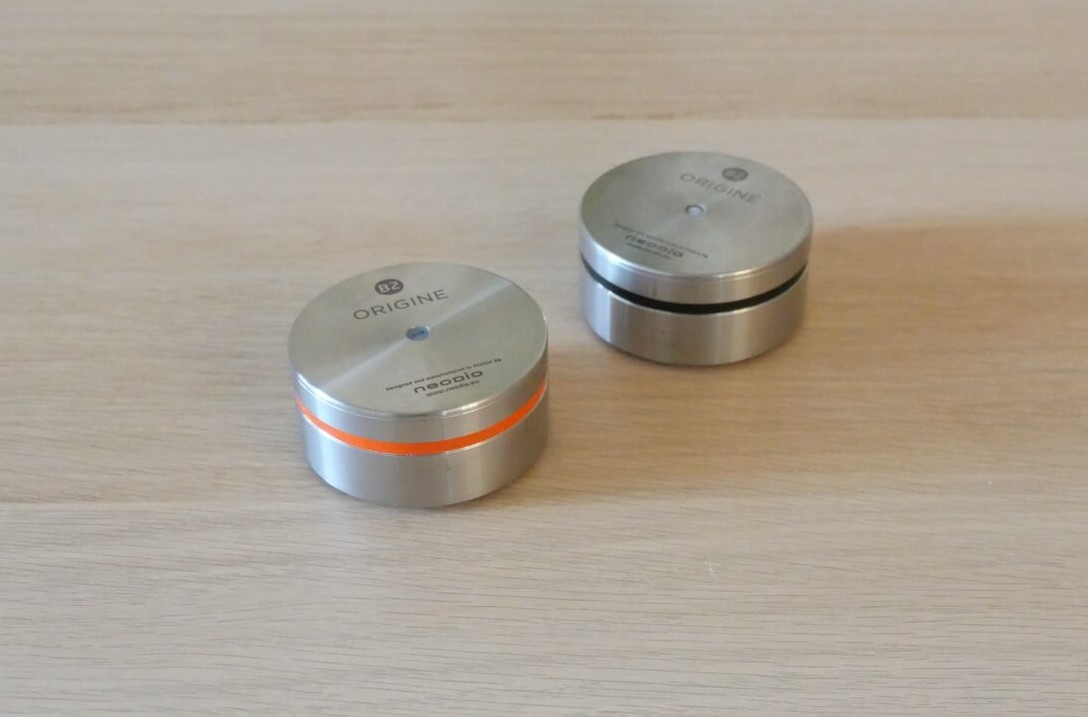
As outlined in the B2 review, placing one of the Neodio units on top of each speaker, directly above the tweeter has a pretty impressive impact on musical performance. However, the extent and nature of the benefits depends on the material that the loudspeaker cabinet is constructed from. They’re most effective on wood-based cabinets, markedly less-so on metal enclosures, while synthetic finishes such as polyurethane lacquers also minimize those benefits. The same strictures apply to the new versions of the B2, but to a lesser extent. Trials on the Göbel Monarque speakers produced a subtle but extremely worthwhile improvement in performance – an improvement I’ll return to later. I don’t have any metal-enclosure speakers in-house currently to test, but the benefits on the Göbel suggest that the increased efficiency and performance of the new B2 versions has also broadened their application.