
Adventures on the outer limits of analogue replay – Chapter 1.
By Roy Gregory
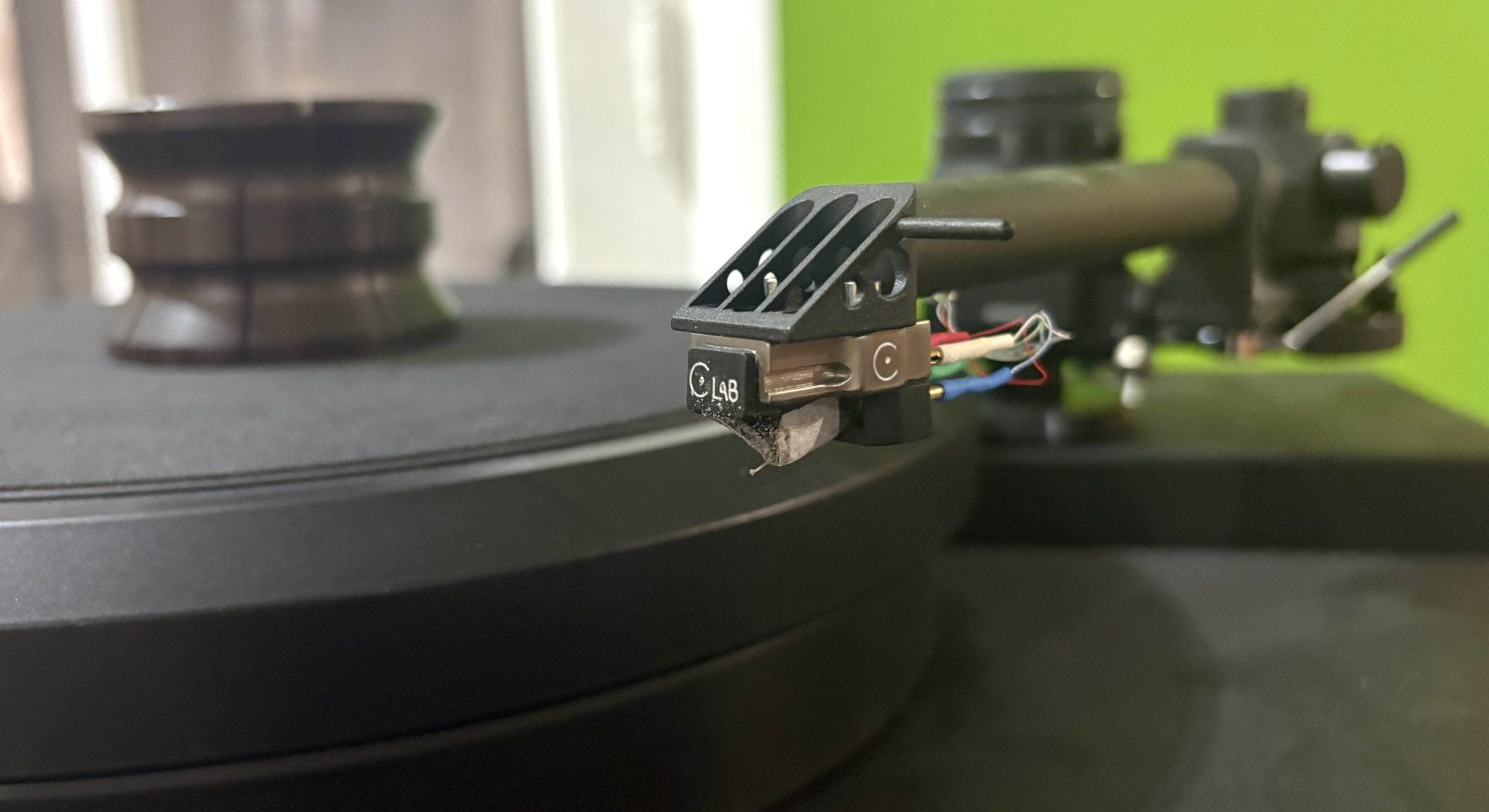
CartridgeLab (often and henceforth referred to by the rather inelegant contraction Clab) started life as a cartridge repair and re-tipping service, offered by Daniele Montebovi and based in Italy. That side of the business is covered in a number of extremely detailed case studies on the company’s website, www.cartridgelab.it. It’s a subject I’ll return to – after all, who doesn’t have an exotic pick-up in need of some serious TLC? – but it’s not the subject of this review. As well as working on other manufacturers’ products, Clab has started to produce a small range of in-house designs, including the visually striking Clab 1:32step-up transformer (with a Vacoperm core built with thin, 0.2mm laminations to prevent saturation, Heptalitz copper wire on the primary and Cardas 7N on the secondary) and the fascinating Clab ti 305 12” tonearm (with a cardan joint bearing, magnetic bias and VTA on the fly).
The business end of that replay chain is the Ebony Titanium (ET) cartridge and that’s what I’m listening to here. Clab have also provided their matching 1:32 transformer and I’ll be looking at that later, but for the moment, I’m more interested in the ET’s performance running straight into an active phono-stage. Why ignore the matching transformer – at least for now? Because it demands a high-quality moving-magnet stage to go with it and, in the case of the CH Precision P1 I’ll be using, the current-sensing inputs easily out-perform the voltage sensing input – something that CH has worked to correct in the P10. That might well trickle down to an updated P1, but as of now, it’s the current sensing stages that set the standard. With a 0.2mV output and 4Ω internal impedance, the Clab’s a shoo-in for the current-sensing input on the P1 (set to 25dB gain), while its output and €8,500 price-tag pitch it head-to-head with the Lyra Etna Lambda SL. Given that Lyra’s Etna has long been a serious sub-10K benchmark for cartridge comparisons and, given that once you reach this price level, cost is absolutely no guide to quality or consistency, the Clab ET is potentially both highly competitive and facing stiff competition.
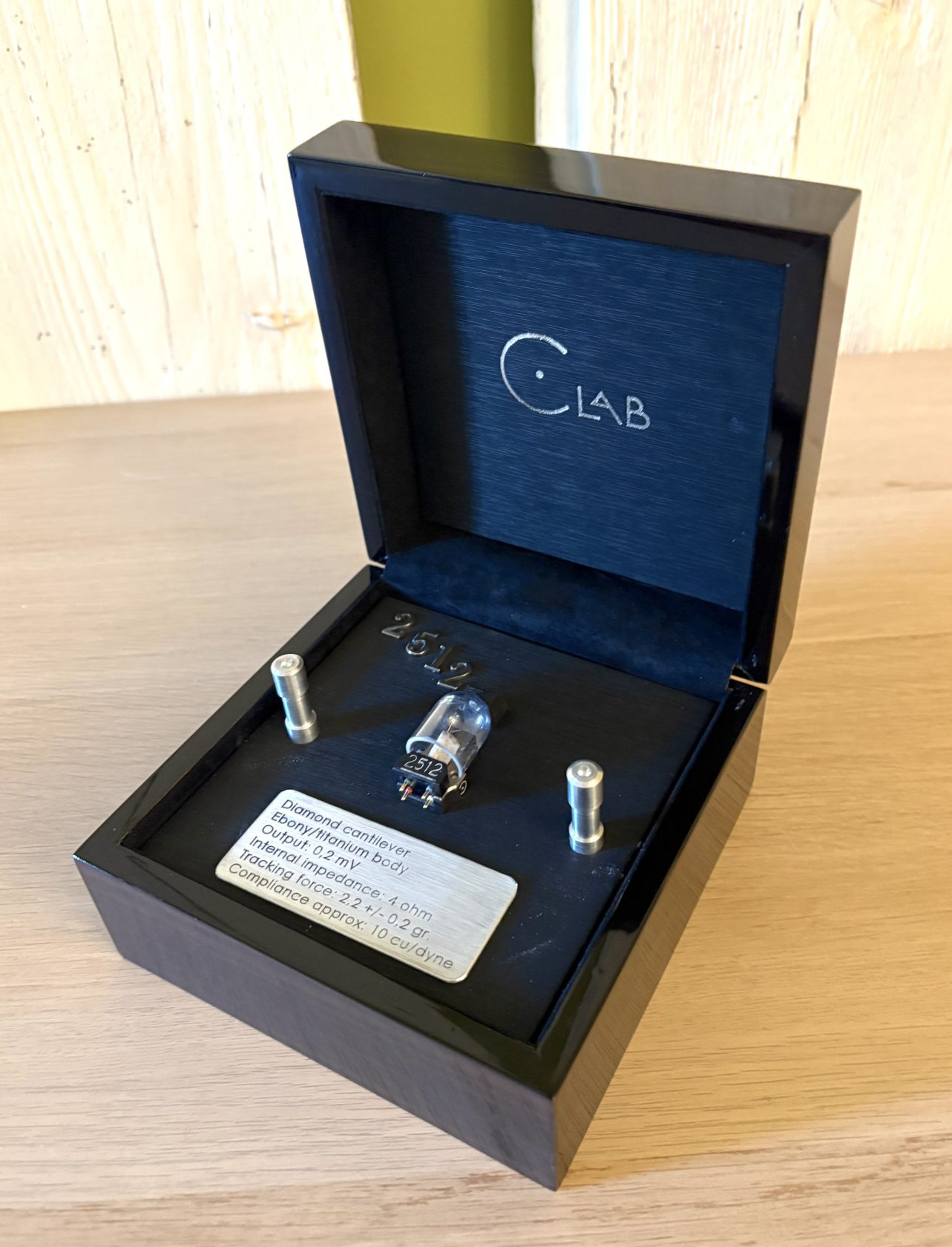
As I’ve already mentioned, the Clab ET uses a machined from solid titanium top-plate, threaded to accept mounting screws and combined in this case with an ebony ‘nose’ and mounting block for the connection pins, the two dissimilar materials chosen to provide mutual damping. The ET is an open-plan cartridge, again similar to the Lyra, but the thick top-plate provides both a substantial mechanical foundation and something to get hold of. Front-entry slots accept a well-designed stylus guard (too many stylus guards are themselves a significant threat to cantilever well-being!) and the ET is a cartridge that can be handled with confidence.
The generator uses an unconventional arrangement of two, rare-earth magnets to deliver a consistent magnetic field. It is driven by a diamond cantilever fitted with a 3×70 micron micro-line stylus (although a one-piece diamond stylus/cantilever is also a cost option). Compliance is 10cu and the cartridge mass is 15g, making it an ideally match for medium to high-mass tonearms. I installed the ET in the same Kuzma 4Point11/Stabi M that I use with the Etna Lambda SL, using the same UNI-DIN alignment, the interchangeable arm-tops making direct comparisons possible. The ET’s stiff suspension preferred minimal bias and a tracking force a shade higher than 2.35g, the final setting as always arrived at by ear, rather than with scales. The required azimuth adjustment was reassuringly minimal, suggesting excellent manufacturing standards – not always the case with the micro-engineered marvel that is the high-end moving coil.