

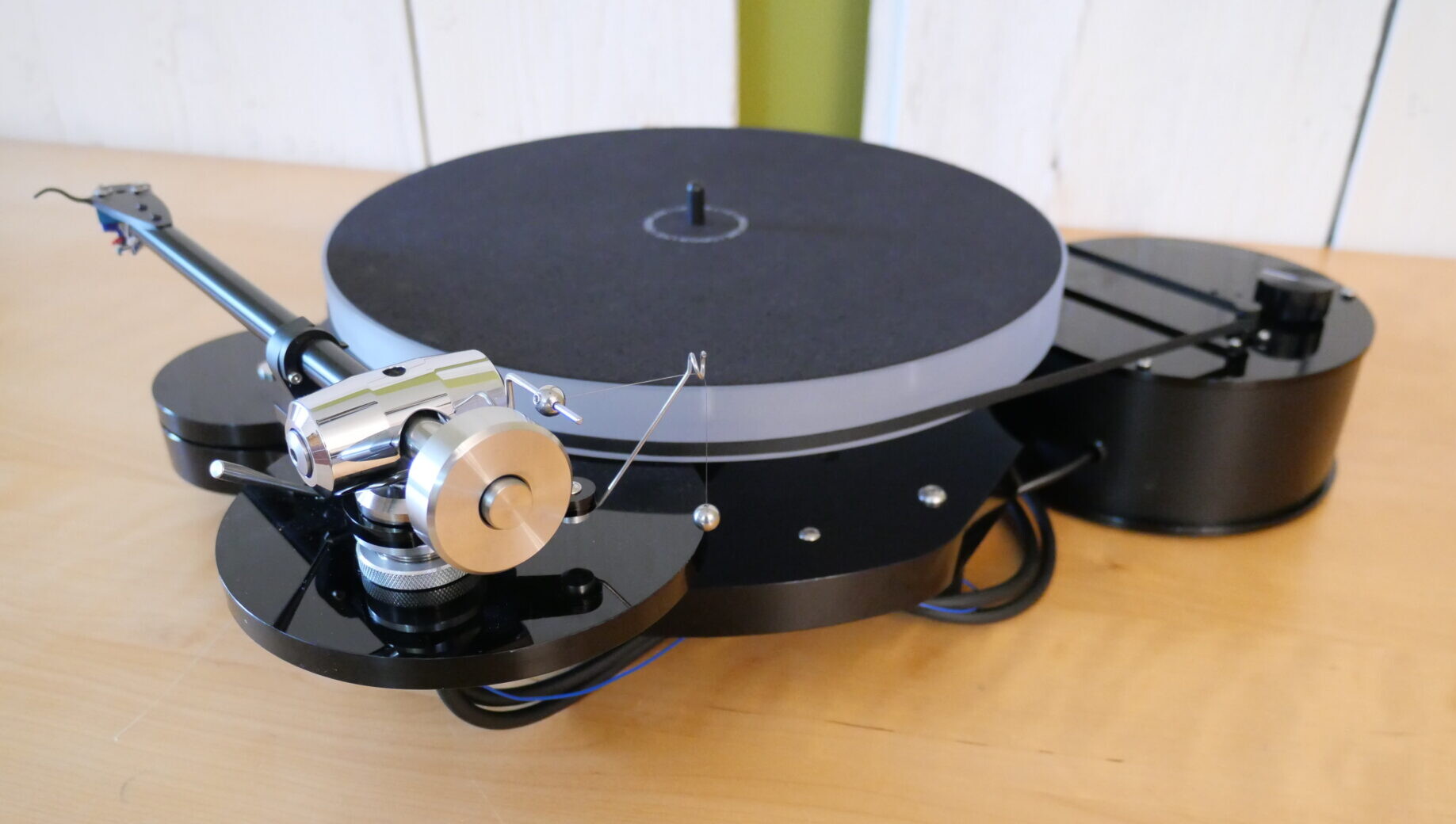
Roll those things together and you’ve got an impressive all-round performer, one that’s equally at home, irrespective of the musical genre. Play the Hyperion vinyl release of the Mendelssohn Violin Concertos (Alina Ibragimova, Vladimir Jurowski and the OAE – Hyperion LPA67795), but rather than the popular and undoubtedly familiar E Minor, flip to the B Side and the juvenile D Minor Concerto, with its rapidly changing musical landscapes and contrasts. It’s an excellent performance and recording of this seldom heard work, one that deserves far more attention. Jurowski delivers his normal, deft direction, the ensemble playing is excellent and the orchestra really respond to the uninhibited brilliance and Joie de vivre in the young Ibragimova’s solo performance. The ‘table really captures the way the orchestra leans into its supporting phrases, with their short, sharp, rising lines, instilling vigour and energy into the music. The sudden shifts in instrumental density and intensity are traversed with a practiced ease that fastens attention on the music rather than the record player struggling to replay it. But it’s the astonishing agility and articulation in Ibragimova’s playing, the almost physical sense of her bowing, that really impresses. Cut to the closing Allegro and marvel at the poised purpose and direction in the playing, the back and forth within the score, but the humour and vitality too. This is a soloist and an orchestra who get the joke and – as they say – in comedy, timing is everything.
By now you might be thinking that the Aurora/Zephyr is a perfect record player – which, if true, would leave OL’s more expensive offerings with a bit of a problem. In practice, it’s not hard to find fault in the record player’s presentation – at least, not in absolute terms. It lacks the resolution and separation, focus, precision, super low noise-floor and instant dynamic response of a really top-flight digital solution like the CH Precision D10/C10 with all its bells and whistles (and a price tag that’s 100 times the size!). It doesn’t give you the bandwidth, dimensionality and sheer scale that you get from the best front-ends, analogue or digital. It lacks the sort of reach-out-and-touch clarity and immediacy that comes with the GPA Monaco turntable. Like I said, the short-comings are there. But you need to go looking and that’s the point. For all its limitations, once you start a record on the OL ‘table, it SOUNDS complete, a master class in covering its tracks.
Settling in…
So, what allows this record player to get away with its limited performance envelope and lack of ultimate resolution? Why don’t we notice what it doesn’t do, rather than enjoying and connecting with what it does? Because it makes the most of the information it does have. It might not project the whole musical pattern, but what it does project is in the right place, at the right time and overall, it’s in proportion. In other words, the pattern might not be complete, but what there is, rather than distorting the whole, makes it easier to fill in the blanks. In this regard, temporal security is absolutely key, both in the way our hearing reacts to timing cues and in the way that stereo systems work. Both depend on time and phase information to recreate a spatial location. The problem is that the reverse is also true. While we don’t need perfect imaging to produce an enjoyable performance from a stereo system, if the time and phase information is shifted or distorted, then it moves energy sources within the sound-field and pulls it out of shape – impacting the musical pattern and our ability to recognize and reconstruct it. Ever wondered why mono records (and old-style table radios) sound so rhythmically tight and musically engaging? That would be the absence of time and phase error…