

Weighing in at £1,750 (inc. sales tax) the Aurora might be the most affordable in a line of six ‘tables, but it’s hardly bargain-basement money. Instead, it’s a considered choice in the quest to discover just how much musical performance you can extract from a soundly designed and solidly engineered record player – and just how good a system you can build around it. You might be surprised by the answers…
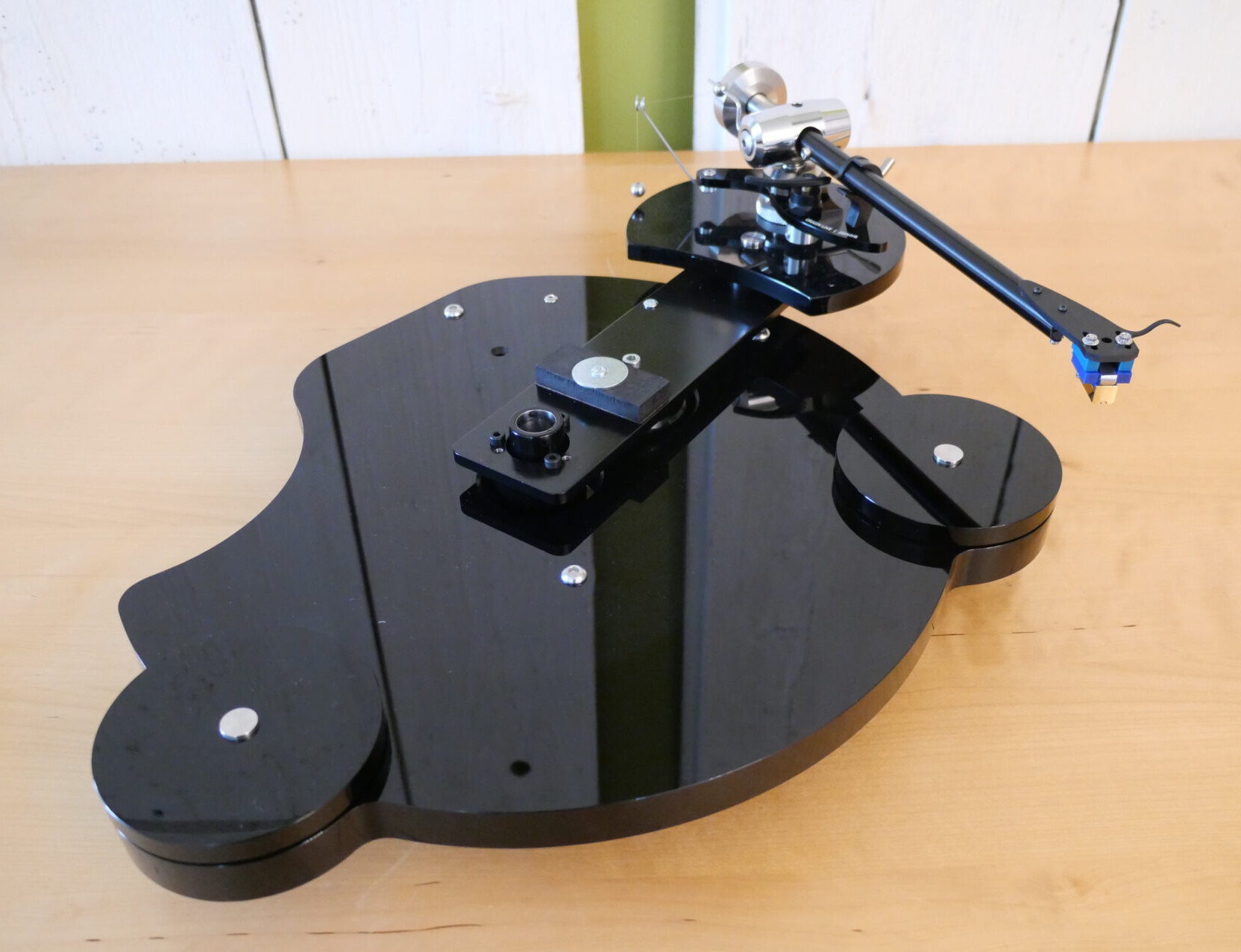
The first thing to appreciate about the Aurora is that, despite appearances, it’s construction and engineering is surprisingly complex. The two, circular bosses that decorate the front of the plinth are somewhat misleading – especially if you are expecting to find the turntable’s feet beneath them. The three, adjustable feet are actually inset and arranged around a de-coupled beam ‘sub-chassis’ that’s inset into the acrylic plinth, balancing the main-bearing/platter at one-end against the armboard and tonearm at the other. The beam can be ordered to suit a 9” or 12” tonearm, is fixed near its midpoint to a damped boss and has an additional damping block fixed to its upper surface. Or, you can order a twin-tonearm board, mounted in the same way, which will accept two 9” tonearms, placing one arm further forward and the other across the rear of the deck.
The main bearing consists of a large diameter standing shaft running on a tungsten carbide ball. It’s an unusual design in that on initial insertion you might feel a small amount of play between the shaft and its sleeve. That’s because its’s a non-pressurized, hydrostatic or oil-bath design, intended to reduce noise through minimizing physical contact. The spinning platter is essentially stable – like a spinning top. Any tendency to tilt or wander is constrained by the thin layer of oil that sits between the shaft and sleeve, a solution that promises far lower noise than lateral thrust-pads or collars, irrespective of precision or material used. It does mean that you have to get the right amount of oil in the bearing to achieve minimum noise without messy leakage or overflow. The deck comes with simple but comprehensive instructions on this (and the other niceties of set-up).
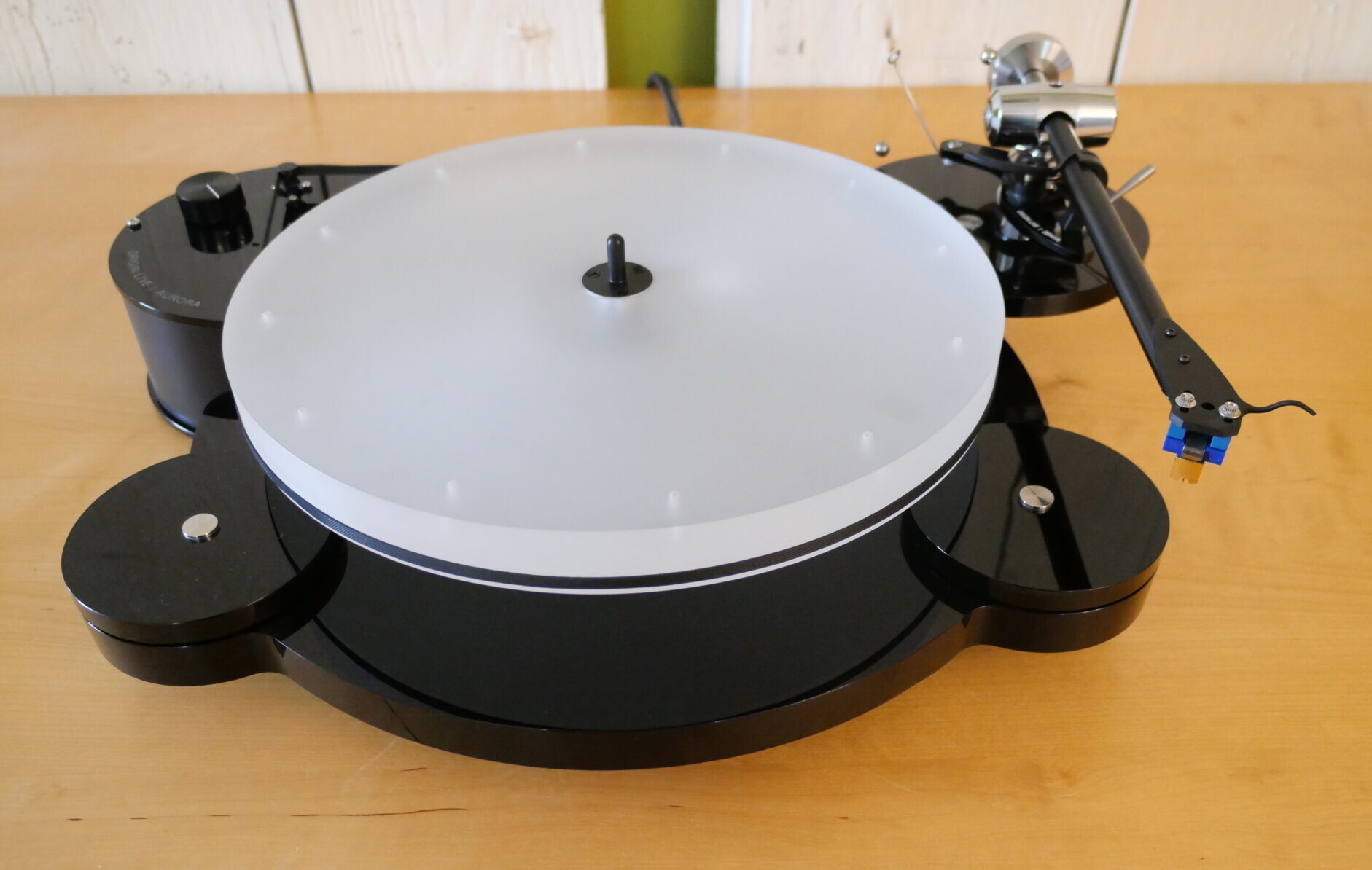
The bearing is securely bolted to the frosted acrylic platter which is topped with a separate, flexible mat. Record mats are something of an OL specialty (https://gy8.eu/blog/origin-story/ ). This one is no exception. Where many basic decks rely on felt discs of various types and thickness, OL’s Classic platter mat uses a smooth, cork-rubber composite material – another example of the company’s obsessive investigation of different material properties. Interestingly, one of their most successful and popular products is the Strata Platter Mat – a more sophisticated, composite design that (at least appears) to bond the material used in the Aurora mat to a stiff sandwich formed by combining two different materials. That’s an option I’ll be visiting down the road, but in the meantime it’s worth noting that the next model up the range, the Swift, is differentiated by a multi-layer platter – which consists of the multiple different material layers fastened to the Aurora’s acrylic component. In fact, look at the Aurora platter and you’ll notice a ring of peripheral drillings – just waiting for the mat’s fixings. These prevent the layers from rotating horizontally, but leave them loose vertically.