

The Trilogies’ solid sense of stability leans into the amplifiers’ spatial presentation. In the same way that they bring the disparate and disjointed elements of the Sibelius together, they bind separate strands in the music rather than pulling them apart. Where some, super high-resolution and ultra-detailed amplifiers (and disc players) end up dismantling the music, presenting the performance like an exploded view of some complicated machine, destroying its internal connections and relationships along the way, the 914/994s present a solidly contiguous picture. This is one of those amplifier set-ups that separates tonally, as much or more than spatially. It’s a mid-hall balance. The stage is broad, the perspective natural and the acoustic tangible, but the instruments are presented as musical energy rather than discrete point sources and pinpoint locations. Instrumental identity is never in question, due to the amplifiers’ natural tonality, but if you crave big orchestras and intra-instrumental space then look elsewhere for your amplifiers (and buy front-row seating for concerts).
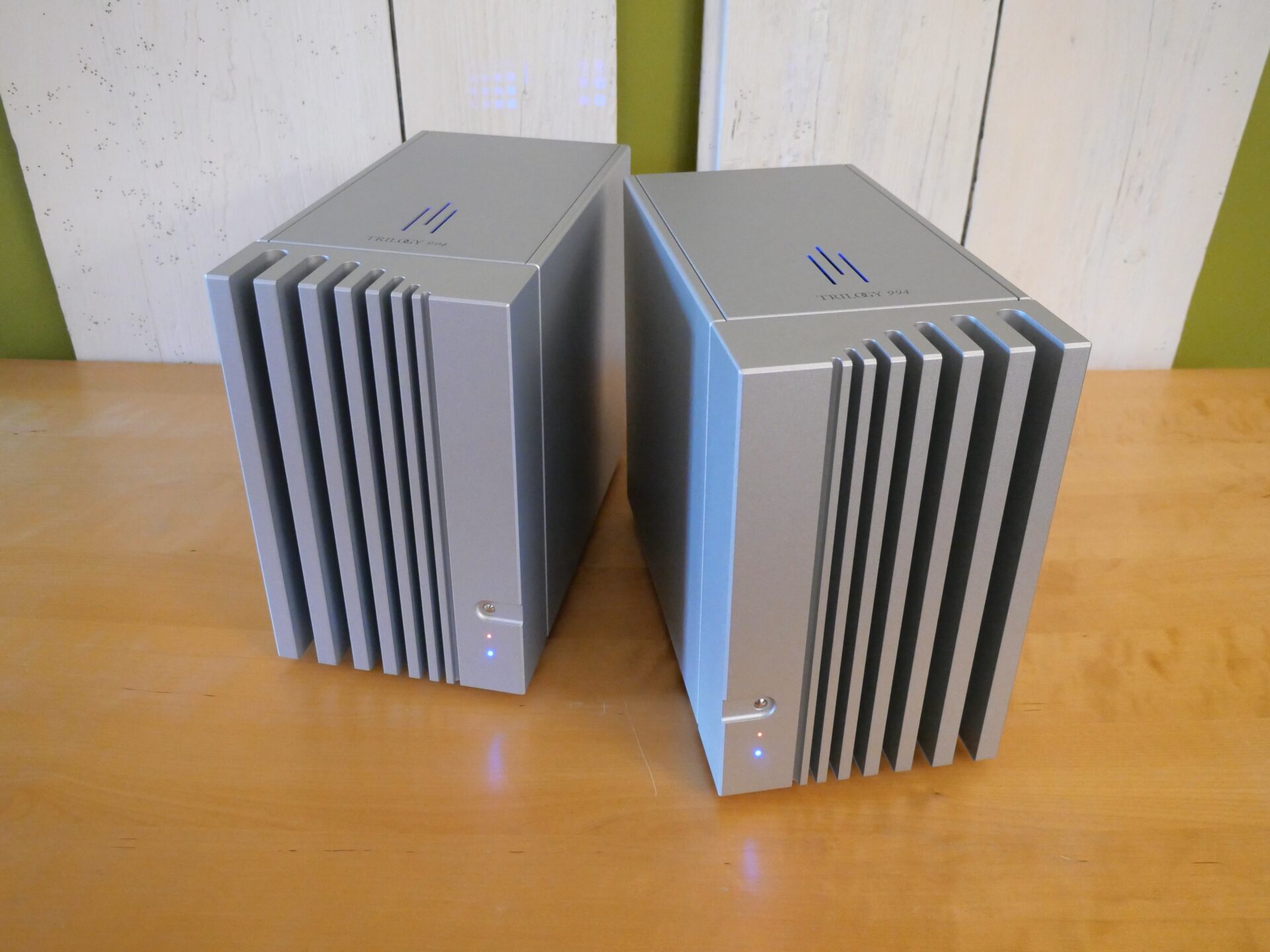
If playing big, orchestral set-pieces reveals the presentational character of the 914/994 pairing, it also serves to remind us just what the amps bring to the large-scale orchestral party, with their rhythmic articulation, convincing dynamics, natural tonality, weight and scale. Whilst I’ve appreciated the Järvi/Gothenburg performances in the past, I’ve never enjoyed them as much as I have with the Trilogy amps. What started as a challenge for the amplifiers soon encouraged me to work my way through most of the cycle, only the need to move on and looming deadlines forcing a change in musical direction.
‘All Cats Are Gray’
Time to shift to smaller and arguably more direct musical forms. Step down in terms of sheer numbers and suddenly the Trilogies’ innate sense of timing and musical substance come into their own. Play The Cure’s Acoustic Hits (Polydor 572 634 0) and the, pitch perfect, tactile presence of the bass guitar gives exactly the right propulsive drive and energy to tracks like ‘A Forest’ or ‘Close to Me’, ably supported by the solid, leading-edge attack of the drums. Smith’s vocals are front, centre and life-sized, articulate, intelligent and intelligible. Each instrument in the pared-back arrangements is clear and distinct, yet the amps’ sense of substance gives shape and power to the tracks, underlining just how tight and musically coherent the band is.
But this is about more than musical meat and potatoes, the weight and urgency of a catchy pop beat. Jóhann Jóhannsson’s reflective, often repetitive music can sound same-y and almost ambient at times. Transcribed for solo piano, Alice Sara Ott’s recent recording (DGG 486 7992) can sound aimless and indulgent, but the 914/944 combination finds shape in the phrasing, subtle shifts of pace that bring a sense of progress and direction to the playing and performance. There’s a beautiful balance between left and right hand, conjuring a fragile beauty from these sparse pieces. It’s all about time and space, the right weight at the right time and in the right place to bring shading, contrast and subtle colour to an almost monochrome soundscape, an underlying sense of musical substance and authority.
