
Oh, Vienna…
By Roy Gregory
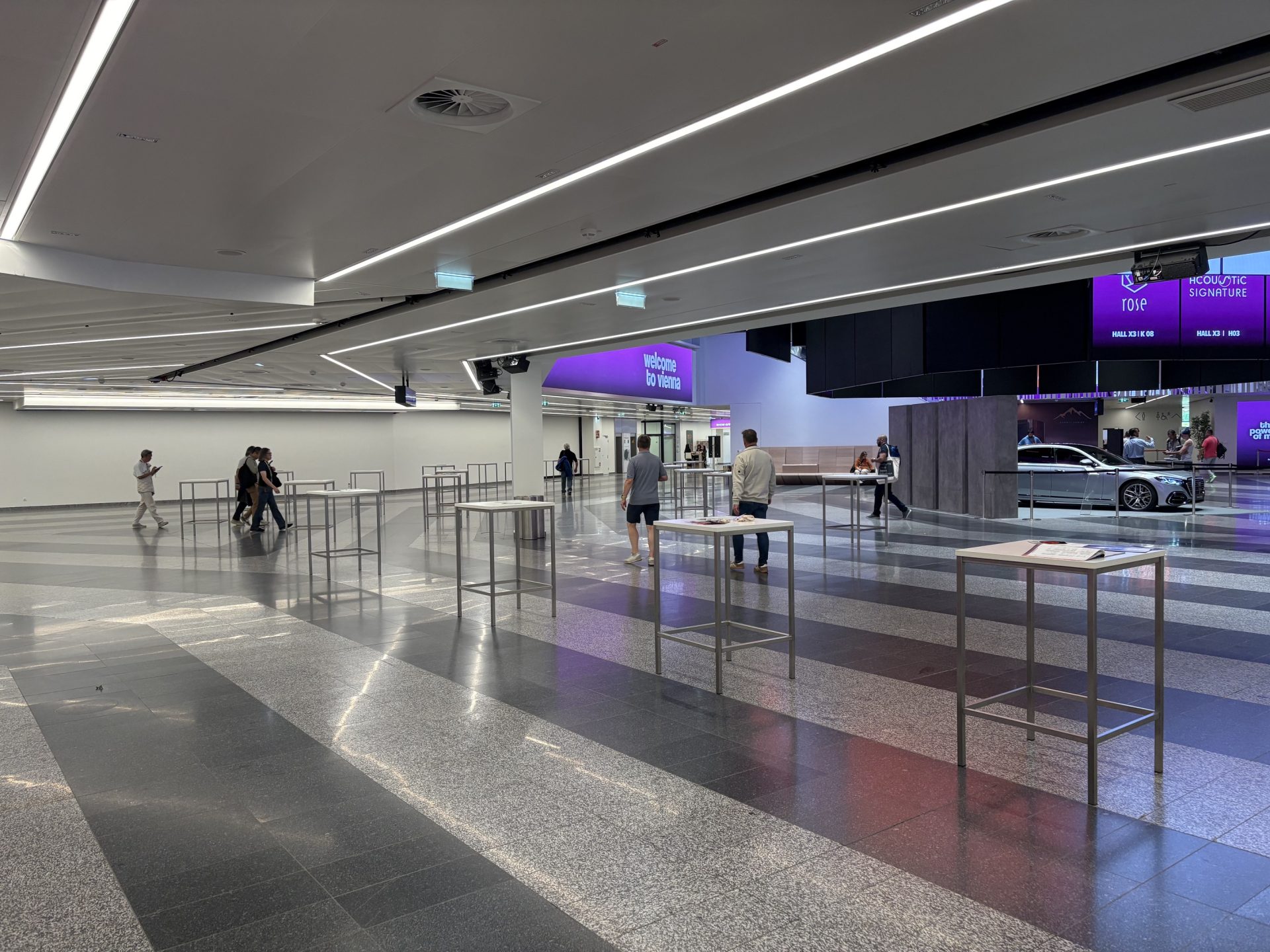
By far the biggest story at the 2026 High-End Show was the show itself. Shifting venue from the familiar (if not exactly much-loved) MOC in Munich to the Austria Centre (ACV) in Vienna was always going to be challenge, even if only logistically. As it turned out, the challenges were significantly greater than the organisers or many of the exhibitors expected – at least, those that got rooms. These particular challenges started well-before the show opened: back around the closing date for room allocations, when many long-time exhibitors were told that the show was already sold out! If anybody was in any doubt that this wasn’t just the Munich Show in a different building, this confirmed it.
In Munich, requests were gathered and, after the closing date, rooms were then allocated, with priority given to existing/repeat exhibitors. Vienna has apparently switched to a first-come, first served system – despite the published date for applications, assurances that the venue offered plenty of rooms and no announcement of the change in policy. Cue panic, anger or simple confusion amongst those belatedly discovering that there was no room at the inn, along with a scramble for alternative accommodation or willing partners. All of which helps explain the existence of no fewer than three off-site, satellite ‘shows’ – although as events subsequently proved, getting the bad news early wasn’t the worst thing that could happen…
Getting to grips with the ACV
The Austria Centre is a huge, purpose built exhibition/convention space. Huge enough to host the Eurovision Song Contest. It has a multi-storey, triangular footprint with a rectangular annexe situated in front of it. It’s also right next next to an underground station and a host of other hotels and office buildings – which is where the exhibitor overflow washed up. But both its size and its nature create inherent structural problems for an audio show. Rooms are located around the edges of the triangular floors, with wide open spaces in the middle. Floors are wood or marble, walls white and ceilings open voids, carrying services, AC ducts and other amenities. It looks more like a vast, empty art-gallery than anything else. Once inside the rooms themselves, you are confronted with tall windows the entire length of one wall, and in most cases, folding partition walls between your space and your neighbour(s). Even if the area has been opened up to create a larger space, there are substantial, intrusive buttresses on the long walls, ‘cupboards’ into which the partitions fold. Those, along with the total absence of absorption and preponderance of reflective surfaces creates an acoustic environment that can only be described as hostile to audio performance. I’m perfectly serious when suggesting that the most significant product in Vienna was the Molo acoustic wall system – a paper concertina that expands to create an absorptive/dispersive barrier. Molo was everywhere and, notably, it was present in many of the best sounding rooms.