

The speaker’s attitude was exactingly adjusted by ear, for listening axis and temporal coherence. The Monarque’s unique attributes (pair matching of crossover, drivers and complete system in an anechoic chamber to within 0.2dB) and symmetrical driver array, make them both more responsive to and critical of precise alignment. The levels were used to track and record adjustments, as well as establishing the final, optimized attitude. It’s a process that proceeded through ever-smaller incremental shifts, one that took an entire morning to conduct.
With the Left-hand speaker positioned, it was time to mirror the location on the right speaker, triangulating off of the listening position using the three-axis laser. This is an exacting but not particularly difficult exercise. But it is essential to remember that you are mirroring the attitudinal adjustment as well as the positional ones – and that the two are interdependent. The more time you take getting this right, cross-checking height, azimuth and rake-angle with each positional shift, the easier final alignment will be.
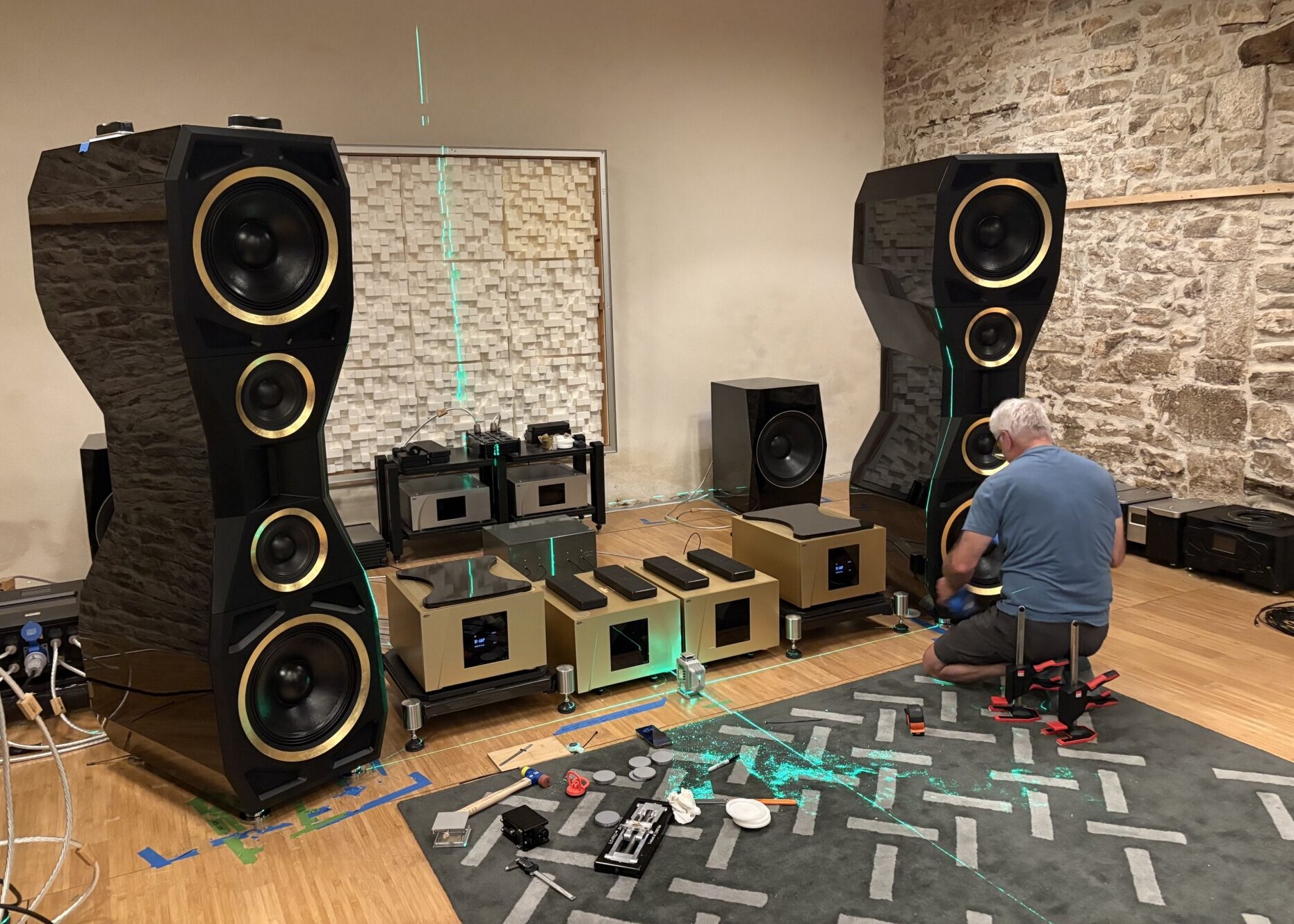
Even then, aural perception easily outstrips our ability to accurately place and align the speakers. With both speakers now in nominally identical location and attitude relative to the listening seat, it was necessary to micro-adjust the right-hand speaker to precisely combine its output with the left-hand speaker’s output, perfectly mating the left and right channel signals for phase and amplitude in order to recreate the stereo relationship. This involves almost impossibly small adjustments of speaker distance and angular attitude. Adjustments that are at once hard to credit – did that tap on the speaker’s rear corner actually move it, at all? – but all too easy to hear, manifest in the musical coherence, integrity and expressive qualities of the performers/performance, rather than any measurable sonic attributes. This is the sort of process that drives the “if you can’t measure it, it doesn’t exist” brigade nuts – to which my response is, “If you can’t hear and appreciate it, you’ve probably already expended too much time and money on audio.” Once completed, the results are easy to appreciate – as the reactions of multiple, seasoned listeners attest.
Like all jobs, the better your tools the easier it is to achieve the right result. Over countless installs, Stirling has developed a highly specialized set of tools, often being used in ways that might not originally have been intended. It’s a tool-kit that continues to grow and evolve, but a prime example is the micro adjustable platform intended to for use in setting the height of a laser level. Fine for that purpose, it’s even more useful as a precision feeler gauge to accurately match the height of speakers off of the floor. Having evolved that function, he’s now acquired a significantly more robust example, also capable of supporting or un-weighting a speaker whilst making microscopic adjustments to spikes or feet, invaluable if you are working alone on cabinets that weigh several times your own body-weight.