

So, the S7s deliver a real sense of musical scale and low-frequency energy, but as these examples attest, they tie that delivery to Magico’s traditional virtues: resolution, transparency and focus. That’s what instils the sensation of almost physical presence – that concentrated energy. But don’t go getting the idea that all of the performance advances represented by the S7 2026 have been in the realm of temporal and spatial coherence. Those traditional strengths have stepped up too, helped in no small part by the focussed energy that locates sounds in space. Playing ‘Gallardo’ from Anastasia Kobekina’s Elipses (Mirare MIR 604) the precision, drive and attack in her bowing is impressively physical, as is the texture of bow on strings. But what really stopped me in my tracks was the spatial resolution and dimensionality of the tambourine. The weight of the individual strikes was crisply defined and dynamically segregated, the air pocket beneath the skin, within the rim, was beautifully defined, as was each individual rattle around the periphery. I have never heard this instrument captured this naturally – partly because the cello so often dominates the stage and the attention. But this is typical of the totally even-handed way in which the S7 treats the incoming signal. Just as it revealed the beautifully balanced arrangement and production on the Womack&Womack track, the intimate chemistry within this tightest of bands, so it allowed the tambourine to exist in its own musical and physical space, adding weight and power to its percussive punctuation and accents.
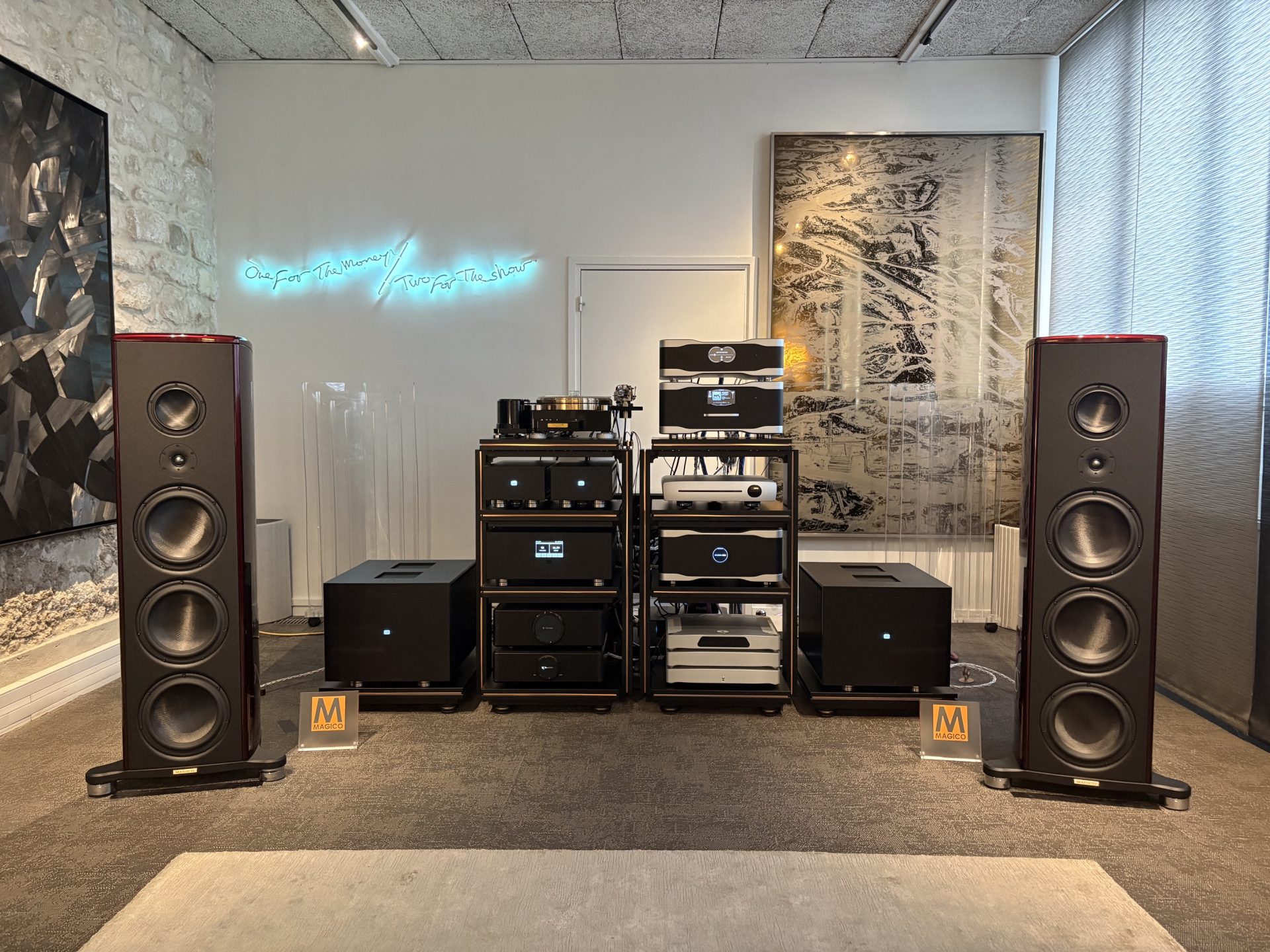
Which is why this new S7 marks a step-change in performance from the more approachable Magico speakers. It excels in terms of resolution and transparency, but matches those qualities with superbly seamless, top-to-bottom integration and much improved musical and dynamic coherence. The result offers that winning combination of clarity and communication, combined with levels of low-frequency definition and information to make many a far more expensive speaker blush. But the S7’s super-power is the way it builds on that bottom-end foundation, the musical roots binding into a solid trunk, spreading boughs and vibrant foliage. Its numbers might track those of the more compact S5, but there’s no missing the physical presence the S7 brings to performances. It integrates more – and it integrates better. It presents music all of a piece, beautifully stable and perfectly proportioned. Its headroom is impressive and it rarely loses control at either frequency or dynamic extreme.
Historically, this level of resolution and transparency has too often been bought at the cost of limited low-frequency weight and extension or dynamics that are musically constipated. The S7 is a poised and balanced performer. It might not have the absolute immediacy, forward presentation and micro-dynamic jump so beloved of those wed to more sensitive systems, but for those seeking genuine tonal neutrality, balanced performance, wide-bandwidth and the ability to approach realistic levels when partnered with (or selected to exploit the benefits of) a modern, high-powered amplifier, the S7 might just be the new benchmark. Final judgement on that will have to wait. If/when we get the S7 2026 home, I’m expecting great things.