
Not your average ‘integrated’ amplifier…
By Roy Gregory
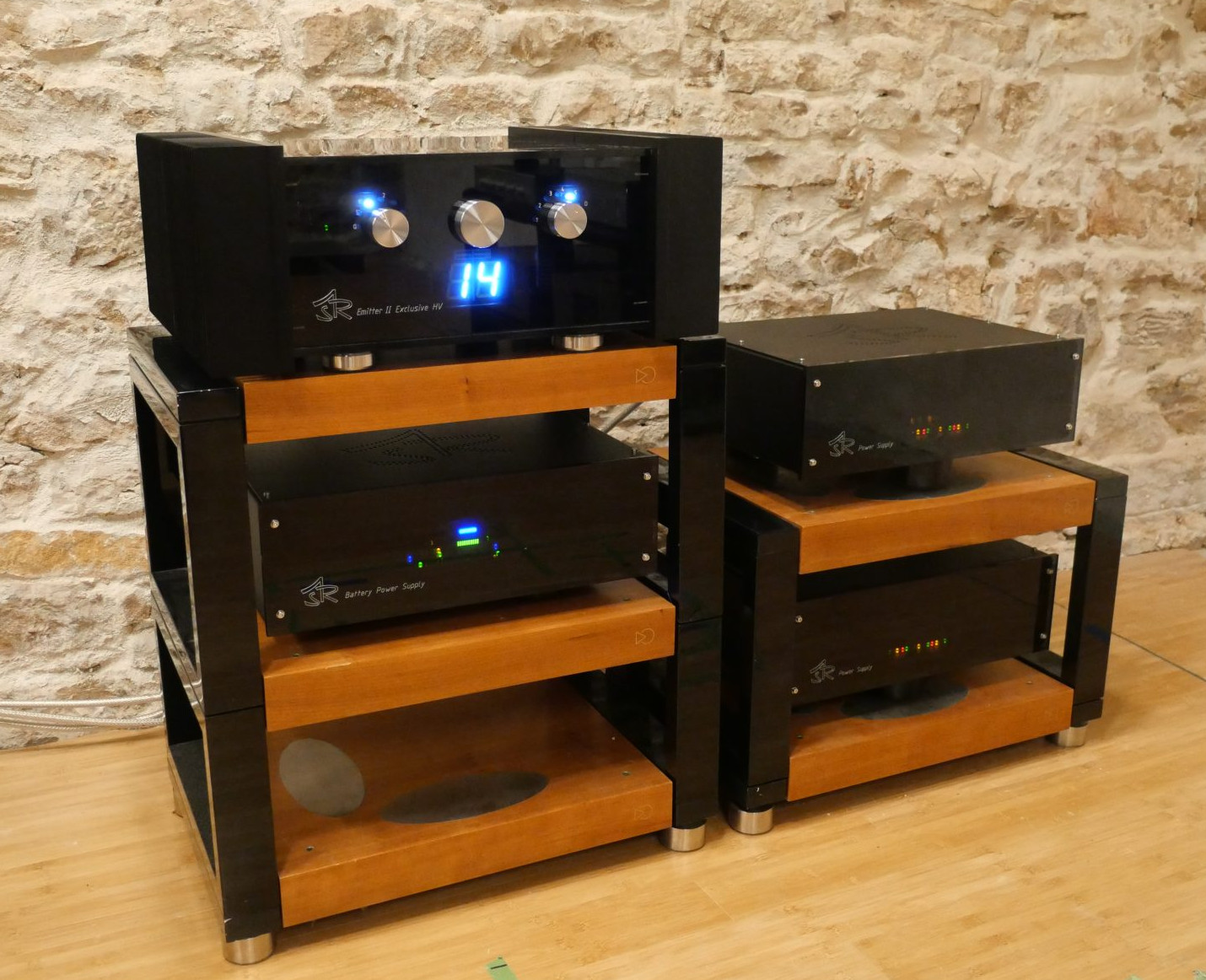
There are two things that make ASR’s Emitter II amplifier unusual, before you even listen to it: the first is that it has been around (outwardly unchanged) for nearly 40 years; the second is that it is generally described as an ‘integrated’ amplifier – and whilst technically correct (the input/line functionality and output stage are in the same box) I’d say that it is also inaccurate, even actively misleading. Generally speaking, integrated amplifiers condense all of their functionality into a single, normally compact chassis. I won’t bore you with examples: there are way too many to mention. Not only is the ASR Emitter II housed in seriously large casework, in this form it comprises not one but four boxes! Anybody looking to simplify their system topology need look no further. Anybody hoping to downsize via an integrated solution better think again. Clearly, there’s a lot more going on here than the ‘integrated’ label suggests, so perhaps we’d better start at the beginning.
ASR Audio was founded in 1980 and launched its first amplifier, the Emitter I in 1985. Visually similar in concept and layout to the later Emitter II, the original model is still available in Basic, Exclusive and Exclusive HV (high-power) versions, with the additional option of a separate battery supply. Even in Basic form, the amplifier comes with a large external Power supply, making this ‘integrated’ into a two-box unit that’s bigger than most equivalently priced pre-power combinations. Add the battery and you are looking at three substantial boxes – broadly equivalent to a two-box line-stage and a stereo power amp, at least in terms of racking and real-estate.
The Emitter II follows the same road map – it’s just bigger! The original model was no shrinking violet, the main chassis measuring 42 x 41 x 18cm and weighed in at 22kg, with its power supply being roughly the same size and adding another 32kg (that’s 16.5 x 16.1 x 7.1 inches and a total of almost 120lbs in old money). Not exactly svelte… The Emitter II bulks up substantially: 57 x 44 x 23cm and 47kg for the main chassis (22.4 x 17.3 x 9.1 inches and 103lbs) with TWO external power supplies for a grand total of over 110kg or nearly 250lbs! And that’s before you add the battery power supply or the optional two-box phono-stage. That’s a four (or six) box unit, visually equivalent to a serious pre-amp and mono-blocs.
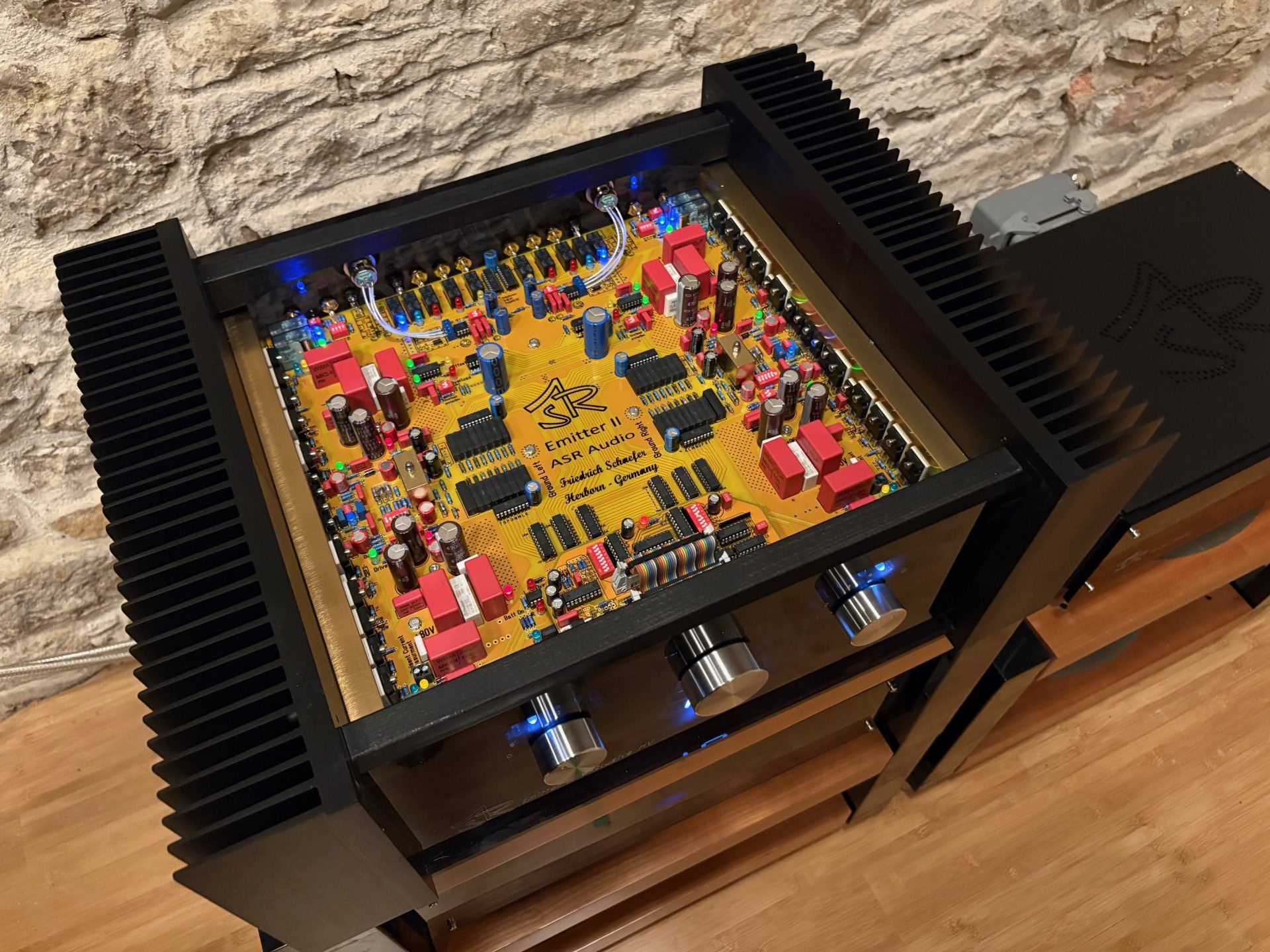
But there’s way more to the Emitter II than just sheer bulk, the minimalist exterior hiding a seriously sophisticated and configurable amplifier. The main chassis is housed in a Perspex case (to minimise the impact of eddy currents in the casework), flanked by large heat-sinks left and right. The Emitter II Basic will pump out 250 W/ch into an 8Ω load, 450 Watts into 4Ω from its MosFET output stage. In the Exclusive HV version reviewed here, that rises to 450 W/Ch into 8Ω and 800 W/Ch into 4Ω. Those heatsinks are not just for show. Controls are limited to three rotary knobs on the front panel: the one on the left selects operating mode, the volume control is in the middle with source select on the right. Below the volume control is the largest numerical display for output level that I’ve ever come across – making it incredibly easy to read, even across a large and well-lit room. It is flanked by vertical bars of status LEDs for left and right channel. Display content, brightness and duration can all be user adjusted via the remote handset. I dispensed with the status bars, reduced the brightness and had the display switch of after 10 seconds. Your choices may differ, but having created such a legible and comprehensive (and potentially irritating) display, full marks to ASR for making it user configurable. But the clever touches don’t stop there. The volume range runs from zero to 76, but the amplifier offers three operating modes – standby (S), energy saving (1) or full power (2). In Standby mode the level can be pre-selected up to a volume setting of 49. When powering up the amplifier for listening, it automatically stays in Energy Saving mode for 30 seconds, in order to ‘soft start’. This supplies the driver and output stages with half power and also limits the output level to 51. Full power, as the name suggests, allows full output up to level 76. In energy saving mode and at lower listening levels, the Emitter II automatically switches to its half-power settings, although the level at which that happens can be adjusted or defeated altogether.