
When performance outstrips price…
By Roy Gregory
If there’s little new under the audio sun, there’s even less that’s genuinely new in the world of high-end cables. Outwardly, current offerings might be getting wilder or more glitzy in appearance, the ‘deconstructed’ look having a surge in popularity just now, but the basic priorities really haven’t changed much since designers realised that there’s no dielectric like no dielectric and minimalist connectors sound better than ostentatious hunks of heavily plated hardware that could double (and often do) as male jewellery. The best sounding cables are those that exhibit consistency of materials, thinking and construction across their product lines. Combined with sensible minimalism (low mass, low volume, low levels of geometrical error) you can achieve remarkable results at surprisingly affordable prices. Sensibly designed and sensibly priced cables that follow the rules can often easily outperform crazy cables with crazy construction and crazy pricing. At the more affordable end of the market, it ain’t rocket science and one of the first companies to recognise that, recognise the rule book and realize the potential performance benefits of a coherent approach to cabling audio systems was The Chord Company.
It might have started as an off-shoot and result of Naim Audio’s refusal to accept (or even touch) RCA plugs – a dogma that presented Naim owners who wanted to use a tuner, tape-deck or CD player (once those arrived) from a different brand, with something of a problem – but it quickly graduated from knocking together Din to RCA leads out of cable off-cuts. It was one of the first dedicated audio companies to commission its own cable (rather than relying on found technology or off-the-shelf product) and one of, if not the first to match connector to conductor plating. It was built on its ability to offer cost-effective, mainstream cable solutions and to supply the specialist, cross connector type cables necessary to integrate a lot of imported (especially US product) into Uk-centric systems. You needed something to mate balanced outputs to Din inputs, or RCAs to Lemos and Chord could provide.
Recent years have seen the development of proprietary grounding and mechanical tuning products and techniques and a steady migration up-market, but at heart, Chord (as the company now prefers to be known) remains a UK-based operation, with the biases and attitudes that implies. They say that you can’t outrun your history and Chord is living proof. Walk into the company demonstration/training room, pick up a cable and, if it’s an interconnect it’s likely to be terminated with RCAs, a speaker cable with 4mm banana plugs. Requests for balanced leads or spades tend to receive a slightly quizzical response, even if it’s willing enough…
The ChordMusic cables reviewed here are the company’s current flagship. Despite sitting at the top of the company’s product line and competing in performance terms with other flagship cables, the Musics are almost laughably affordable – that is, if you can afford to laugh at high-end cable prices! In a world where pricing (not to mention performance) seems to have become divorced from reality, the ChordMusics are definitely down to earth, with pricing that’s at least related to and a musical presentation that is firmly rooted in, the real world.
Different strokes…
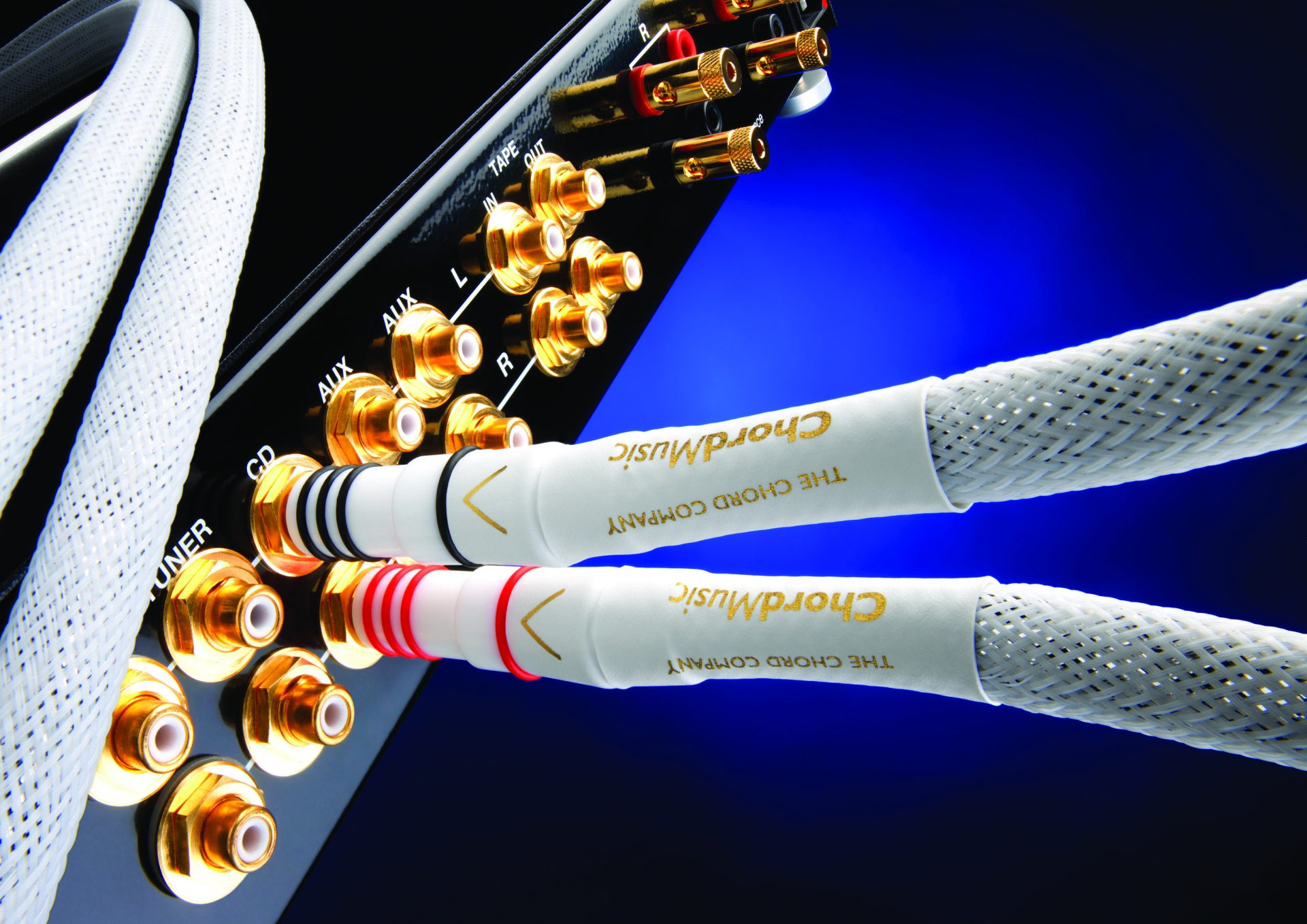
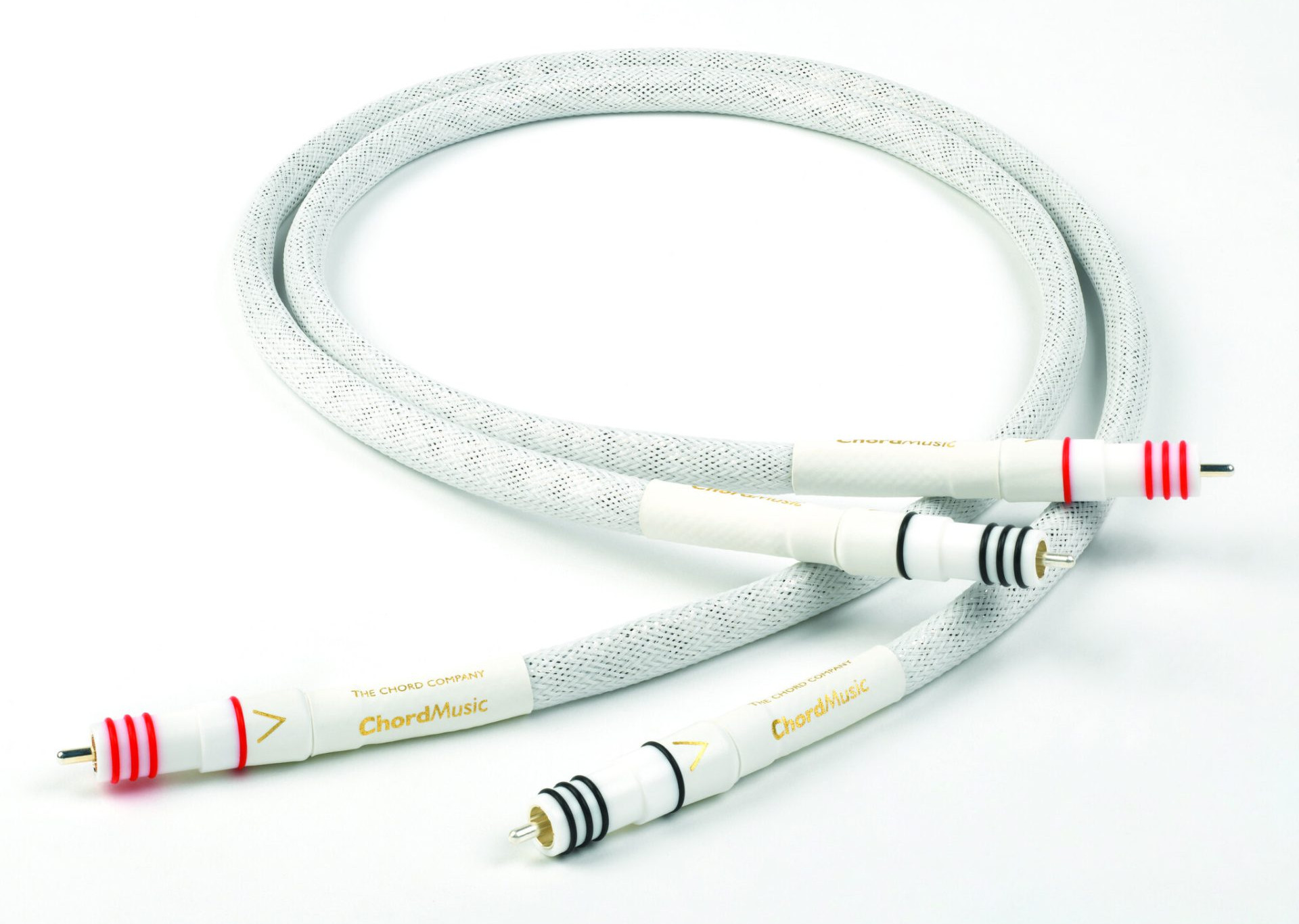
Outwardly, almost stubbornly traditional in appearance, there’s more here than meets the eye, more than enough here to pleasantly surprise the ear. Perhaps the first real indicator is the RCA plugs themselves (RCA? You can’t fight City Hall – and, in this case, why would you want to?). Chord’s proprietary plug design relies on bulky, white barrels with slightly stepped, parallel sides that narrow towards the nose. The thick walls and milky finish are the giveaways: the plug structure is entirely machined from PTFE. Even the coloured bands that indicate channel identity are actually silicon-rubber O-rings, chosen to offer some low-frequency damping to the cylindrical plug bodies. Originally, the colour and number of O-rings indicated directionality, but as this was open to interpretation, the company eventually bit the bullet and screen-printed directional arrows on the heat-shrink/strain-relief. It’s an object lesson in minimising the metal content in a component that still needs to conduct. Short of the contacts and solder pads, there’s almost no metal at all… The solid, wide diameter barrel accepts the incoming conductors for a solid physical connection, reinforced by the outer heat-shrink. The contacts feature Chord’s proprietary, silver-based, tarnish resistant ChorAlloy plating – to match the silver-plated copper conductors. The connectors are plated straight onto brass, with no intervening layers of nickle or other metals. Even the thickness of the ChorAlloy plating has been listened to, in order to optimise results.