

Talking of conductors, these are slow drawn copper, to improve dimensional accuracy, pulled in a nitrogen atmosphere to prevent oxidation. Handle the interconnect cable and it’s far lighter and more flexible than you’d expect. In part that’s down to the cable’s reliance on the ARAY electro-mechanical tuning, rather than heavy, materials-based damping – with all the attendant down-sides that go with heavier construction.
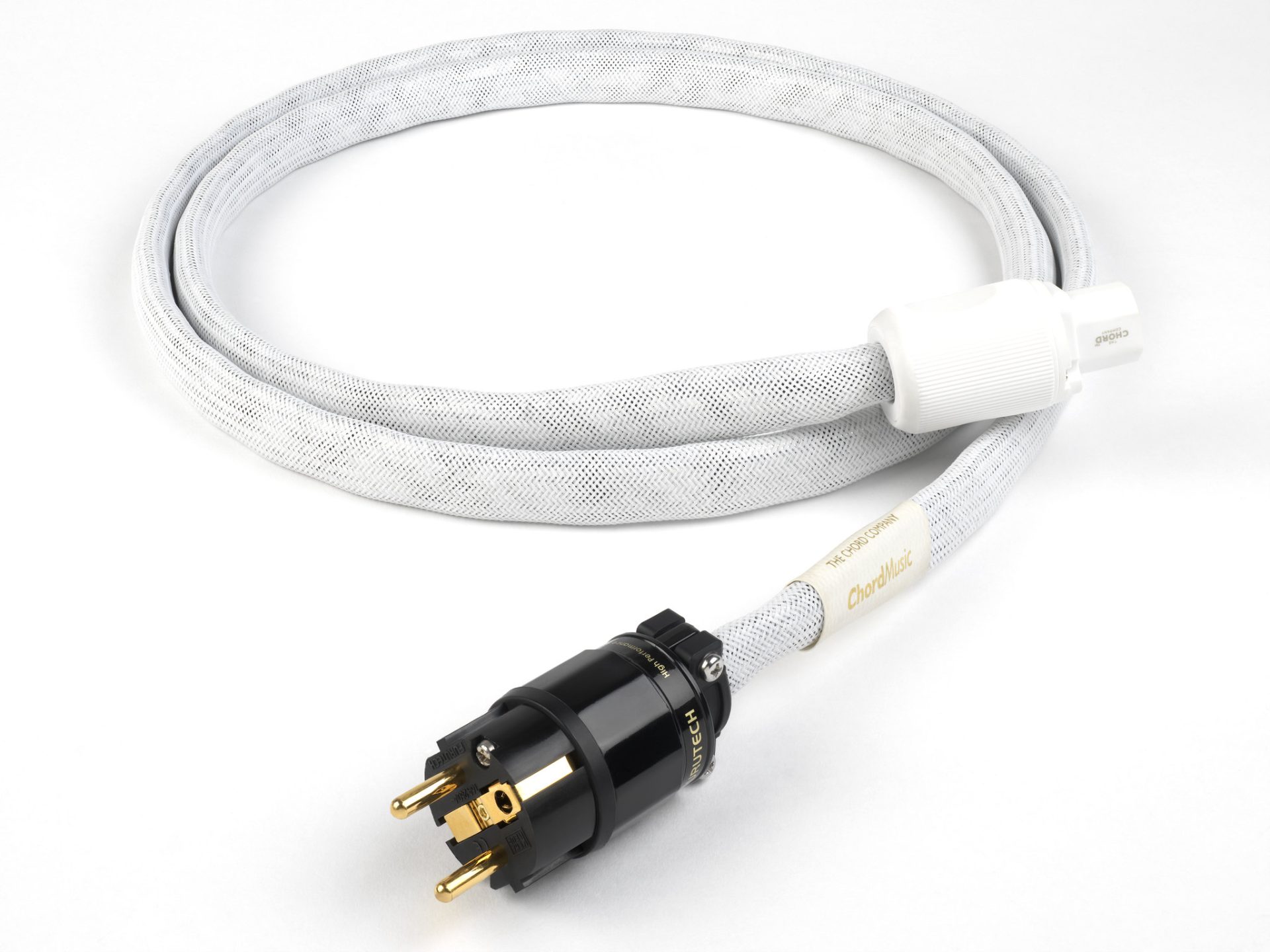
You’ll find similar concerns embodied in the speaker cables and power cords. The same plating on the connectors, the same move towards lower mass and minimal extraneous metal. They are neither as light nor as flexible as the interconnect, a function of the larger/larger number of conductors, but they are nowhere near as springy as the Nordost Valhalla 2, nor as ridiculously weighty as the bigger AudioQuests. The cables’ flexibility makes installation surprisingly easy, while a certain resilience also aids dressing. The only apparent oversight in all this is the directional breakouts on the speaker cables, but the logic here is simple: speaker cables come under strain and the breakouts need to resist that strain. A minimal, low-mass aluminium machining is deemed less musically intrusive than the larger block of a weaker material that would be required. Other than that, my only other observation is that the sparkly white net surface is going to get grubby. My cables live a far harder life than most, so perhaps I’m more aware of the issue, but at least Chord has avoided loud or multi-colours, making the Musics really quite discrete for what is not a small cable.
Hidden high-tech…
So far, so very sensible: Chord have followed (and in some cases extended) the low-mass playbook perfectly, exploiting construction and developing components and techniques to eliminate as much redundant mass and metal as possible. But the thing that sets this cable apart from any other cable on the market (save Chord’s own Sarum T) is its employment of a genuinely unique di-electric material – Taylon. Unusual di-electrics are not that rare, with ‘artisan’ cable companies in particular, mining human history for organic or manufactured materials that might offer an electrical or mechanical advantage. Hunt around and you’ll find people using anything from silk to linen, wood fibres to thin air (or as close to it as they can get). What sets Taylon apart is that it’s the result of serious, defence industry research into the short-comings and especially the temperature related phase behaviour of Teflon – behavioural variation that was affecting the accuracy of signal transfer in guidance systems. So, Chord is leveraging the research that lands smart weapons on target for the wholly preferable purpose of delivering your musical signals intact.
But the benefits of the classified status of the Taylon dielectric don’t stop there. Because the Taylon wrapped cables are used in mission critical military applications, they are manufactured using a ‘zero fail’ protocol – meaning that at each stage in the production process, the cable needs to meet exacting physical and electrical standards. With eleven stages in total, from drawing the conductor, to polishing it, plating it, polishing it again and then applying the dielectric and multiple shields, the cable might fail to meet tolerance at any point. In turn that imposes a set of rigid physical constraints on production, leading to a remarkably consistent final result, geometrically, mechanically and electrically. That makes for high failure/wastage rates and manufacturing costs, but it also means that not only do the Chord Music cables sound excellent, they ALL sound the same (or, more nearly the same than most other cables). Despite audio cables inhabiting a world in which channel balance is critical, that’s far from a given.