

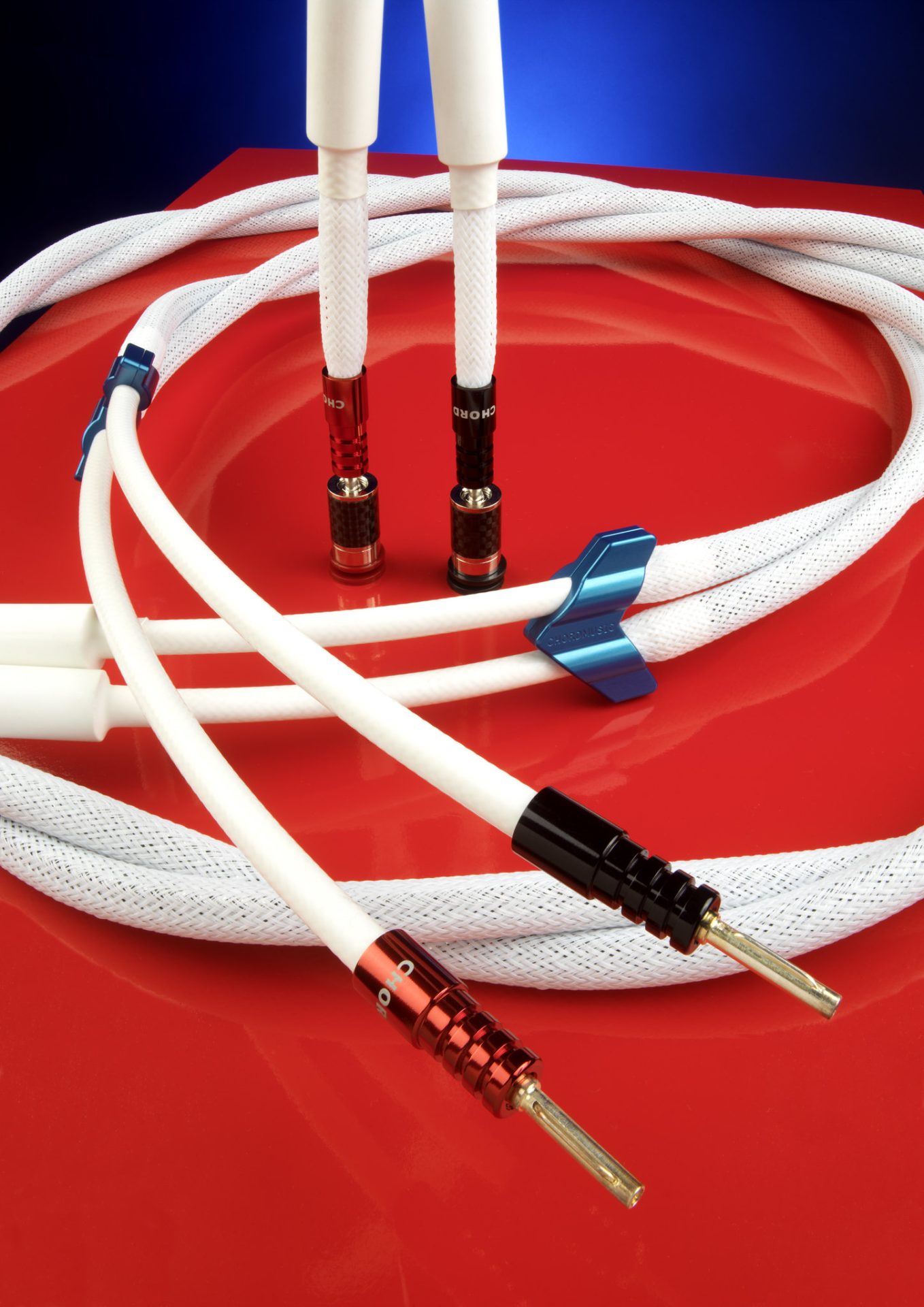
Reviewing cables is also far from a given. The simple one-in/one-out approach to reviewing individual interconnects, speaker cables or power cords simply doesn’t work, fastening on cable/system interactions rather than actual performance. Instead, it’s essential to assess cables as a complete system within the system, and to do so in more than one system too. To that end I’ve been using a full loom of ChordMusic for over a year, traversing systems including electronics from CH Precision (1 Series and 10 Series), VTL, Connoisseur (4.2 phono and line) Jadis and Kora, speakers from Diptyque, Clarisys, Peak, Wilson and Göbel – amongst others. The sheer range and breadth of that listening tells its own story: I wouldn’t be using the cables that widely if they didn’t deliver, both sonically and, more importantly, musically. The cables in question are single-ended interconnects and speaker cables equipped with 4mm bananas (reflecting Chord’s heritage), along with a mix of 13A and 20A power cords, Chord’s PowerHAUS M6 distribution blocks and various ARAY grounding devices. Collectively they offer a comprehensive solution to wiring a system and reducing its noise-floor. Throughout the review period and the many system changes it has involved, I’ve had no connectivity issues or cable failures – which definitely isn’t always the case when reviewing cables. The ChordMusic review loom has lived a hard life, but it has also been reliable and robust, suggesting that the termination and connectors match the exacting standards established by the cable itself.
Quietly ever-present…
What has emerged over this extended listening period is an even-handed, unforced and unfailingly natural performance. It’s not that the cable is without character: it’s that the character it has is fundamentally natural, involving and expressive in nature. If you want to sum up the quality that ChordMusic brings to a system in a single word, then that word is “ease”: the ease with which the system tracks the recording’s demands; the ease with which you can access the inner reaches of the performance; the ease with which you can tell who is playing what (and more importantly, why).
What contributes to that ease? An almost preternatural sense of perspective and proportion. Instruments and performers are unambiguously arranged and perfectly scaled, both physically and in terms of their output. The top-to-bottom evenness (in terms of dynamics and energy) is exemplary, making most of the competition sound clipped or warped out of shape. That even spread of musical energy translates directly into the pace and timing in the piece, while the natural perspective and sense of proportion preserve the spatial (and thus the rhythmic) relationships within the band. Finally, there’s an almost total absence of edge or intrusive noise. The cables are mechanically quiet and do nothing to exaggerate sibilance or surface noise. In fact, quite the opposite. Playing noisy records, the ChordMusic pushes intrusive clicks and pops well into the background. They’re there – they’re just not part of the music. Combined with a sweet, slightly rolled off top end, even the most abrasive recordings are called to heal and, if the price you pay is a slight loss of air, it’s a price worth paying to make more music so much more accessible.