
After multiple visits to Munich and now Vienna, it’s difficult to reach any conclusion other than that the failure of most rooms can be laid fairly squarely at the feet of exhibitors who don’t get as much out of the space as they could. Like most of the larger spaces in Vienna, the Peak room was far from ideal – thin walls, lots of glass and flat, reflective surfaces, a significant void above the ceiling and plenty of input from noisy neighbours, but the artefacts that ‘difficult’ rooms create were, if not absent, then certainly far less prevalent than one might expect at a show like this. So, the care and attention to detailed set-up extended well beyond positioning the speakers. Having said that, the speaker positioning also went well beyond the norm, with precise adjustment of attitude and azimuth as well as height off of the floor – settings that were adjusted each throughout three set-up days and each morning of the show. It wasn’t until Sunday morning that the speaker placement and orientation had settled to the point where only a tweak in azimuth was required!
The racks weren’t just levelled, but the loading of each spike was checked. Cables were carefully dressed, with subtle attention paid to damping/support via Acouplex pieces. The system was up and running on the Monday before the show – and stayed that way until it was unplugged on Sunday. I’ve already listed the cleaning contacts, but this extended beyond the system components to the wall sockets and ethernet feed. Apparently, it took more than 40 Q-tips to clean each AC outlet! Meanwhile, the supporting cast of components was not simply chosen from what was available, but selected specifically for their musical and sonic capabilities. This really was a system, built from the ground (connections) up.
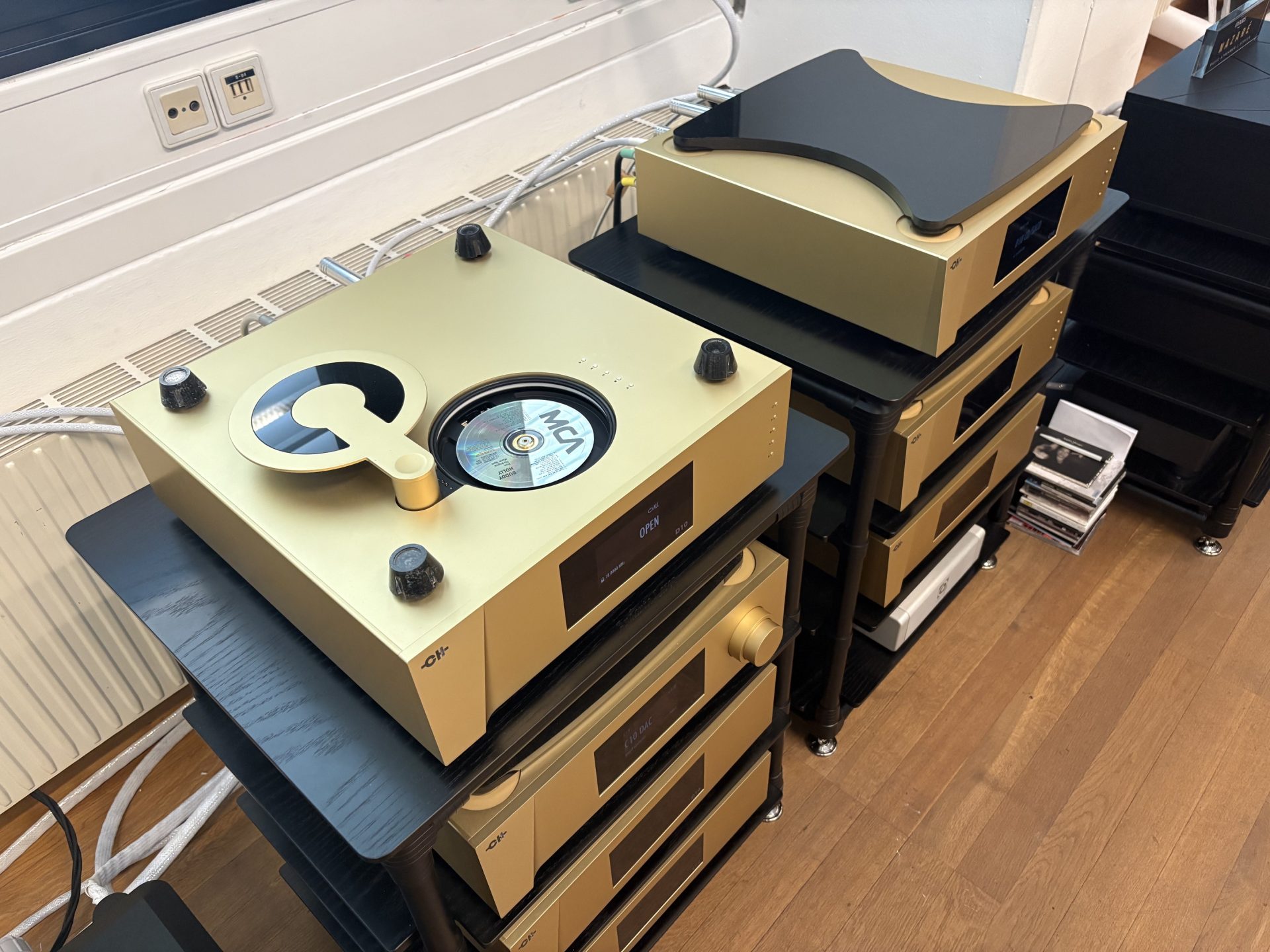
And it’s not just about the big, shiny, gold-finish CH electronics or the Innuos boxes. Each and every part of this system, from the racks and cable risers to the CH Link-HD data transfer and the Telos power supplies played its own, significant part in the result. At this level of performance these have stepped beyond being considered as ancillaries, and long since left the status of ‘accessories’ far, far behind. There’s no question that these, or near equivalents, are ‘must have’ not ‘nice to have’ components in any serious system – at least if you’re to have any hope of realising the potential of the active hardware. Periodic demonstrations of what happened to the system performance if just one of these elements wasn’t used, or wasn’t set up ‘just-so’, made the point in ways that were hard to ignore. This was a system whose total price comfortably exceeded three quarters of a million Euros, but which could still be made to sound relatively mundane if the setup was ‘off’. There’s a lesson here, and it’s not just applicable to stratospheric systems comprising components built without compromise – though that lack of compromise does presume that the user won’t introduce compromises of their own through less than meticulous setup. But I firmly believe that getting the best from real world components means avoiding compounding the inherent compromises in equipment built to a price point, by insufficient attention to infrastructure.