

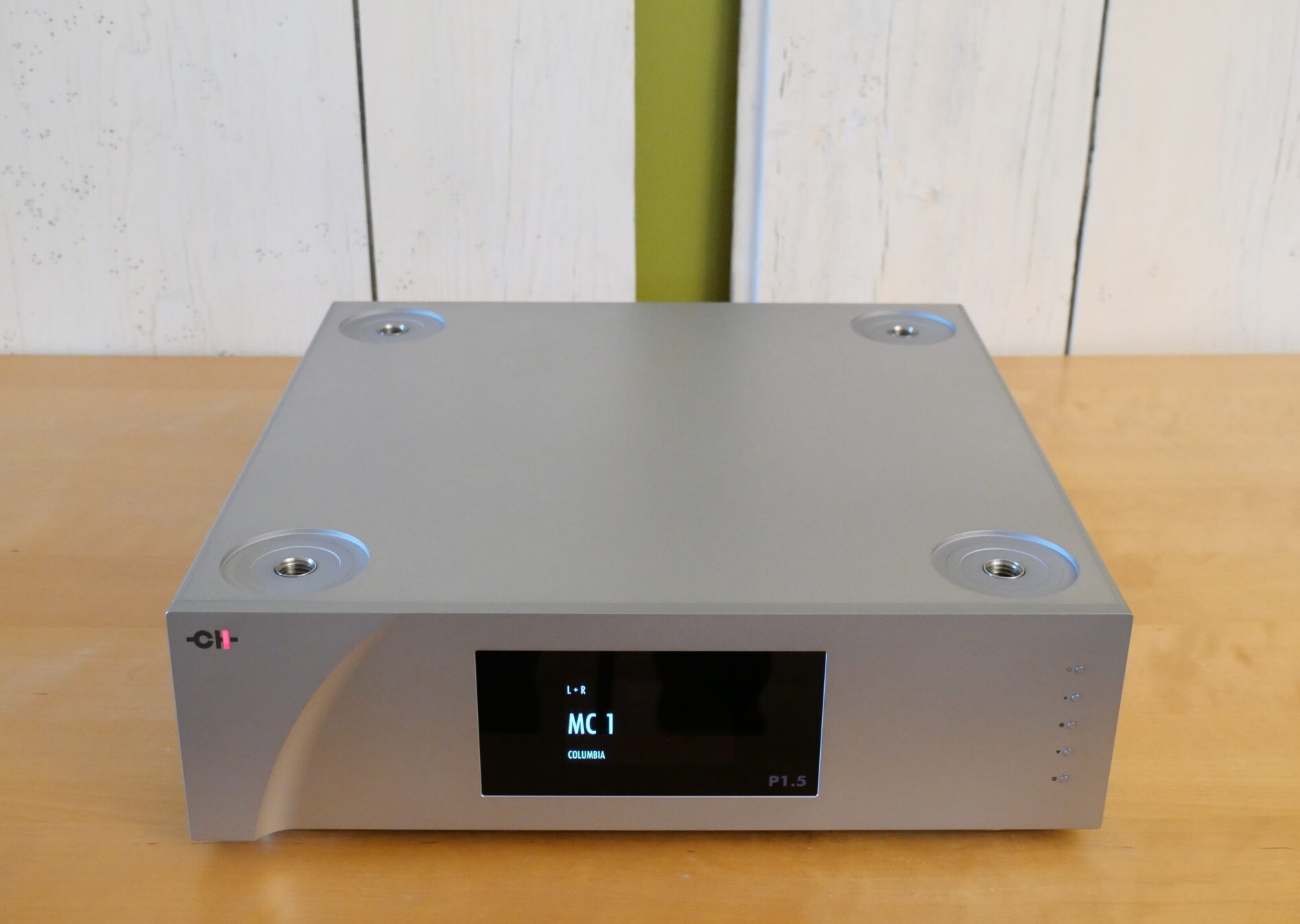
Look at a P1.5 and the only clue to its identity is the model number engraved on the display panel. The two transimpedance MC inputs (best suited to cartridges with an internal impedance of less than 10Ω, ideally less than 5Ω) and the conventional, voltage-sensing MM/MC input, along with the full suite of balanced and single-ended inputs/outputs, is identical to the P1 line-up. The five push buttons to the right of the display are likewise, identical. The only other outward difference is that CH has (finally) deleted the non-sensical 50Ω BNC outputs. They’ll not be missed.
But lift the lid and you discover that inside, the circuit boards are now based on the three-stage gain architecture and interleaved passive EQ developed for the P10. Include the optional EQ curves and you’ll find there are now eight (rather than the P1’s five). Open the accessory box and inside you’ll find an IR remote-control handset that allows you to switch curves, phase and input. All of which (if you are familiar with the P1) should tell you that you’re not in Kansas anymore. The P1.5 is to all intents and purposes, a one-box implementation of the P10 circuitry, with some de-scaling of component tolerances and matching. Of course, you can still add an X1 external power supply, creating a two-box P1.5, although note that the X1 is somewhat less than half of a 10 Series supply. But even allowing for that, the P1.5 offers a serious slice of P10 performance in a more affordable form, along with a stepped upgrade path. By now, even without looking at (the extremely impressive) numbers it should be apparent that the P1.5 promises a major step up in performance over the P1. Perhaps the real question is – just how close does it get to the P10?
But I’m getting ahead of myself. Let’s run down those numbers first – and then see how they’re reflected in the performance of the P1.5 when you sit it alongside the P1. There’s a more comprehensive discussion of the improved specs and topological changes in the article I wrote about the upgrades to both the L1 and P1 to 1.5 status:
https://gy8.eu/news/ch-precision-p1-5-phono-stage-and-l1-5-line-stage/
Cutting to the chase, compared to the P1, the P1.5’s current-sensing inputs offer a 6dB reduction in noise floor, the voltage-sensing MM/MC input 4dB, with similar increases in available headroom. Those improvements are far from subtle, in measured, sonic or musical terms. At the tiny signal levels present in a moving-coil step-up, they are vast. Listening to the P1.5, it offers an immediately obvious drop in noise floor, greater focus and transparency, richer tonal colours and more emphatic dynamics. Play an album like The Cure’s Seventeen Seconds (Fiction Records – FIX 004) and the impact is immediate. The disjointed, off-key and off kilter piano notes and chimes of ‘The Final Sound’ are more distinct in space and one from another. Their progressively growing sense of shape and structure moves more clearly and purposefully towards the opening of ‘A Forest’, giving way to that track’s keyboard chords and etched guitar. The drums are more solid, each strike clearer and more clearly a real drummer, rather than a drum machine, despite the repeating pattern. Smith’s vocals, deliberately sunk into the mix are more distant but clearer and more intelligible. The bass goes deeper with more weight, is more pitch specific and has greater texture. The ‘whoosh’ that opens ‘M’ starts way outside the left speaker, sweeps across the stage and explodes outside the right. The bar-by-bar evolution of ‘At Night’ has an almost Baroque inevitability to its structure and development. The whole album is crisper and rhythmically more on-point, the dynamic accents that push bars and the shifts in density that add emphasis hit home with greater clarity and impact.
