

By now, you might have noticed the two omissions from this description. While early jazz labels seemingly each had their own specific variation when it came to EQ, most were based in the US and most farmed out their pressing to larger plants. Together those two things make the vast majority (although not all) post ’58 jazz recordings RIAA. There are exceptions, notably first US pressings of Kind Of Blue which used Columbia EQ. But, as regards earlier, mono releases, I simply don’t have the record collection to investigate. Which brings me to our second caveat. Pretty much everything pressed this century, regardless of genre, will be RIAA. If you only buy current recordings or 180g re-issues, you don’t need to futz with alternative EQs. Which is why the facility is optional on all CH phono-stages. If you don’t need it, don’t buy it. You can always add it later…
First there was one…
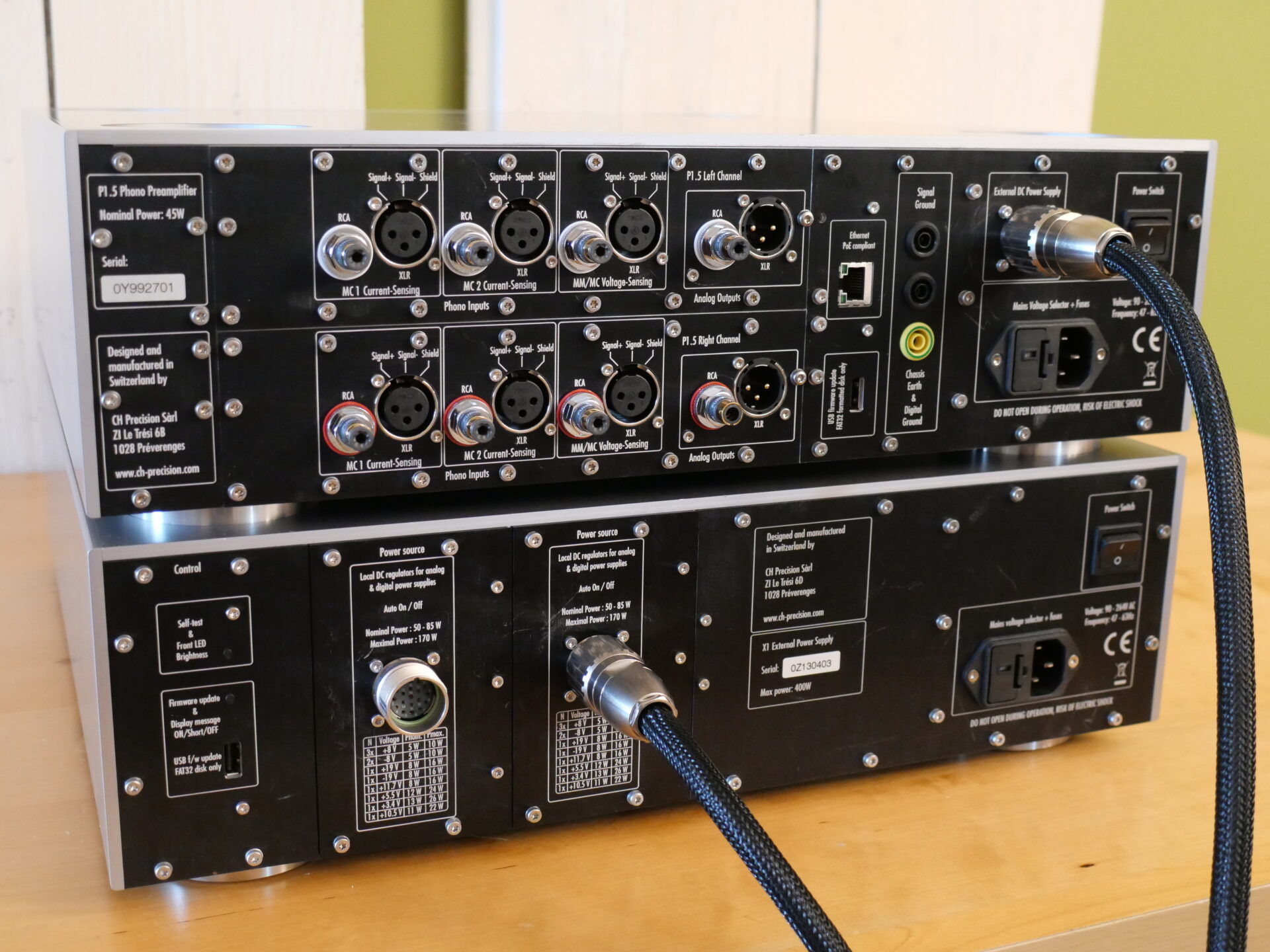
The desire to play mono-discs with a mono cartridge (that only reads lateral groove modulation, massively reducing spurious noise) has been a big driver amongst record collectors looking for turntables that can support a second tonearm, or phono-stages with multiple inputs. The P1.5 takes that requirement seriously, with three separate mono connection modes to optimise replay of different mono cartridge topologies (single-coil/dual-coil, two-pin or four-pin output). Along with the provision of the highly configurable MM/MC voltage input, with its almost infinite range of gain and loading permutations and the unique Cartridge Loading Wizard set-up aid, it’s yet another example of just how comprehensively CH has addressed the multifarious challenges of record replay. The P1’s feature count was impressive both in terms of scope and targeting. The P1.5 offers more features and has honed their application to further improve its matching top different replay demands. It really is a one-box, do-it-all solution; one that combines incredible configurability with bench-mark performance. Like I said earlier, the P1 has pretty much ruled the roost when it comes to solid-state phono-stages – until the arrival of the P1.5, which sets a completely new and even higher bar for musical insight, communication and expression.
One final example sums up and really brings home the importance of correct EQ when it comes to playing older records – and just how important the inclusion of the Philips curve is in terms of musical access. I recently lucked into someone clearing out a secondhand collection, including a substantial range of Claudio Arrau recordings, amongst them his Beethoven Piano Concertos, performed with Haitink and the Concertgebouw for Philips in 1965. The collection included a set of nice, early Hi-Fi Stereo first pressings, but also later Universo issues, dating from the early ‘70s. It was no surprise to find that the first pressings required the Philips curve, but so too did the Universo discs, while the impact of the correct EQ was astonishing.
Play these recordings on the P1 and they sound measured, flat and pedestrian; certainly nothing to get excited about. But switch to the P1.5 and engage the Philips curve and the musical connection and experience is transformed. A single example will suffice; the Second Movement of the Fourth Piano Concerto. Generally played in less than five-minutes, this is the shortest but one of the most emotionally intense and desolate movements that Beethoven ever wrote, embodying the realization of his impending, profound deafness. The precision with which the P1.5 places and weights the widely separated and exposed piano notes reveals the sensitivity and depth of emotion in Arrau’s beautiful yet devastating performance. Google a list of Top Ten Classical Pianists and Claudio Arrau should be somewhere in the top half. Listening to this performance on the P1.5 you can absolutely understand why – an understanding that’s impossible to achieve via the P1, simply because it doesn’t possess the Philips curve…
