

We’ve walked this way before, but the journey and its lessons are worth repeating.
Having already flagged up the difference between draining energy and isolating equipment, isolating equipment and protecting the signal that flows inside it, it’s also necessary to establish the nature of the various mechanical distortion mechanisms that apply. The first and most obvious is the acoustic and structural energy generated by the music itself. For most rack manufacturers, this is their prime directive: isolate the system from mechanical feedback coming through the floor – a construct that conveniently ignores the airborne energy that’s potentially battering the components. But although the energy levels here are large, they are far from the most important in performance terms. Far more destructive is the energy generated inside the equipment in the system. Electronic components – especially disc drives and power supplies – vibrate as they operate.
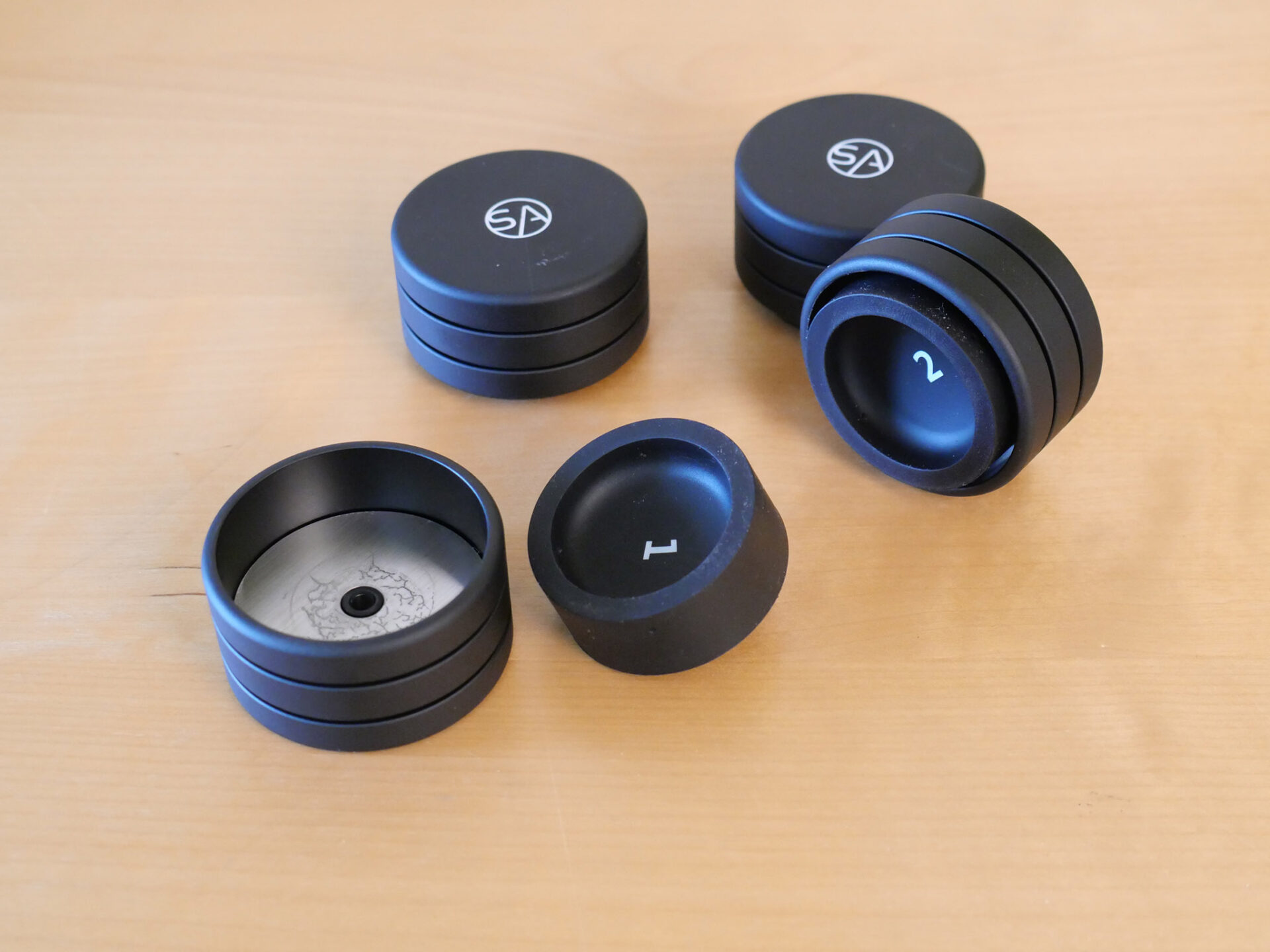
Even if those vibration levels are low, they are positioned right alongside the components that actually carry the signal. Drawing that energy away from the sensitive signal path is crucial to performance, but all too often, manufacturers trap it within the chassis by fitting soft ‘isolation’ feet to their products. That’s where hard couplers that bypass the feet come in, providing an exit path to a (hopefully) dispersive supporting surface, allowing stored energy to drain from the chassis. A response to that problem started with Goldmund’s mechanical chassis grounding approach, has been continued and evolved by CH Precision and is increasingly spreading to other manufacturers, even if only in the shape of hard (as opposed to soft) feet. But, although this is a definite step in the right direction, it’s not a universally efficient approach. It still relies heavily on the nature of the supporting surface – both as a dispersive element and, in some cases, as an isolator from external energy. Not all equipment generates a lot of internal energy and not all equipment is equally susceptible to it.
Once you start putting power supplies in separate boxes, you minimise that source of mechanical interference. If you use switch-mode power-supplies, you don’t eliminate the problem, but you change its nature. If you eliminate disc drives you certainly remove their mechanical influence – but you eliminate their performance advantages too. And over all of this hangs the particular vulnerability of digital circuitry to even low-level mechanical interference. To that you can add signal tubes, generally nine-pin twin triodes, which are also extremely (but differently) vulnerable to mechanical energy and you start to develop categories of product that need both mechanical grounding AND isolation. If you are depending on couplers to do the job, you’d better have decent shelves. If you are depending on the shelves alone, the job probably isn’t getting done.
Which is the landscape against which Stack Audio started their business, at first offering, high-value network components (which they still do), an experience that led them headfirst into the issues and performance benefits of component (and loudspeaker) support. Their solutions are distinctly different and, if they don’t exactly break technological barriers, the implementation is novel and extremely clever. Time to meet the Auva EQ equipment footer, a small step for audio kind but potentially in giant leap in terms of the performance/value equation.
It’s a sandbox Jim – just not as we know it…
At the heart of Stack Audio’s approach to equipment support lies “particle damping”. This involves using chambers filled with a proprietary mixture of metal particles to dissipate energy. It’s not a new idea. Back in the ‘90s, audiophiles built or bought trays full of sand on which they sat top-boards, separate from the box itself, to support their equipment. It’s a cheap and astonishingly effective solution, especially when used in conjunction with modern equipment couplers. So much so that I rejuvenated it for a DIY article of our own (https://gy8.eu/blog/diy-system-support/). But where Stack has got clever is in locating the dissipation far closer to the source of the problem.