

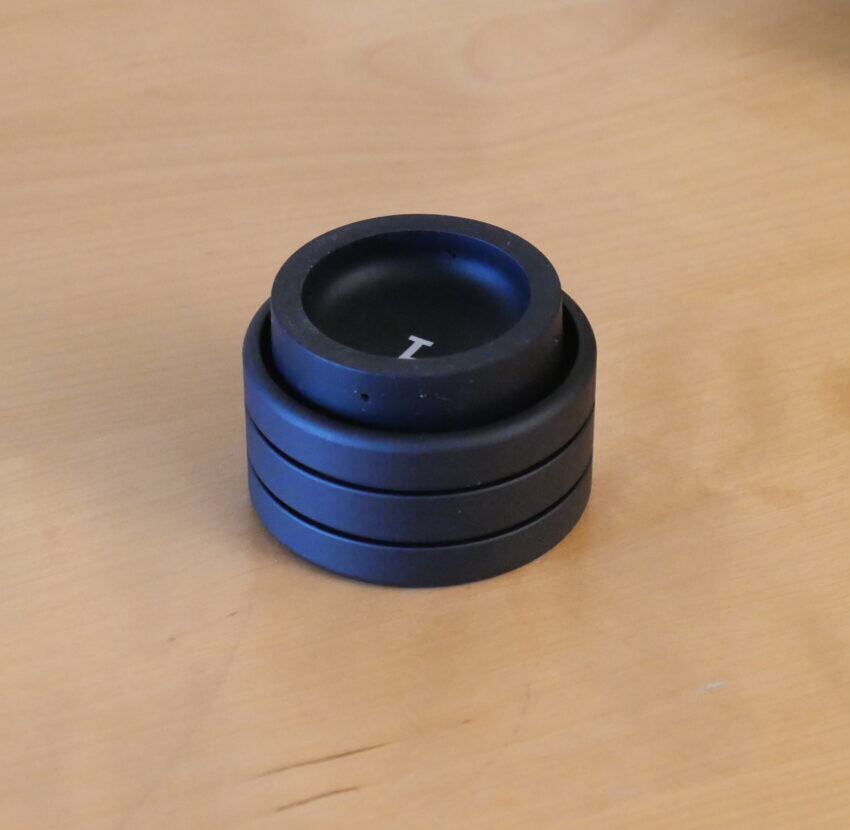
Look at a Stack Audio Auva EQ foot and it resembles a small drum, 50mm in diameter and a little under 30 mm tall. Pick it up and you realise two things: it’s surprisingly dense (and inert) and it is actually a two-piece structure. The ‘drum’ is effectively an inverted cup, the bottom half of which is occupied by a silicon-rubber ‘cup’ that is connected to the inside of the drum by a fine pitch, free-running thread. That allows you to raise or lower the rubber element, giving really precise height adjustment.
So much for the basic structure; this is where it gets clever. The upper half of the drum is a pocket filled with ‘mineral particles’. Combined with the flat top surface of the Auva EQ, this offers an intimate connection to the supported chassis/component and extremely efficient dissipation of mechanical energy within that chassis. Meanwhile, the hollow rubber element is vented through four tiny pin holes in its vertical walls. Place the footer on a smooth surface and these allow the trapped air pocket to breathe. By carefully choosing the composition of the silicon-rubber and the shape and wall thickness of the ‘cup’, Stack has created a damped spring that acts as an efficient and remarkably stable isolator. Simple and extremely effective, the Auva EQ is weight rated with three different models intended to support 0-4kg, 4.1-10kg or 10-15kg, the weight-rating being for each foot. You can use Auva EQ feet in threes, fours or more, matched to the weight of your equipment.
This two-part structure allows the Auva EQ to be both an isolator and a dissipater. So, as well as sinking energy out of your component, it isolates it from structure-borne energy – and isolates it from the wider influence of the supporting surface. Stack also produce complete platforms based on the same thinking, but those are a different story – and a whole different cost.
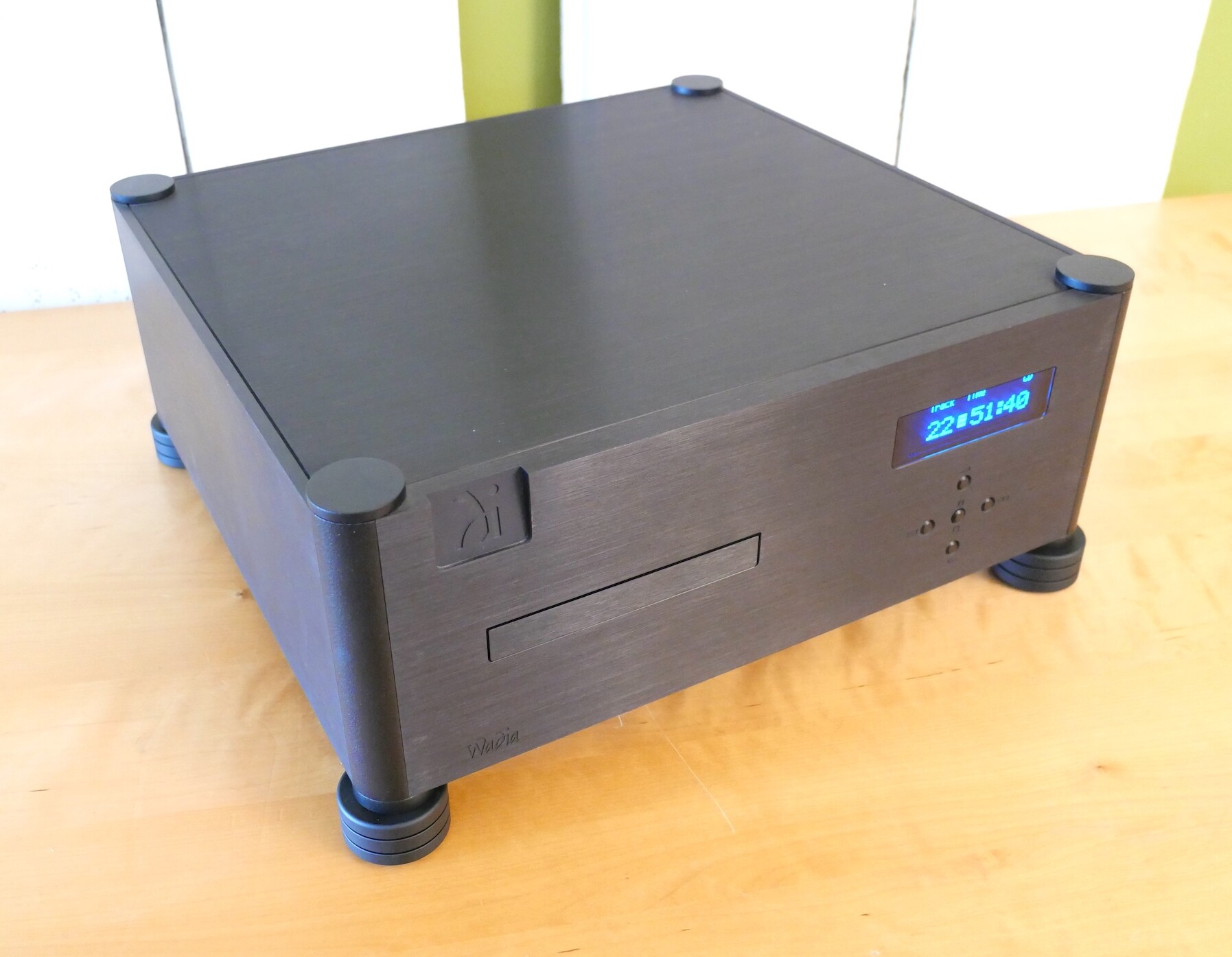
Inserting the Auva EQs into your system couldn’t be simpler. Their height allows them to bypass all but the tallest standard feet, you just have to make sure that they sit on a flat under-surface, rather than screw or bolt heads. Like all couplers or supports, it’s worth experimenting with positioning, but they seem less sensitive to this than most. Levelling can be a bit fiddly, due to the inaccessibility of the rubber cup’s rim when the Auva EQ is in place, but that’s a one-time thing and they don’t lose their level, the rubber interface with the supporting surface effectively locking them in place.
“There Is No Such Thing as the Unknown, Only Things Temporarily Hidden.” JTK
I first encountered the Stack Audio Auva EQs as an option underneath Reiki Audio’s X Series SuperSwitch (https://gy8.eu/review/the-reiki-audio-superswitch-x-and-pro-x-psu/). The benefits were, frankly, astonishing. Astonishing enough for me to get in touch with Stack and request samples for wider evaluation. I duly received sets of CSA 1 (>4kg) and CSA 2 (>10kg) feet, along with a quartet of the larger, Auva speaker feet, a similar dispersive structure, but without the rubber isolation element to allow solid coupling of loudspeakers. I’ll report on their use with speakers later, but they performed a useful function here, too – which we’ll come to.