
Audiophile Lego for adults!
By Roy Gregory
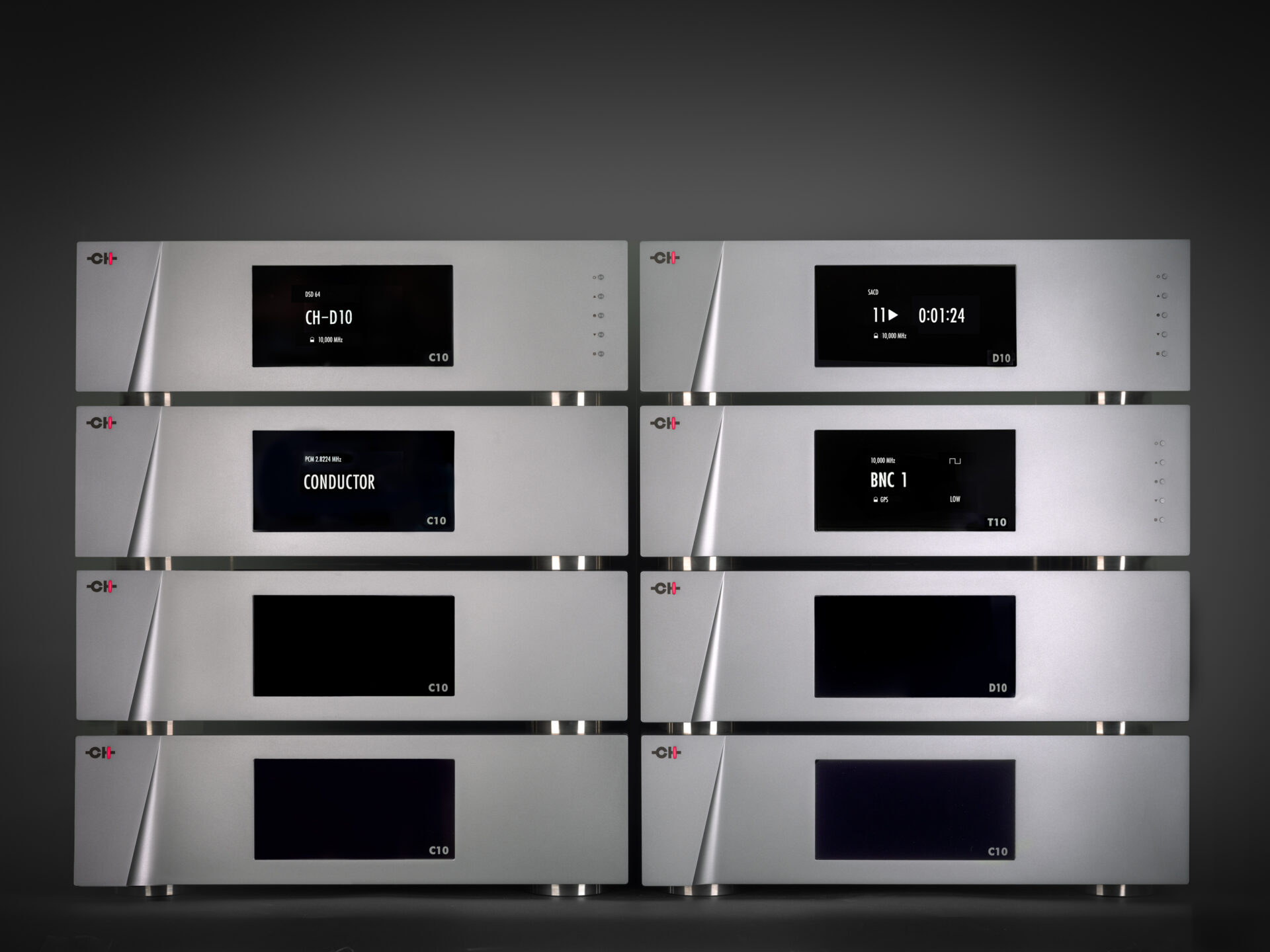
By now, most readers will be familiar with the upgradable/expandable nature of CH Precision’s products. Buy one box and it can be turned into two, three or four, without cost penalty or redundancy. Likewise, buy a box now and if it evolves or changes in the future, you’ll be able to upgrade your product to the new spec for the difference in price between the two versions. That’s a serious commitment on the part of the company – and serious protection for the investment made by the owners of its products. To appreciate just how serious, it’s worth taking a look at an actual example…
The C1 DAC/Controller was CH’s second ever product, after the D1 CD/SACD transport. It was launched in 2011. Since then, it has undergone a series of significant changes, in terms of both software and hardware – and performance. Yet, owners of that original DAC, now a decade-and-a-half old, can have it upgraded to full current C1.2 spec, complete with a new product identity and serial number, for the difference between what they paid originally and what a C1.2 would cost them now. Not only is that the very definition of future proof, it’s future proofing a product in the category with the shortest shelf-life of anything in high-end audio. Normally, a DAC’s run at the top of the market can be measured in months – not decades!
Nor is it any coincidence that I chose the C1.2 as my example. The 1 Series products really established the one-box, two-box, three-box, four-box progression, whether you are talking about the P1/X1 phono-stage or the L1/X1 line-stage. Even the power amps were configured to double up (stereo to mono) and then potentially double up again (with bi-amped operation). But the one place where the numbers didn’t quite track was with the C1. You could add an X1, to go two-box. But the next step on the ladder – from C1-to-C1 Mono – involved splitting the DAC across three boxes, not two. It’s essential to have a single connection for digital inputs as the data stream carries both channels and that information must be precisely synchronized. Thus, in reconfiguring a C1-to-C1 Mono, an owner would receive two new boxes, one each for the left and right D-to-A conversion. Those DAC cards would be transferred across from the C1, leaving the original chassis to carry the input, control and DSP functions – the latter, responsible for filtering and up-sampling, becoming increasingly important in modern DACs. After that, the truly committed audiophile could add an additional X1, dual output power supply to run the two DACs, or even individual supplies for the last word in CH digital replay.
Even with the slight numerical mis-step around the DAC’s expansion, it all made sense, the performance advantages were easily demonstrable and the whole approach was understandably popular with customers.
Then the 10 Series arrived…
Having established a nice, logical and orderly upgrade path for the 1 Series, the new, up-market products promptly upset the apple cart. Being two-box units to start with, the external PSU upgrade represented by the X1 was already redundant. But what really disturbed the natural order was the discovery that the two-box L10 (or P10) outperformed the four-box L1 – did it in half the space and for less money (and that’s leaving aside the cost of the extra shelves and power cables). Of course, you can still go four-box with the 1 Series, but these days, the four-box option is really focused on the 10 Series, with a surprising number of owners choosing to double up their L10s and P10s.