
Which makes this the right time to talk about absolute phase. More than any other digital system I’ve used, the CH C10 is, in all its forms, incredibly sensitive to absolute phase. Get it right and there’s an added sense of tonal purity, dimensionality and substance to the sound – whether that sound is classical, pop or jazz. As I write this I’m listening to the Semyon Bychkov/CPO Má Vlast (Pentatone PTC 5187 203); you need go no further than the opening harp notes to hear what absolute phase can do. In this instance it adds depth, warmth, dimensionality and substance, establishing a really convincing soundstage and a naturally warm and inviting orchestral tone. It’s no small difference and it’s immediately apparent from those opening bars. Now, normally, whilst I can clearly hear the impact of switching absolute phase on CD/SACD replay, it’s not a critical concern for me. Well, here, in this case it definitely is. Fortunately, CH has included a phase switch on the small, handheld remote they supply with the C10. Again, normally I’m allergic to remotes, but in this instance it makes it easy to sit, listen, decide on the correct phase and then restart the disc (or track) manually, to maximise performance. If you are auditioning, or own, a C10, overlook this setting at your peril. Once you’ve heard what it can do, it will become a natural part of the listening process – especially if you are in the habit of using remote controls anyway. Meanwhile, Má Vlast sounds simply sumptuous, immersive and emotive in equal parts. It’s another example of just how even-handed and communicative (and downright musically powerful) the eight-box CH rig can be.
If any single recording captures what the eight-box CH digital replay chain brings to compact disc, it’s Bernstein’s astonishingly vibrant and explosive performance of William Schuman’s short but dramatic American Festival Overture (with the LAPO – UHQCD DGGUCCG-90541). Written in 1939, full of percussive interjections, dynamic and instrumental contrasts and with a constantly shifting musical and tonal landscape, it plays to both Bernstein’s ‘showman’ tendencies and the CH’s attack, dynamic composure and organisation, planted temporal security and illuminated tonal palette. It’s insistent rhythms and bold percussion have more than a hint of West Side Story about them. With dynamics to challenge any player (and frighten any system) as well as its changes in pace and the demands those place on rhythmic flexibility, it’s a musically vivid and exciting audio obstacle course, which the CH traverses with an utterly unflustered grace, delivering a substantial, stable platform against which the musical fireworks can explode. Order out of chaos? That’s one way of describing it; but the order here adds power, energy and musical intensity, rather than flattening it.
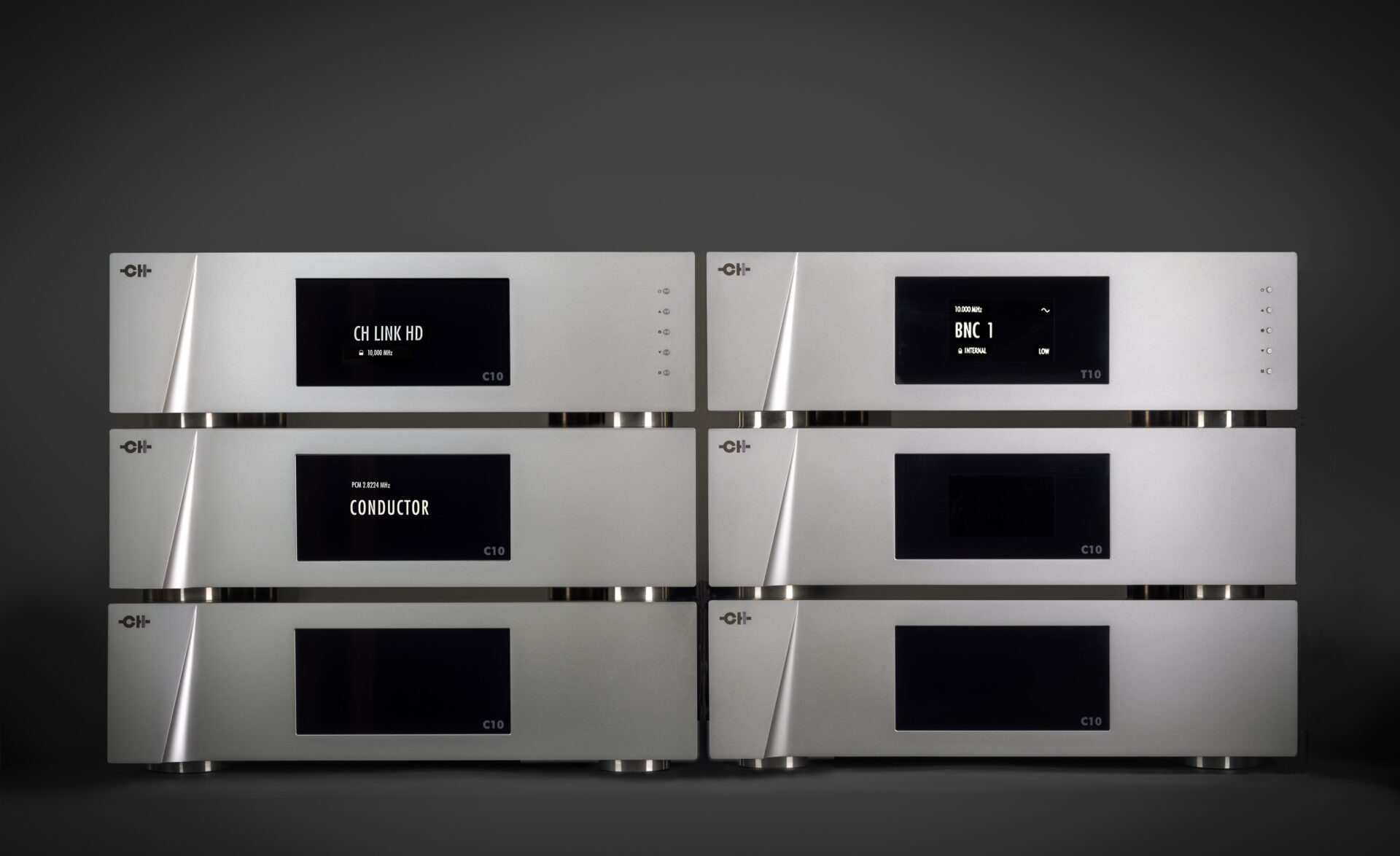
One of the first things to emerge from listening to the five-box digital system, built around the C10/2 and the Clock, was its ability to ‘see into’ and sort out less than wonderful recordings, fastening on the music rather than the medium. In part that’s due to its clarity, organisation and leading-edge response, qualities that embody the full PRAT panoply so beloved of Linn-Naim devotees – although the CH system is about much more than just that. In adding bandwidth, weight and body, musical substance and dimensionality to the mix, the C10/5 also risks slowing the response and diminishing that laser-like clarity. In practice, that doesn’t happen. The extra weight and musical energy is so well-marshalled by the five-box DAC that it actually extends the C10/2’s level of access and insight on poor recordings, broadening its appeal and musical capabilities still further. Although the CH flagship digital components will do a stellar job with audiophile recordings and high-res material, that isn’t their raison d’être. Their focus is firmly musical, the performance (if you like) rather than simple audio performance per se. As sonically impressive as they undoubtedly are, it’s their musical credentials that justify the price.
Swings – or roundabouts? The C10/4 – or the C10/3?
Do you need to go all the way to five-boxes with the CH DAC, or eight if you include the D10 transport and T10 clock? Do the interim stages make more financial and practical sense, or do the musical advantages of going the whole hog pay off in value terms too? Given the investment levels we’re talking here, value might seem like a remote concept, but in the context of the highest-end systems, those systems in which you find multi-box digital replay set-ups, investing in improving your source(s) is still the most cost-effective step you can take. So, where does the C10/4 option sit between the C10/2 and the C10/5? Is it a stepping-stone, a temporary waypoint or a valid solution in its own right?